
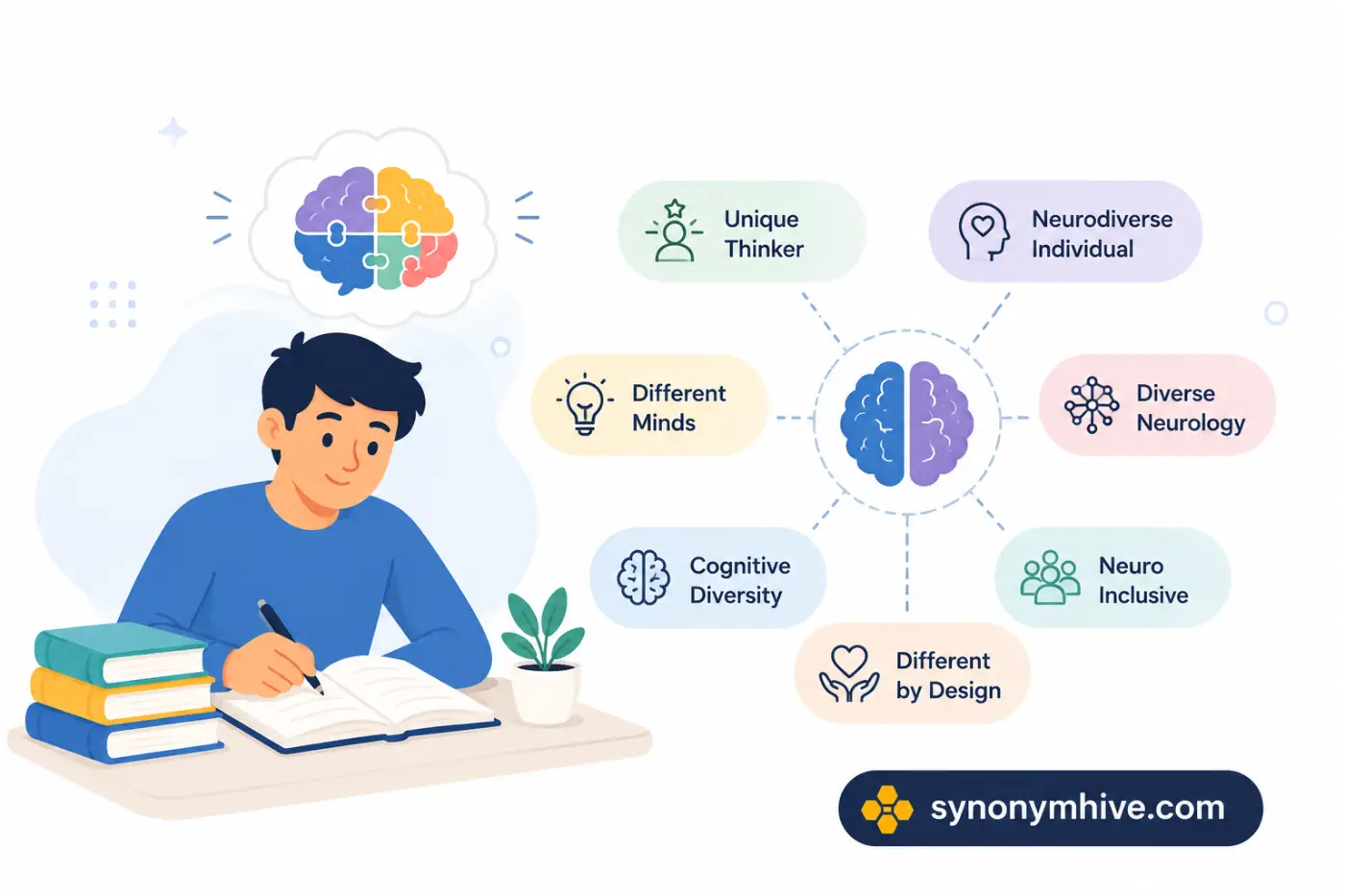
Have you ever written an email, essay, workplace document, or social media post and wondered if there was another way to say neurodivergent? Many people search for alternatives of neurodivergent because they want to write with care, accuracy, and respect. The challenge is that this word has very few true synonyms.
phrases of neurodivergent are limited because neurodivergent is a specific term, not a general adjective. Most alternatives are related terms that fit certain situations instead of every situation.
There are very few true synonyms of neurodivergent. The closest alternatives include neurologically diverse, neurodistinct, neuroatypical, and cognitively diverse in some contexts. Many other expressions are related terms rather than direct replacements. This guide explains the origin of the word, its meaning, the best alternatives, when each one works, and which outdated expressions you should avoid. By the end, you’ll know exactly which term fits your audience and your purpose.
Discover another helpful synonym list in Synonyms For Normal Best Guide (2026).
What Does Neurodivergent Mean
Neurodivergent describes a person whose brain works differently from what society considers typical. It is not a medical diagnosis. Instead, it is an umbrella term that may include people with conditions such as:
- Autism.
- ADHD.
- Dyslexia.
- Dyspraxia.
- Dyscalculia.
- Tourette syndrome.
- Some other neurological differences.
Many neurodivergent people see these differences as natural variations in the human brain instead of problems that need to be fixed. The word focuses on difference rather than deficiency.
Word Origin And Plain English Meaning
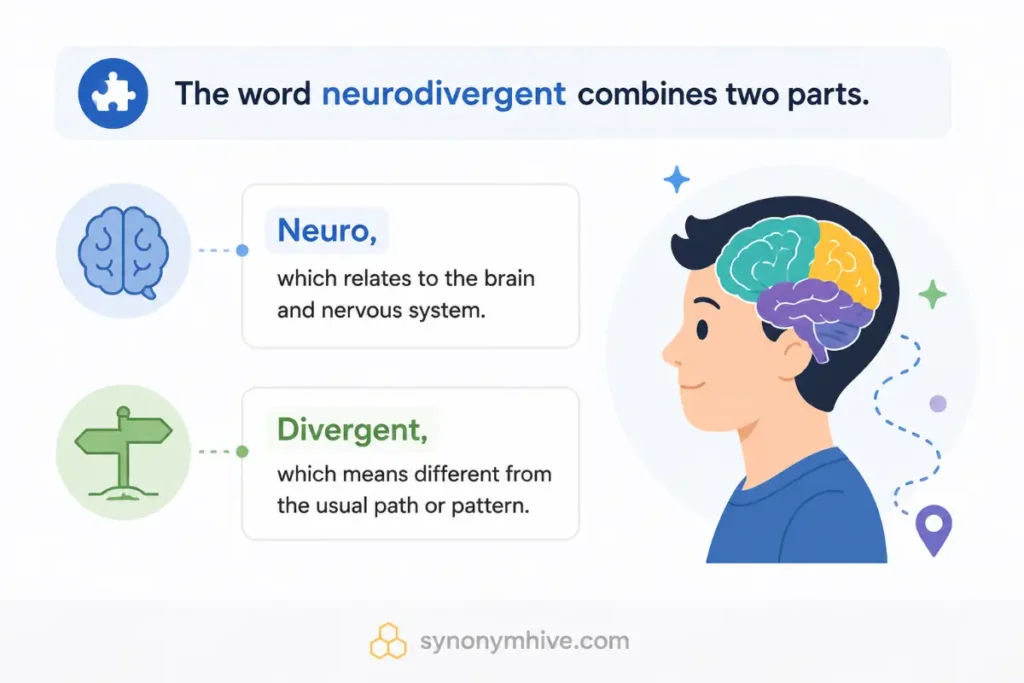
The word neurodivergent combines two parts.
- Neuro, which relates to the brain and nervous system.
- Divergent, which means different from the usual path or pattern.
The term became widely known through the neurodiversity movement. It encourages people to recognize that brains develop and work in many different ways.
In plain English, neurodivergent means:
- A brain that works differently from the typical pattern.
- A natural difference in thinking, learning, communicating, or processing information.
- A broad identity that may include several neurological conditions.
The word does not automatically mean someone has a disability. Every neurodivergent person has different strengths, challenges, and experiences.
Are There True Synonyms Of Neurodivergent
This is where many websites get the answer wrong. Unlike words such as happy or important, neurodivergent has very few true expressions. Many articles mix together:
- Medical diagnoses.
- Community terms.
- Descriptive phrases.
- Outdated language.
Those words cannot always replace each other.
For example, autistic is not a synonym for neurodivergent. Autism is one form of neurodivergence.
Likewise, ADHD is a diagnosis, not another word for neurodivergent.
Using accurate language shows respect and avoids confusion.
Synonyms Of Neurodivergent Master Word List
The table below includes the closest alternatives and related expressions. Some are direct substitutes. Others work only in specific situations.
Simple Alternatives
| Word Or Phrase | Meaning | Tone | Example |
|---|---|---|---|
| Neurologically Different | Brain works differently. | Simple | She describes herself as neurologically different. |
| Different Thinking Style | Different way of thinking. | Simple | He has a different thinking style. |
| Different Learning Style | Learns differently. | Simple | Every student has a different learning style. |
| Different Cognitive Style | Different mental processing. | Simple | Their cognitive style helps with problem solving. |
| Brain Works Differently | Plain explanation. | Everyday | My brain works differently from yours. |
| Unique Thinking Pattern | Different mental approach. | Simple | She has a unique thinking pattern. |
Everyday Related Terms
| Word Or Phrase | Meaning | Tone | Example |
|---|---|---|---|
| Neurodistinct | Different neurological profile. | Everyday | He identifies as neurodistinct. |
| Neuroatypical | Not neurologically typical. | Everyday | She describes herself as neuroatypical. |
| Neurologically Diverse | Brain develops differently. | Everyday | Our team includes neurologically diverse employees. |
| Cognitively Diverse | Different ways of thinking. | Everyday | Cognitively diverse teams solve problems creatively. |
| Diverse Thinker | Different mental perspective. | Everyday | She’s a diverse thinker with fresh ideas. |
| Alternative Thinker | Different thinking approach. | Everyday | He’s an alternative thinker who enjoys creative solutions. |
| Different Processor | Processes information differently. | Everyday | Every learner is a different processor. |
Formal Terms
| Word Or Phrase | Meaning | Tone | Example |
|---|---|---|---|
| Neurodevelopmentally Different | Different neurological development. | Formal | The study included neurodevelopmentally different participants. |
| Neurodevelopmental Profile | Describes neurological characteristics. | Formal | Each student has a unique neurodevelopmental profile. |
| Cognitive Difference | Difference in thinking. | Formal | Cognitive differences vary widely among people. |
| Neurological Difference | Brain functions differently. | Formal | Neurological differences should be respected. |
| Neurodiverse Individual | Individual with neurological differences. | Formal | The company supports every neurodiverse individual. |
| Atypical Neurology | Different neurological pattern. | Formal | Researchers studied atypical neurology. |
| Divergent Neurology | Different brain development. | Formal | Divergent neurology appears across many conditions. |
| Neurodiversity Community Member | Person within the neurodiversity community. | Formal | She is an active neurodiversity community member. |
Community And Identity Terms
| Word Or Phrase | Meaning | Tone | Example |
|---|---|---|---|
| Neurodiverse Person | Person within a neurodiverse group. | Community | The conference welcomed every neurodiverse person. |
| Neurodiversity Advocate | Supports neurodiversity. | Community | He’s a neurodiversity advocate. |
| Neuroinclusive Individual | Supports inclusion. | Community | Our organization values every neuroinclusive individual. |
| Neuroaffirming Thinker | Supports neuroaffirming practices. | Community | She’s a neuroaffirming thinker. |
| Different Mind | Informal description. | Casual | Everyone has a different mind. |
| Unique Brain | Casual explanation. | Casual | Every unique brain deserves respect. |
| Unique Perspective | Different point of view. | Casual | His unique perspective improved the project. |
Synonyms By Accuracy
Not every related term has the same level of accuracy.
Closest Alternatives
These are the nearest substitutes.
| Word | Accuracy |
|---|---|
| Neurodistinct | Very close. |
| Neuroatypical | Very close. |
| Neurologically Different | Very close. |
| Neurologically Diverse | Close in many contexts. |
Related Terms
These describe similar ideas but are not direct replacements.
| Word | Notes |
|---|---|
| Cognitively Diverse | Focuses on thinking. |
| Different Thinking Style | Plain English explanation. |
| Alternative Thinker | Describes thinking style only. |
| Unique Perspective | Describes viewpoint instead of neurology. |
| Different Learning Style | Focuses on education. |
Terms That Are Not Synonyms
These words are often listed incorrectly.
| Word | Why It Is Not A Synonym |
|---|---|
| Autism | A diagnosis within neurodivergence. |
| ADHD | A diagnosis, not another word. |
| Dyslexia | One neurological difference. |
| Dyspraxia | A specific condition. |
| Tourette Syndrome | A medical diagnosis. |
These conditions may be included under the umbrella of neurodivergence, but they cannot replace the word neurodivergent.
Related Words By Part Of Speech
Most people use neurodivergent as an adjective, but related forms appear in different parts of speech.
Adjectives
| Word | Example |
|---|---|
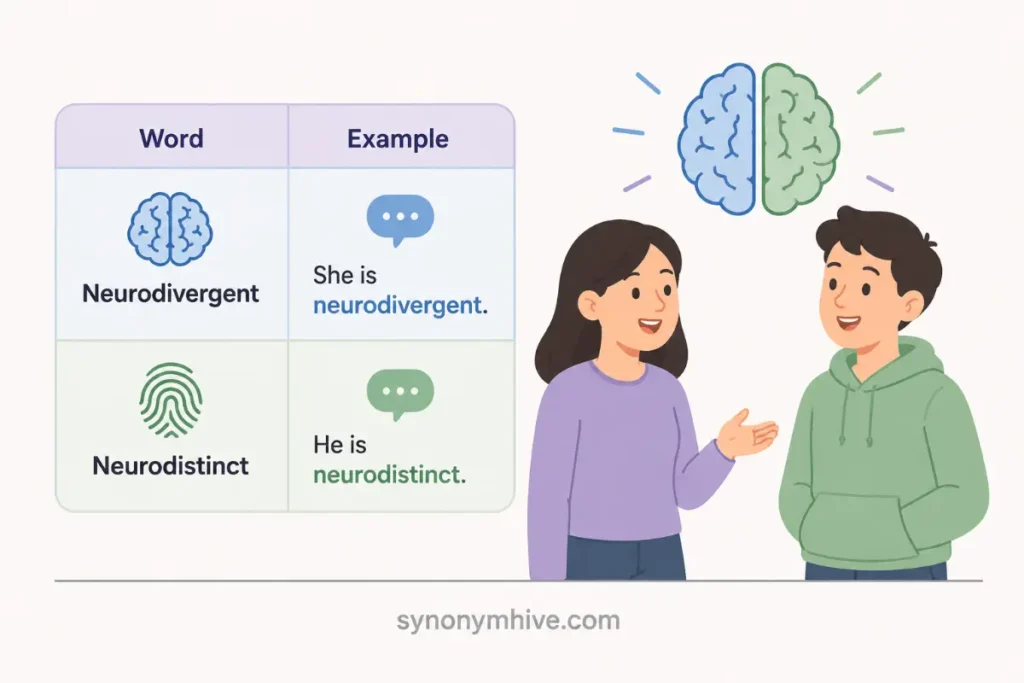
| Neurodivergent | She is neurodivergent. |
| Neurodistinct | He is neurodistinct. |
| Neuroatypical | They describe themselves as neuroatypical. |
| Neurologically Different | She is neurologically different. |
| Cognitively Diverse | Our team is cognitively diverse. |
Nouns
| Word | Example |
|---|---|
| Neurodivergence | Neurodivergence includes many experiences. |
| Neurodiversity | Neurodiversity benefits society. |
| Neurodivergent Person | Every neurodivergent person is unique. |
| Individual | Every individual deserves respect. |
| Community Member | Community members share experiences. |
Descriptive Phrases
| Phrase | Example |
|---|---|
| Thinks Differently | She thinks differently. |
| Learns Differently | He learns differently. |
| Processes Information Differently | They process information differently. |
| Has A Different Cognitive Style | She has a different cognitive style. |
| Has A Different Learning Profile | Every student has a different learning profile. |
Do Americans And British People Use Different Terms
The word neurodivergent is widely accepted in both American English and British English. Most professionals, educators, healthcare providers, and advocacy groups use the same language. Some small differences appear in everyday communication.
| Term | More Common In | Notes |
|---|---|---|
| Neurodivergent | United States and United Kingdom | Standard term. |
| Neurodiversity | United States and United Kingdom | Widely accepted. |
| Neurodistinct | United Kingdom | Becoming more common. |
| Neuroaffirming | United States and United Kingdom | Often used in education and healthcare. |
| Cognitively Diverse | International | Used in workplaces and research. |
No matter where your audience lives, neurodivergent remains the clearest and most widely recognized choice in most situations.
Which Word Fits Your Situation Best
The best choice depends on who you’re writing for. Some alternatives work well in professional settings, while others sound more natural in everyday conversations. Because there are very few true expressions of neurodivergent, many situations call for using the original word instead of replacing it.
Best Word For A Resume
A resume should sound respectful, professional, and accurate. If you mention neurodiversity, avoid informal expressions.
| Best Word | Why It Works | Example |
|---|---|---|
| Neurodivergent | Widely recognized and respectful. | I advocate for neurodivergent employees in the workplace. |
| Neurodistinct | Accepted in many professional settings. | I help create neurodistinct friendly learning programs. |
| Neurodiverse | Best when describing a group. | Worked with neurodiverse project teams. |
| Cognitive Diversity | Focuses on different ways of thinking. | Promoted cognitive diversity across departments. |
| Neuroinclusive | Highlights inclusion efforts. | Helped build a neuroinclusive workplace. |
If you’re describing yourself, neurodivergent is usually the clearest choice.
Best Word For An Essay
School essays should use accurate language instead of trendy expressions.
| Best Word | Best Use | Example |
|---|---|---|
| Neurodivergent | General writing. | Neurodivergent students often benefit from flexible learning environments. |
| Neurodiversity | Explaining the broader concept. | Neurodiversity recognizes natural differences in human brains. |
| Cognitive Difference | Academic discussions. | Every cognitive difference deserves understanding. |
| Neurological Difference | Science or psychology topics. | Neurological differences appear in many forms. |
| Neurodevelopmental Profile | Research papers. | Every learner has a unique neurodevelopmental profile. |
These words help your writing stay clear and respectful.
Best Word For A Text Message
Casual conversations usually call for simple language.
| Best Word | Example |
|---|---|
| Neurodivergent | She’s neurodivergent. |
| Thinks Differently | Everyone thinks differently. |
| Learns Differently | He learns differently than I do. |
| Different Brain | Our brains work differently. |
| Different Thinking Style | We have different thinking styles. |
Simple language often feels warmer than technical vocabulary.
Best Word For An Email
Choose language that matches your audience.
| Situation | Best Word | Example |
|---|---|---|
| Workplace | Neurodivergent | We want to support neurodivergent employees. |
| School | Neurodiversity | Our school values neurodiversity. |
| Parent Communication | Learns Differently | Your child learns differently and has many strengths. |
| Healthcare | Neurodevelopmental Difference | We discussed your child’s neurodevelopmental differences. |
| Community Organization | Neuroinclusive | We are building a more neuroinclusive program. |
Professional emails should always use respectful and person centered language.
Best Word For Speaking
When speaking, shorter words usually sound more natural. These expressions work well.
| Word Or Phrase | Example |
|---|---|
| Neurodivergent | He’s neurodivergent. |
| Thinks Differently | She thinks differently. |
| Learns Differently | My son learns differently. |
| Different Brain | Every brain is different. |
| Unique Perspective | She brings a unique perspective. |
Simple language helps people understand your meaning without confusion.
Explore another synonym guide: Synonyms for Determination: Better Words 2026.
Original Example Sentences
These examples show respectful ways to use the word and related expressions.
- Every neurodivergent student deserves a learning environment where they can succeed.
- Our company values cognitive diversity because different perspectives improve problem solving.
- She describes herself as neurodivergent and enjoys sharing her experiences.
- Every child learns differently, and that’s completely normal.
- Neurodiversity makes communities stronger by bringing many ways of thinking together.
- Teachers should recognize that students process information at different speeds.
- Flexible workplaces support neurodivergent employees more effectively.
- His unique thinking style helped solve a difficult engineering problem.
- Our school introduced more neuroinclusive classroom practices.
- Different minds often discover creative solutions that others miss.
- Every person’s neurological profile is unique.
- Respect always matters more than labels.
Neurodivergent Vs Neurodiverse
These words are often confused.
| Neurodivergent | Neurodiverse |
|---|---|
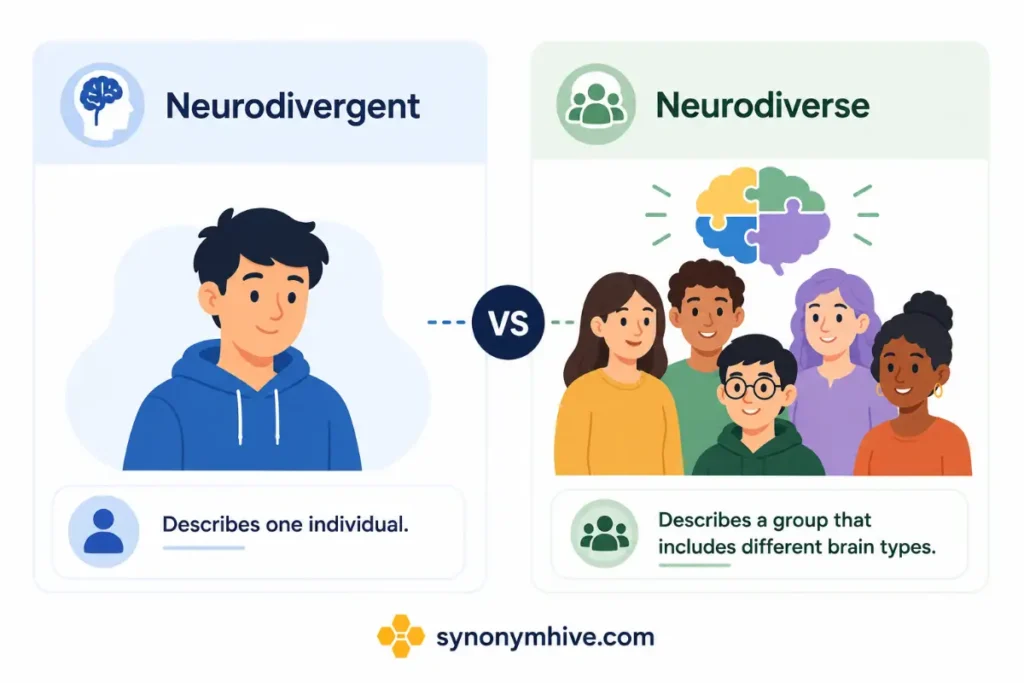
| Describes one individual. | Describes a group that includes different brain types. |
| Refers to a person’s neurological differences. | Refers to diversity within a group. |
| Most common personal identity term. | Best used for teams, classrooms, or communities. |
Examples.
Correct.
She is neurodivergent.
Correct.
Our classroom is neurodiverse.
Using these words correctly improves clarity.
Neurodivergent Vs Neurotypical
These words describe different concepts.
| Neurodivergent | Neurotypical |
|---|---|
| Brain develops differently from the typical pattern. | Brain develops in the expected pattern. |
| Umbrella term. | Comparison term. |
Examples.
Her brother is neurodivergent.
Her sister is neurotypical.
Neither word suggests that one person is better than another.
Neurodivergent Vs Disabled
These terms are not interchangeable.
| Neurodivergent | Disabled |
|---|---|
| Describes neurological differences. | Describes disability. |
| May or may not include disability. | Covers many kinds of disabilities. |
Some neurodivergent people identify as disabled.
Others do not.
The correct term depends on the individual.
Person First Language Vs Identity First Language
This topic comes up often.
| Identity First | Person First |
|---|---|
| Neurodivergent person. | Person who is neurodivergent. |
| Autistic person. | Person with autism. |
Many people in the neurodiversity community prefer identity first language because they see neurodivergence as part of who they are.
Others prefer person first language.
The respectful approach is simple.
Use the language the individual prefers whenever possible.
Common Mistakes People Make
Many websites make these mistakes.
Avoid them in your own writing.
- Calling autism a synonym for neurodivergent.
Autism is one form of neurodivergence, not another word for it.
- Treating ADHD as another name for neurodivergent.
ADHD is also a diagnosis within the broader umbrella.
- Using outdated medical labels.
Older terms can sound disrespectful or inaccurate.
- Assuming every neurodivergent person has the same experience.
Every individual is different.
- Using neurodiverse to describe one person.
Normally, neurodiverse describes a group, not an individual.
When You Should Not Replace Neurodivergent
Sometimes the original word is simply the best choice.
Avoid replacing it when:
- Writing educational articles.
- Creating healthcare content.
- Writing workplace policies.
- Discussing disability rights.
- Referring to someone’s personal identity.
Using the accepted term often creates less confusion than trying to find an alternative.
Antonyms And Opposite Terms
Unlike many everyday words, neurodivergent does not have several true antonyms. The main opposite term is neurotypical, which describes someone whose brain develops and functions in ways that society generally considers typical. These terms are not opposites in terms of value. They simply describe different neurological experiences.
| Term | Meaning | Example |
|---|---|---|
| Neurotypical | Brain functions in a typical way. | Most classroom materials are designed for neurotypical students. |
| Typically Developing | Common in child development. | The study included typically developing children. |
| Typical Neurology | Typical neurological development. | The research compared typical neurology with neurodivergent experiences. |
| Conventional Learning Profile | Traditional learning pattern. | The lesson was designed for a conventional learning profile. |
| Standard Cognitive Development | Expected cognitive development. | Doctors monitored standard cognitive development. |
Remember that these words describe differences. They do not rank one group above another.
How Do You Choose The Right Term
Choosing respectful language matters just as much as choosing accurate language. Use these simple guidelines.
- Use neurodivergent when talking about an individual whose brain works differently from what society considers typical.
- Use neurodiverse when describing a group that includes people with different neurological profiles.
- Use neurodiversity when discussing the broader idea that human brains naturally vary.
- Use plain language if your audience may not know technical terms.
- Respect personal preferences. Some people prefer identity first language. Others prefer person first language.
- Avoid outdated medical labels unless discussing historical terminology.
- If you’re unsure, ask the person which language they prefer.
Clear and respectful communication builds trust.
Quick Reference Table
Use this table when you need a fast answer.
| If You Mean | Best Choice |
|---|---|
| One person | Neurodivergent |
| A group with different brain types | Neurodiverse |
| The overall concept | Neurodiversity |
| Different way of thinking | Cognitive difference |
| Different learning approach | Different learning style |
| Inclusive workplace | Neuroinclusive |
| Respectful plain English | Brain works differently |
| Scientific discussion | Neurological difference |
This quick guide helps you avoid common mistakes while choosing the most accurate wording.
Everyday Situations And The Best Choice
Different audiences expect different language.
| Situation | Best Term | Example |
|---|---|---|
| Resume | Neurodivergent | I advocate for neurodivergent employees. |
| School Essay | Neurodiversity | Neurodiversity benefits classrooms through different perspectives. |
| Business Email | Neuroinclusive | Our company supports neuroinclusive hiring practices. |
| Parent Meeting | Learns Differently | Every child learns differently and deserves support. |
| Healthcare | Neurodevelopmental Difference | The evaluation identified neurodevelopmental differences. |
| Public Speaking | Neurodivergent | We should create spaces where neurodivergent people can succeed. |
| Social Media | Neurodivergent | I’m proud to support neurodivergent creators. |
| Casual Conversation | Thinks Differently | Everyone thinks differently, and that’s okay. |
Matching your language to the situation makes your message clearer.
Why Accurate Language Matters
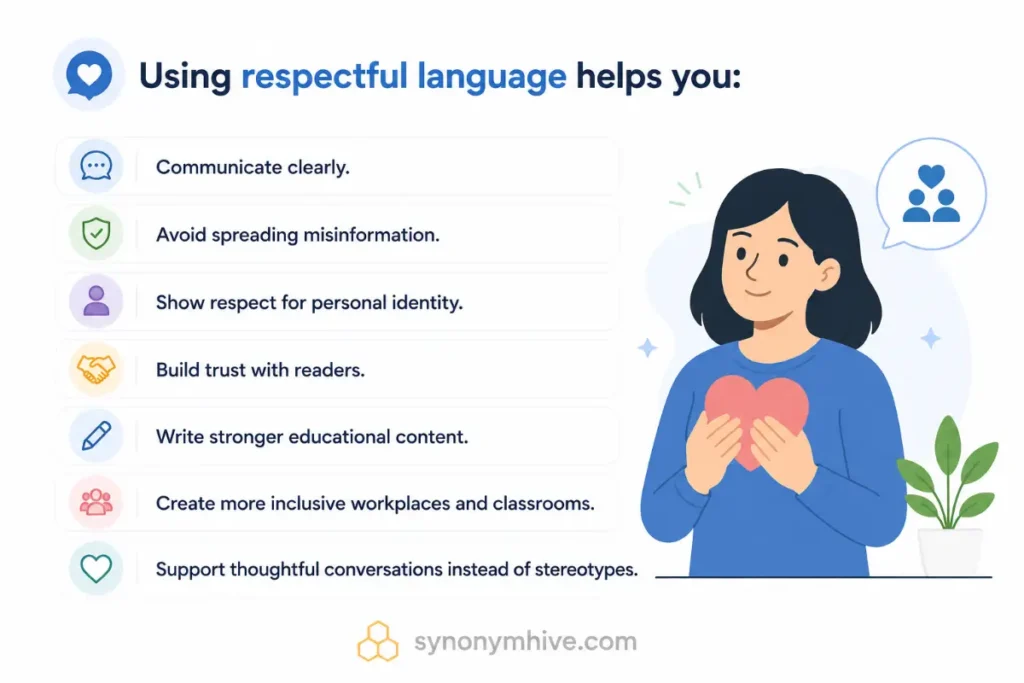
Words shape how people understand each other. Using respectful language helps you:
- Communicate clearly.
- Avoid spreading misinformation.
- Show respect for personal identity.
- Build trust with readers.
- Write stronger educational content.
- Create more inclusive workplaces and classrooms.
- Support thoughtful conversations instead of stereotypes.
Learning alternatives of neurodivergent is not about replacing one word with another every time. It’s about understanding which terms are accurate, respectful, and appropriate for each situation.
Terms To Avoid
Some older expressions no longer reflect current respectful language. Avoid using these terms unless you’re discussing historical language or quoting a source.
| Term | Why To Avoid It |
|---|---|
| Normal Brain | Suggests other brains are abnormal. |
| Mentally Defective | Outdated and offensive. |
| Brain Damaged | Usually inaccurate and disrespectful. |
| Handicapped | Outdated in this context. |
| Abnormal Person | Focuses on stigma instead of respect. |
Using modern language helps your writing stay accurate and inclusive.
You may also like Synonyms For Development Ultimate Guide: Word Finder 2026.
Conclusion
Learning synonyms of neurodivergent helps you write with greater care and precision. Unlike many common words, neurodivergent has very few true expressions. In most situations, using the original term is the clearest and most respectful choice. Related expressions like neurodistinct, neurologically different, or cognitive difference can work in specific contexts, but they are not perfect replacements.
The most important goal is not finding the fanciest word. It is choosing language that is accurate, respectful, and easy for your readers to understand. When you match your words to your audience and the situation, your writing becomes stronger, more trustworthy, and more inclusive.
Frequently Asked Questions
What’s Another Way To Say Neurodivergent?
There are only a few close alternatives. phrases of neurodivergent include neurodistinct, neuroatypical, neurologically different, and neurologically diverse in some contexts. Most other expressions are related terms rather than true synonyms.
Is Neurodivergent The Same As Neurodiverse?
No. Neurodivergent usually describes one person. Neurodiverse describes a group that includes people with different neurological profiles.
Is Autism A Synonym For Neurodivergent?
No. Autism is one example of neurodivergence. It is not another word for neurodivergent.
Is ADHD Another Word For Neurodivergent?
No. ADHD is a specific diagnosis that falls under the broader neurodivergent umbrella.
What’s The Most Respectful Term To Use?
In most situations, neurodivergent is the clearest and most widely accepted term. If someone has a preferred way to describe themselves, use the language they choose.
Can I Use Neurodiverse For One Person?
Usually no. Most style guides and advocacy groups recommend using neurodivergent for one person and neurodiverse for groups.
Why Are There So Few Synonyms Of Neurodivergent?
Because neurodivergent is a specific identity and descriptive term rather than a general adjective. Most words people list as expressions of neurodivergent are actually related concepts, diagnoses, or descriptive phrases instead of true replacements.