
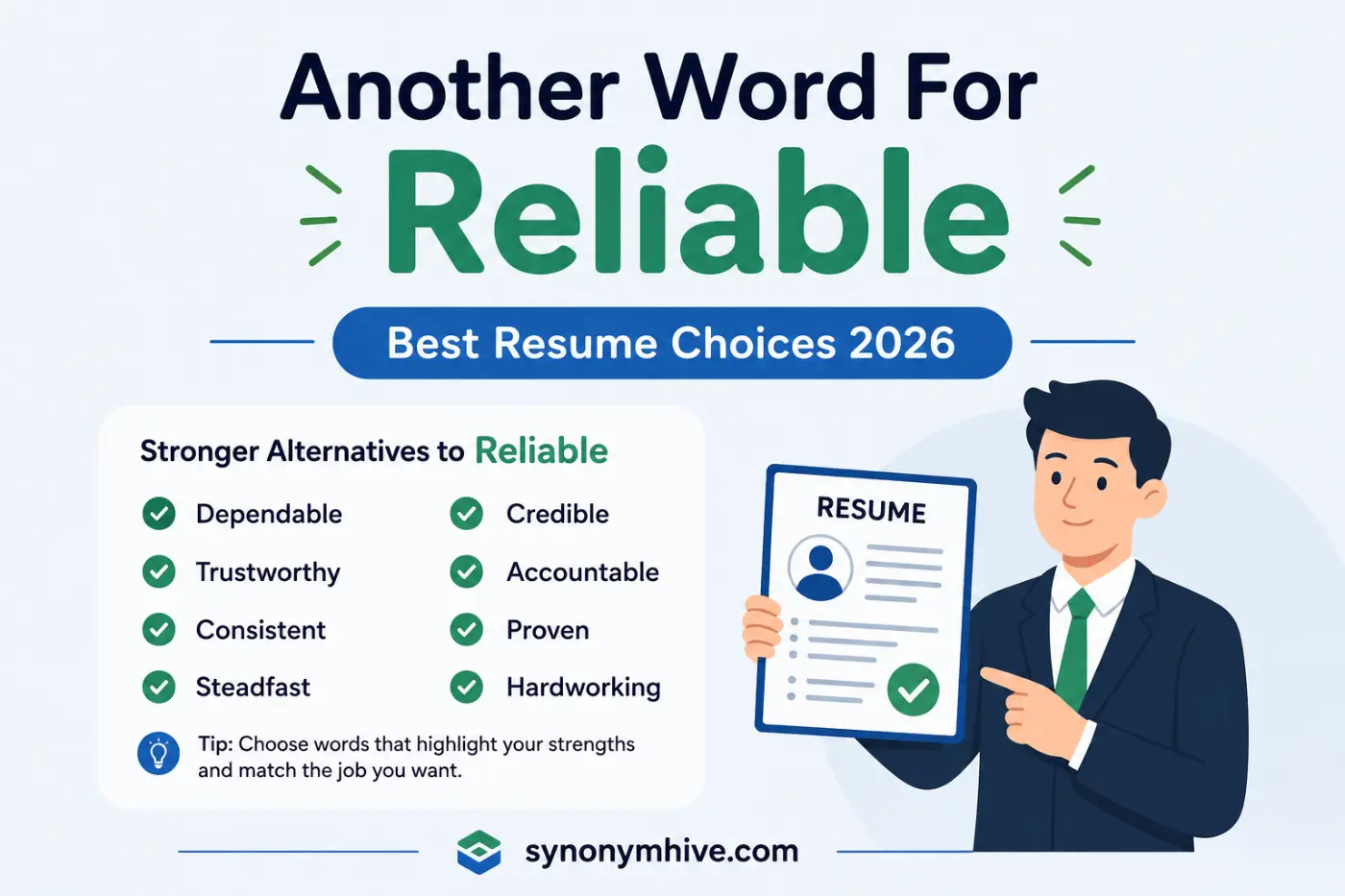
Writing a resume can get tricky when you want to describe yourself as reliable. The word is strong and useful, but you may want a fresher choice that shows exactly how you work. If you’re searching for another word for reliable, options such as dependable, trustworthy, consistent, responsible, punctual, and steady can help. Each word highlights a slightly different strength, so you can choose the one that best fits your skills and work style.
The best replacement depends on the quality you want to highlight. Dependable shows that people can count on you. Consistent shows steady performance. Trustworthy focuses on honesty. Responsible points to good judgment and ownership.
Another word for reliable can be dependable, trustworthy, consistent, responsible, steady, punctual, or dependable. The best choice depends on the situation and the quality you want to show.
Discover related words in Another Word for Developed Best Resume Choices 2026.
What Does Reliable Mean In Plain English
Reliable describes someone or something that can be trusted to work well or do what is expected. A reliable person keeps promises, meets responsibilities, follows through, and can be counted on when something needs to get done.
For example, a reliable employee arrives on time, finishes assigned work, and communicates when a problem comes up. A reliable coworker doesn’t disappear when the team needs help. A reliable product performs as expected over time.
The word can describe people, services, systems, information, equipment, results, and even sources.
You might say a reliable employee meets deadlines. You might also describe a car as reliable because it usually works without major problems.
The central idea is trust through consistent performance.
That makes reliable a valuable word on a resume. However, the word becomes much stronger when you connect it to something you actually did.
Try this.
I consistently meet deadlines and keep client records accurate.
This sentence shows reliability through action instead of simply claiming it.
Where Does Reliable Come From
Reliable comes from the verb rely. Rely traces back to older French roots connected with the idea of depending on or trusting someone or something.
The suffix able means capable of or fit for something. So reliable developed around the idea of being worthy of dependence.
That meaning still fits modern English.
When you call someone reliable, you’re saying you can depend on that person. When you describe information as reliable, you’re saying you can trust it.
The word became especially useful because it works across many situations.
A reliable worker can be trusted with responsibilities. A reliable source can provide dependable information.
The basic idea stays simple.
Reliable means you can count on it.

What Is Another Word For Reliable
The best alternative depends on what kind of reliability you mean.
Dependable is one of the closest choices. It means someone can be counted on to do what they promise.
Trustworthy focuses more on honesty and trust.
Consistent emphasizes steady performance.
Responsible highlights ownership and good judgment.
Punctual focuses on arriving or finishing on time.
Steady suggests calm and dependable performance over time.
Faithful can describe strong loyalty and continued support.
Accountable works well when someone takes responsibility for results.
Diligent emphasizes careful and persistent work.
Stable often describes something that stays dependable instead of changing suddenly.
The strongest replacement isn’t always the most formal one. Choose the word that gives the reader the clearest picture.
What Are The Best Synonyms For Reliable
The following words cover several meanings of reliability. Some work naturally in everyday speech. Others are better suited to resumes, essays, and professional writing.
| Word | Meaning | Tone | Example |
|---|---|---|---|
| Dependable | Can be counted on | Professional | She is a dependable team member. |
| Trustworthy | Deserves trust | Professional | He is trustworthy with sensitive records. |
| Consistent | Performs steadily | Professional | She delivers consistent results. |
| Responsible | Handles duties properly | Professional | He is responsible with client accounts. |
| Steady | Stable and dependable | Everyday | She provides steady support. |
| Punctual | Arrives on time | Professional | He is punctual for every meeting. |
| Accountable | Takes responsibility | Professional | She remains accountable for project results. |
| Diligent | Works carefully and persistently | Formal | He is diligent when reviewing records. |
| Faithful | Loyal and dependable | Formal | She remained faithful to the team’s goals. |
| Dedicated | Gives strong effort and commitment | Professional | He is dedicated to customer service. |
| Committed | Stays focused on a duty or goal | Professional | She is committed to meeting deadlines. |
| Consistent | Maintains the same quality | Everyday | He provides consistent support. |
| Stable | Remains dependable over time | Formal | The system provides stable performance. |
| Loyal | Shows continued support | Everyday | She is loyal to her team. |
| Prompt | Acts or responds quickly | Professional | He gives prompt responses to clients. |
| Thorough | Completes work carefully | Professional | She takes a thorough approach to reviews. |
| Dependable | Can be trusted to follow through | Everyday | He’s dependable when deadlines are tight. |
| Conscientious | Careful about duties and standards | Formal | She is a conscientious employee. |
| Reliable | Can be trusted to perform as expected | Neutral | He is a reliable project assistant. |
| Trusting | Willing to place trust in others | Everyday | The manager has a trusting relationship with staff. |
| Attentive | Pays close attention | Professional | She is attentive to customer needs. |
| Stable | Remains steady and dependable | Formal | The team maintains stable operations. |
Which Reliable Synonyms Are Simple And Everyday
Simple words often work best because readers understand them immediately.
Dependable is one of the easiest replacements. It sounds natural in both professional and everyday speech.
Trustworthy is also common. It works especially well when honesty matters.
Steady is useful when you want to describe calm and consistent performance.
Responsible works when reliability comes from taking ownership.
Punctual is more specific. Use it when being on time is the main point.
Loyal focuses on continued support rather than general dependability.
For example.
She is dependable and always follows through on client requests.
He is responsible for keeping the weekly reports accurate.
She provides steady support during busy periods.
These choices sound natural because they don’t try too hard.
Which Reliable Synonyms Sound More Formal
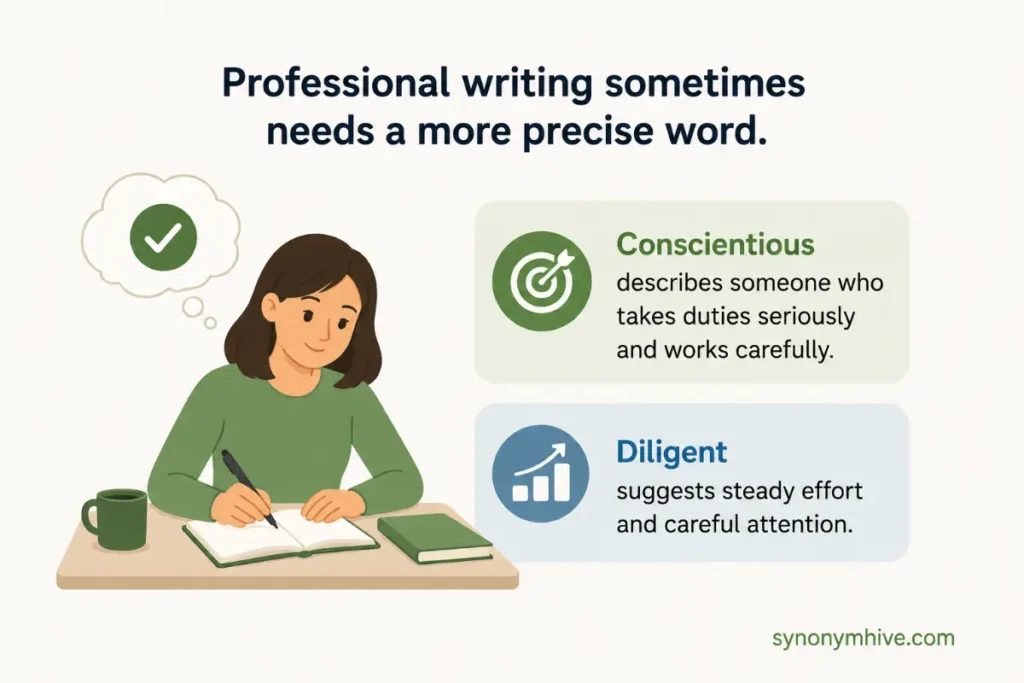
Professional writing sometimes needs a more precise word.
Conscientious describes someone who takes duties seriously and works carefully.
Diligent suggests steady effort and careful attention.
Accountable focuses on accepting responsibility for outcomes.
Committed shows strong dedication to a goal.
Thorough emphasizes complete and careful work.
Consistent highlights stable performance.
These words can work well on resumes when they match the actual role.
For example.
I take a conscientious approach to reviewing financial documents.
I deliver consistent results across multiple customer accounts.
The important point is accuracy. Don’t choose a formal word just because it sounds impressive.
Which Synonyms Work In Casual Speech
Casual conversations usually favor familiar language.
You can say dependable, steady, responsible, on time, or someone you can count on.
For example.
She’s someone you can count on.
He’s always on time.
They’re really dependable.
She’s steady under pressure.
These phrases sound warmer than formal words such as conscientious or accountable.
How Strong Are The Different Synonyms
Not every synonym carries the same level of meaning. Some simply describe basic dependability. Others suggest a deeper quality.
Mild Reliability
Punctual, steady, prompt, and dependable can describe basic dependable behavior.
These words work well when you want to make a simple point without adding extra meaning.
Moderate Reliability
Consistent, responsible, committed, diligent, and attentive suggest a stronger pattern.
They show that the person doesn’t just meet expectations once. They do so regularly.
Strong Reliability
Trustworthy, accountable, conscientious, dedicated, and dependable can carry more weight in professional settings.
These words suggest that others can place meaningful responsibility in the person’s hands.
Still, strength comes from context.
A strong word without evidence can sound like an empty claim. A simple word supported by a real example can sound much more convincing.
How Reliable Works As Different Parts Of Speech
Reliable is an adjective.
For example.
She is a reliable employee.
The team provides reliable service.
Reliability is the noun form.
For example.
The position requires reliability and good judgment.
The company values reliability.
Reliably is the adverb form.
For example.
He reliably completes his reports before the deadline.
Rely is the related verb.
For example.
The team relies on her to manage client schedules.
You can vary these forms to avoid repeating the same adjective.
Instead of saying someone is reliable several times, describe what they do.
She meets deadlines.
He follows through on commitments.
They maintain consistent service.
She responds promptly to customers.
These sentences give readers useful evidence.
What Is Another Expression For Reliable On A Resume
For resumes, dependable, consistent, responsible, accountable, diligent, and trustworthy are strong choices.
The best option depends on the job.
Dependable works well for general workplace reliability.
Consistent fits roles where steady results matter.
Accountable works well for leadership and project responsibilities.
Trustworthy fits positions involving private information, money, or important decisions.
Diligent fits work that requires patience and careful attention.
Responsible works across many job types.
Try this.
I consistently meet project deadlines while maintaining accurate client records.
This is stronger than saying:
I am a reliable employee.
The first sentence gives evidence. The second only gives a claim.
What Is Another Phrase For Reliable In An Essay
Essays often need a word that describes information, evidence, research, or a person’s behavior.
Trustworthy works well for sources.
For example.
The researcher used trustworthy sources to support the argument.
Dependable can describe information or methods.
For example.
The study provides dependable data for the analysis.
Consistent works well when discussing repeated results.
For example.
The experiment produced consistent results across several trials.
Credible is especially useful when discussing sources or claims.
For example.
The article uses credible evidence from established research.
Reliable remains useful too, but precise synonyms can make academic writing clearer.
What Is Another Term For Reliable In An Email
Emails usually need direct language.
Dependable works well when talking about a person.
For example.
John has been a dependable partner throughout the project.
Consistent works well when discussing results or service.
For example.
We’ve received consistent support from the customer service team.
Trustworthy works well when discussing information.
For example.
This is a trustworthy source for the report.
If the email is casual, you can simply say someone is someone you can count on.
For example.
She’s someone we can count on to handle the meeting.
What Is Another Phrase For Reliable In A Text
Text messages usually favor simple language.
You might say dependable, steady, trustworthy, or someone you can count on.
For example.
You’re always dependable when I need help.
He’s someone I can count on.
She’s really steady under pressure.
You don’t need a formal synonym in a casual message.
Words such as conscientious and accountable may sound too formal for a quick text.
What Is Another Phrase For Reliable In Everyday Speech
Dependable is probably the most natural everyday replacement.
Trustworthy works when you mean someone is honest.
Steady works when you mean someone stays calm and consistent.
Responsible works when someone handles duties well.
For example.
My brother is really dependable.
She’s trustworthy with important information.
He’s steady even when things get stressful.
She’s responsible and always follows through.
The best choice depends on what you want the listener to notice.
What Is Another Expression For Reliable In A Job Interview
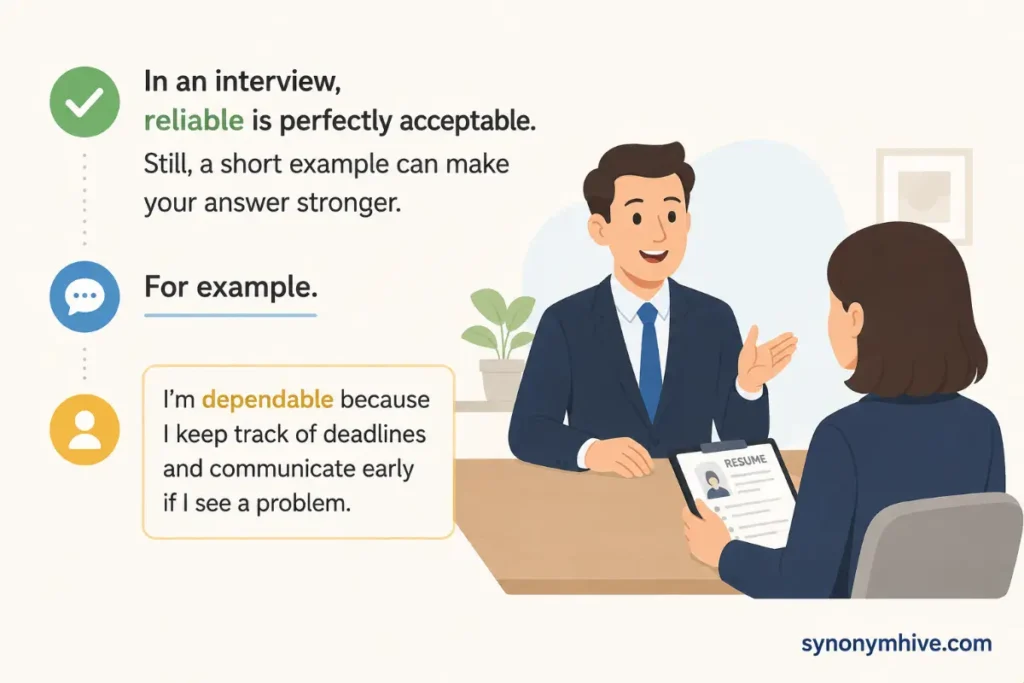
In an interview, reliable is perfectly acceptable. Still, a short example can make your answer stronger.
For example.
I’m dependable because I keep track of deadlines and communicate early if I see a problem.
You could also say:
I’m consistent with my work. I follow the same review process so I can catch mistakes before they reach the client.
These answers show how you behave instead of simply giving yourself a positive label.
What Is Another Word For Reliable In A Cover Letter
A cover letter gives you space to connect reliability to your work.
Try this.
My dependable approach helps me keep projects on schedule and maintain clear communication with clients.
Another option is:
I take responsibility for my deadlines and follow through on commitments from start to finish.
These examples sound stronger because they connect the quality to a useful result.
Ten Real Examples Of Reliable Synonyms
The right word becomes easier to understand when you see it in real situations.
- She is dependable and consistently meets client deadlines.
- He is trustworthy with confidential customer information.
- The assistant provides consistent support during busy weeks.
- She is responsible for maintaining accurate financial records.
- He takes a diligent approach to reviewing applications.
- The manager remains steady when unexpected problems arise.
- She is punctual and arrives before each morning meeting.
- He stays accountable for project milestones and final results.
- The team provides dependable service to customers across the region.
- She is conscientious about checking reports before submission.
- He is committed to meeting the needs of long term clients.
- The system produces stable results under normal conditions.
- She responds promptly to customer questions.
- He is dedicated to maintaining high service standards.
- The researcher used credible sources to support the conclusion.
Dependable Vs Trustworthy What Is The Difference
Dependable and trustworthy overlap, but they focus on different qualities.
| Dependable | Trustworthy |
|---|---|
| Focuses on follow through | Focuses on trust |
| Suggests consistent behavior | Suggests honesty and integrity |
| Useful for tasks and responsibilities | Useful for sensitive information and decisions |
| She is dependable with deadlines | She is trustworthy with private records |
Choose dependable when you mean someone will do what they promised.
Choose trustworthy when you mean someone can be trusted with information, money, decisions, or personal matters.
A person can be dependable without being especially trustworthy in every situation. The words are close, but they aren’t identical.
Reliable Vs Consistent What Is The Difference
Reliable means someone or something can be counted on.
Consistent means performance stays steady over time.
For example, a reliable employee may always finish assignments on schedule.
A consistent employee may produce the same strong quality across many assignments.
| Reliable | Consistent |
|---|---|
| Focuses on dependability | Focuses on steady performance |
| Can describe people and things | Often describes results or behavior |
| He is reliable with deadlines | He delivers consistent results |
Use reliable when trust and dependability matter.
Use consistent when the main point is stable performance.
Looking for another word? See Another Word for Detail Oriented: Resume Wins 2026.
Responsible Vs Accountable What Is The Difference
Responsible and accountable are also close.
Accountable means someone accepts responsibility for the outcome.
For example.
She is responsible for managing the schedule.
She is accountable for keeping the project on track.
The first sentence focuses on the duty.
The second focuses more strongly on ownership of the result.
Both can work well on resumes, especially for roles involving management or independent work.
Punctual Vs Reliable What Is The Difference
Punctual means being on time.
Reliable has a much wider meaning.
A reliable employee may arrive on time, meet deadlines, communicate clearly, and complete work consistently.
If your main strength is time management, punctual is precise.
If you want to describe broader dependability, reliable or dependable is better.
What Is Another Term For Reliable At Work
At work, dependable, consistent, responsible, accountable, and trustworthy are useful choices.
Choose dependable for general follow through.
Choose trustworthy for sensitive responsibilities.
For example.
She is a dependable team member who consistently meets deadlines.
This sentence uses two related qualities without repeating the same word.
How To Show Reliability Without Saying Reliable
You don’t always need a synonym.
Sometimes the strongest choice is an action that proves the quality.
Instead of saying:
I am reliable.
Try this.
I meet weekly deadlines and communicate early when priorities change.
Instead of:
Reliable administrative assistant.
Try this.
Manage calendars, prepare meeting materials, and maintain accurate records for a busy office.
Instead of:
Reliable customer service representative.
Try this.
Respond to customer requests promptly and resolve issues while maintaining accurate records.
These examples let the reader reach the conclusion themselves.
Common Mistakes When Using Reliable Synonyms
One common mistake is choosing a word that changes the meaning.
For example, punctual only tells the reader that someone is on time. It doesn’t automatically mean the person is dependable in every area.
Another mistake is using trustworthy when you really mean productive.
Trustworthy relates to trust and honesty. It doesn’t directly describe speed or efficiency.
Another mistake is using dedicated as a direct replacement every time.
Dedicated suggests commitment and effort. It can support the idea of reliability, but it isn’t an exact match.
Another mistake is using stable to describe a person in a situation where dependable would sound more natural.
Stable is often better for systems, conditions, performance, or situations.
A final mistake is stacking too many positive adjectives.
For example:
I am highly reliable, dependable, trustworthy, responsible, dedicated, and committed.
This sounds forced.
Choose one or two qualities and prove them with an example.
When Should You Not Use Reliable
Don’t use reliable when you really mean fast.
Efficient or prompt may be better.
Don’t use reliable when you mean honest.
Trustworthy is more precise.
Don’t use reliable when you mean careful.
Diligent, thorough, or conscientious may fit better.
Don’t use reliable when you mean on time.
Punctual is more specific.
Don’t use reliable when you mean loyal.
Loyal or faithful may communicate the idea better.
Don’t use reliable when you mean productive.
Efficient or effective may be stronger.
Good writing depends on precision. A close synonym isn’t always the right synonym.
What Are The Antonyms Of Reliable
The most direct opposite is unreliable.
Other options include inconsistent, undependable, unpredictable, careless, irresponsible, unstable, untrustworthy, and erratic.
Unreliable is the clearest opposite.
Inconsistent suggests performance changes over time.
Untrustworthy focuses on a lack of trust.
Irresponsible suggests poor handling of duties.
Unpredictable describes behavior or results that are difficult to count on.
Unstable suggests a lack of steady performance or condition.
Choose the opposite that matches the problem instead of using the strongest negative word automatically.
How Reliable Changes Across US And UK English
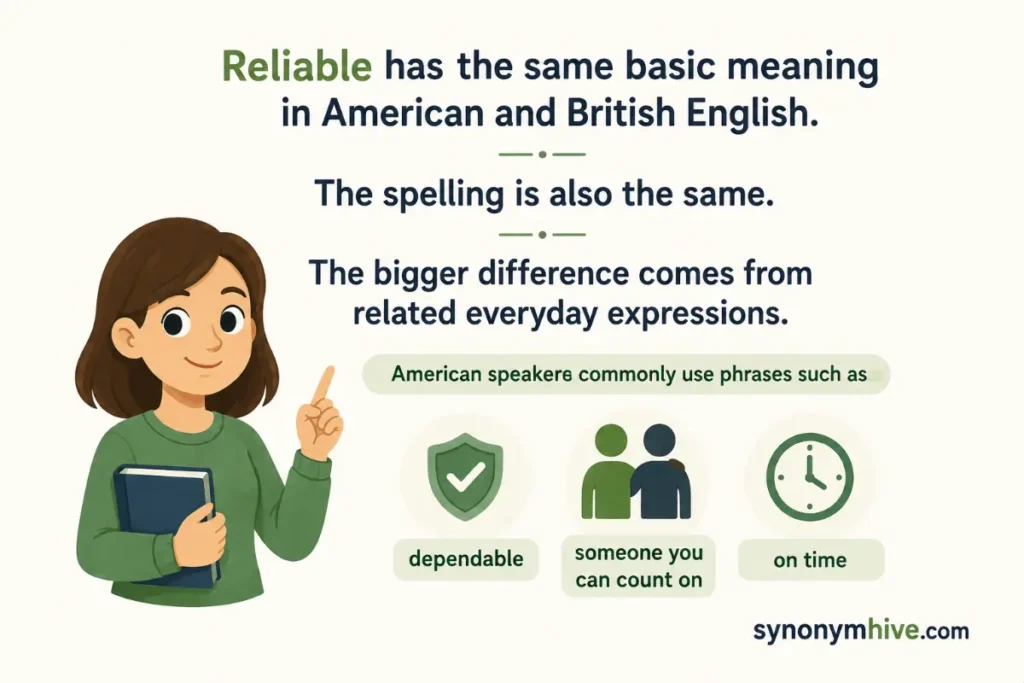
Reliable has the same basic meaning in American and British English.
The spelling is also the same.
The bigger difference comes from related everyday expressions.
American speakers commonly use phrases such as dependable, someone you can count on, and on time.
British speakers may also use dependable and reliable in the same ways. Some casual expressions can differ by region and situation.
For a US resume, reliable, dependable, consistent, responsible, trustworthy, and accountable are safe and natural choices.
You don’t need a regional expression to sound professional.
How To Choose The Best Synonym Quickly
Start by asking what kind of reliability you mean.
People can count on you, so choose dependable.
A person can trust your judgment or honesty, so choose trustworthy.
Your results stay steady, making consistent the better choice.
You handle your duties properly, so responsible fits best.
You accept ownership of your results, making accountable a strong choice.
Careful and focused work is best described as diligent.
Arriving on time makes punctual the right word.
A calm and stable approach can be described as steady.If you mean you stay committed to a goal, choose dedicated or committed.
This simple test can help you choose a stronger word without reaching for a thesaurus every time.
How To Use Reliable Words On A Resume
A resume should show evidence instead of relying on broad claims.
Compare these two statements.
I am reliable and hardworking.
I consistently meet weekly deadlines while maintaining accurate project records.
The second sentence is stronger because it gives the reader something concrete.
You can also use action verbs.
Manage.
Maintain.
Complete.
Coordinate.
Track.
Deliver.
Follow through.
Respond.
Prepare.
Review.
These verbs naturally communicate reliability.
For example.
I maintain accurate customer records and complete weekly reports ahead of schedule.
This sentence shows responsibility, consistency, organization, and dependability without needing several adjectives.
How To Choose A Reliable Word For Different Jobs
Different roles highlight different forms of dependability.
Administrative roles often suit dependable, responsible, organized, and punctual because these words show strong work habits.
Customer service jobs can benefit from trustworthy, responsive, dependable, and consistent because these qualities support good communication and service.
Management positions may call for accountable, responsible, steady, and dependable to show strong leadership and follow through.
Finance roles often suit trustworthy, diligent, careful, and accountable because these words highlight accuracy and responsibility.
Healthcare support work can be described with dependable, attentive, responsible, and conscientious to show care and reliability.
Sales roles may benefit from consistent, committed, responsive, and dependable because these words show steady effort and strong customer support.For technical work, reliable, systematic, consistent, and thorough may fit better.
The job description should guide your choice. Match the word to the actual responsibility instead of using the same synonym everywhere.
Why Evidence Makes A Resume Word Stronger
A hiring manager can read dozens of resumes in a short time.
Positive adjectives alone don’t tell much.
Anyone can write that they’re dependable.
Evidence makes the claim believable.
Instead of:
Dependable employee who always gets the job done.
Write:
Manage daily customer requests while meeting response targets and maintaining accurate records.
The second example gives the reader a clear picture.
It also avoids making the resume sound like a list of personal claims.
Your actions can communicate reliability more effectively than adjectives.
How To Avoid Repeating Reliable On Your Resume
Repeating the same adjective can make a resume feel flat.
You can vary the language by describing specific behaviors.
Manage competing priorities.
Meet project deadlines.
Maintain accurate records.
Follow through on commitments.
Respond promptly to customers.
Coordinate schedules.
Track important details.
Communicate early about problems.
Complete assigned tasks.
Maintain consistent results.
These phrases naturally show that someone can be counted on.
They also make the resume more useful to the reader.
What Is Another Phrase For Reliable When You Mean Consistent
Consistent is the best choice when your main point is steady performance.
For example.
I deliver consistent results across multiple client accounts.
You can also use steady when the situation involves calm and stable performance.
For example.
I provide steady support during high demand periods.
Predictable can work when results are expected and stable, but it can sometimes sound neutral rather than positive.
For resumes, consistent is usually the safer choice.
What Is Another Term For Reliable When You Mean Trustworthy
Trustworthy is the clearest choice when you mean someone can be trusted.
For example.
I am trusted to handle confidential customer information with care.
Credible can work when you describe information, sources, or claims.
For example.
The report uses credible sources to support its findings.
Dependable is different because it focuses more on follow through.
If honesty and integrity matter most, trustworthy is more precise.
What Is Another Term For Reliable When You Mean Responsible
Responsible is useful when someone handles duties properly.
For example.
I am responsible for maintaining accurate inventory records.
Accountable is stronger when the person owns the outcome.
For example.
I remain accountable for project deadlines and final deliverables.
Both words work well on resumes because they describe behavior that employers can connect to actual job duties.
What Is Another Expression For Reliable In Professional Communication
Professional communication works best when the language is clear.
You don’t need complicated vocabulary.
For example.
The team has been dependable throughout the project.
I’ve received consistent support from the service team.
Maria is responsible for coordinating the weekly schedule.
John is accountable for the final report.
These sentences are simple but precise.
The right word makes the message clearer without making it sound formal for no reason.
Quick Tips For Choosing The Right Word
- Use dependable when people can count on someone.
- Use trustworthy when honesty matters.
- Use consistent when performance stays steady.
- Use responsible when duties and ownership matter.
- Use accountable when someone owns the result.
- Use punctual when being on time is the key point.
- Use diligent when careful effort matters.
- Use conscientious when someone takes duties seriously.
- Use steady when calm and stable performance matters.
- Use committed when dedication matters.
- Use dedicated when strong effort matters.
- Use credible when information or sources can be trusted.
- Use prompt when quick responses matter.
- Use thorough when complete and careful work matters.
- Use action verbs when writing a resume.
What Is Another Phrase For Reliable In A Strong Resume Statement
The strongest resume statements usually combine an action with a result.
Try this.
I consistently meet project deadlines while maintaining accurate client records.
Try this.
I manage customer requests promptly and follow through until each issue is resolved.
Try this.
I maintain dependable service by tracking priorities and communicating clearly with clients.
Try this.
I remain accountable for weekly reports and complete each submission before the deadline.
These examples show reliability without sounding repetitive.
They also give the employer a reason to believe the claim.
Find similar expressions in Another Word for Problem Solving Best Resume Guide 2026.
Conclusion
Choosing another word for reliable isn’t about finding the fanciest synonym. It’s about finding the word that describes your actual strength.
Use dependable when people can count on you. Choose trustworthy when honesty matters. Use consistent for steady results. Pick responsible for duties and ownership. Choose accountable when you want to show that you stand behind the outcome. Diligent and conscientious work well when careful effort matters.
For resumes, don’t stop at the adjective. Show the behavior behind it. Mention deadlines you meet, records you maintain, customers you support, or projects you complete. That evidence gives your wording more credibility and makes your resume more memorable.
Frequently Asked Questions
What Is Another Term For Reliable?
Dependable, trustworthy, consistent, responsible, steady, and accountable are strong alternatives. The best choice depends on the exact quality you want to describe.
What’s Another Way To Say Reliable?
You can say dependable, trustworthy, consistent, steady, responsible, or someone you can count on. Choose a word that fits the situation and your intended meaning.
What Is Another Phrase For Reliable On A Resume?
Dependable, consistent, accountable, responsible, diligent, and trustworthy are strong resume choices. Support the word with a specific example whenever possible.
What Is A Professional Word For Reliable?
Dependable and consistent are natural professional choices. Accountable, conscientious, and diligent can work when they match the responsibility you want to highlight.
What Is The Difference Between Reliable And Dependable?
Reliable and dependable are very close in meaning. Dependable often sounds more personal and focuses strongly on someone you can count on.
What Word Means Reliable And Trustworthy?
Trustworthy focuses on honesty and integrity while dependable focuses on follow through. A person can show both qualities at the same time.
What Is The Opposite Of Reliable?
Unreliable is the direct opposite of reliable. Other choices include inconsistent, untrustworthy, irresponsible, unpredictable, and undependable.