

Writing a resume can make simple words feel surprisingly difficult. You know you communicate well but you don’t want to write communication skills in every section. If you’re searching for another word for communication, you have many useful choices. You can use dialogue, conversation, interaction, correspondence, discussion, expression, messaging, contact, or collaboration depending on what you mean.
Another term for communication can be interaction, dialogue, conversation, correspondence, discussion, expression, messaging, or exchange. The best choice depends on the situation and the type of communication you want to describe.
Communication is more than talking. It can involve writing, listening, presenting, explaining, negotiating, sharing information, and building relationships. A strong word choice should show the exact part of communication that you handle well.
That matters on a resume. Communication is a broad skill. A hiring manager may want to know if you can present ideas, work with customers, explain complex information, write clearly, or collaborate with a team. This guide covers the meaning and origin of communication along with more than 30 useful alternatives. You’ll also find examples for resumes, essays, emails, texting, interviews, and everyday speech.
You may also like Another Word For Implemented Resume Choices 2026.
What does communication mean in plain English.
Communication means sharing information, thoughts, feelings, or ideas with another person or group.
Communication can happen through speech, writing, gestures, signs, facial expressions, technology, or other forms of expression.
For example:
Good communication helps teams work together.
This sentence is clear but broad. It doesn’t tell the reader what kind of communication matters.
You could make the idea more specific:
Clear instructions help teams avoid mistakes.
Or:
Open discussion helps employees solve problems faster.
Or:
Regular interaction helps customers feel supported.
Each sentence communicates a different idea.
Communication can also happen in both directions.
Speaking is communication.
Listening is communication.
Writing an email is communication.
Giving a presentation is communication.
Negotiating with a customer is communication.
Explaining a technical issue is communication.
Working through a disagreement is communication.
This wide meaning explains why you have so many alternatives to choose from.
Where did communication come from.
Communication comes from the Latin word communicare. It carried the idea of sharing or making something common.
The word later entered English through French and developed into the modern word communication.
The basic idea has stayed connected to sharing.
When you communicate an idea you make that idea available to someone else.
When two people communicate clearly they create a shared understanding.
That core meaning helps explain the difference between communication and some related words.
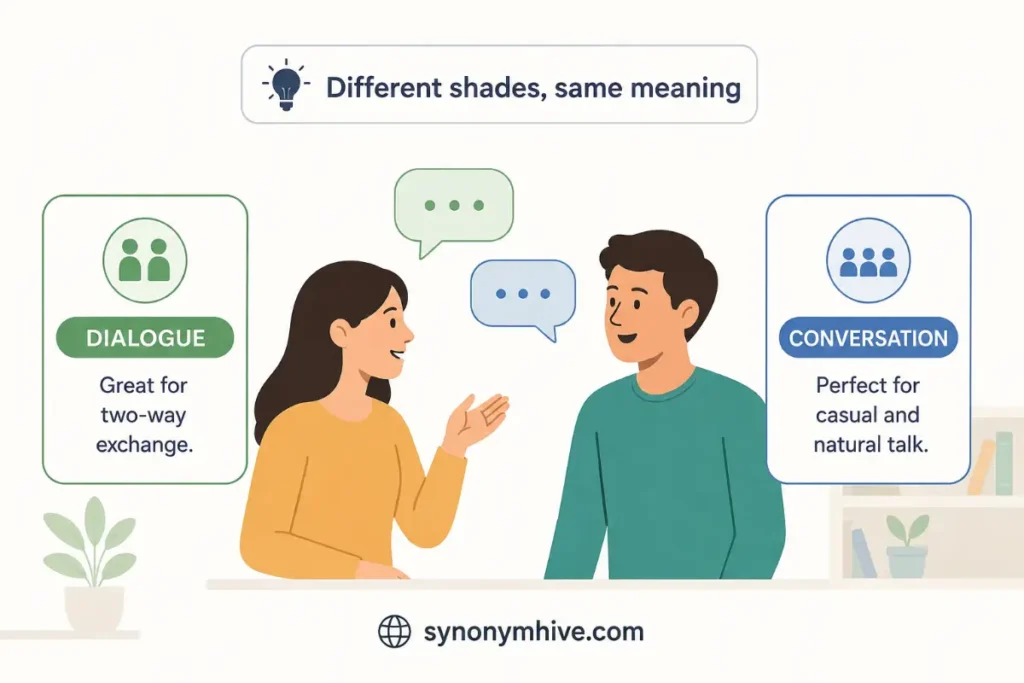
Conversation usually involves people talking with each other.
Correspondence often involves written messages.
Dialogue suggests an exchange between people.
Expression focuses on showing thoughts or feelings.
Interaction focuses on how people respond to each other.
Collaboration focuses on working together toward a goal.
Messaging focuses on sending information.
These words overlap but they aren’t identical.
What is another phrase for communication.
The best alternative depends on the meaning you want to express.
Dialogue works well for a two way exchange.
Conversation sounds natural and informal.
Correspondence fits written communication.
Interaction works when people respond to each other.
Discussion fits an exchange of ideas.
Expression focuses on showing thoughts or feelings.
Messaging works for sending information through digital channels.
Exchange highlights the movement of information or ideas between people.
Contact describes communication between people or organizations.
Collaboration works when communication supports joint work.
Consultation fits professional discussions where advice or input is shared.
Negotiation fits communication used to reach an agreement.
Presentation fits one way communication to an audience.
Briefing fits the delivery of important information.
Instruction fits communication that explains how to do something.
Reporting fits formal communication about facts or results.
These choices can make your writing much more precise.
What are simple synonyms for communication.
Simple words are often the easiest for readers to understand.
- Conversation.
- Discussion.
- Talking.
- Contact.
- Exchange.
- Interaction.
- Sharing.
- Expression.
- Messaging.
- Dialogue.
These words work well in everyday writing.
For example:
Strong communication helps employees work together.
You could write:
Open discussion helps employees work together.
Or:
Regular interaction helps employees work together.
Or:
Clear conversation helps employees solve problems.
The best option depends on the exact situation.
What are everyday alternatives for communication.
Everyday English gives you several natural choices.
- Conversation.
- Talking.
- Discussion.
- Interaction.
- Contact.
- Exchange.
- Sharing.
- Messaging.
- Dialogue.
- Connection.
These words don’t sound overly formal.
For example:
We need better communication between the two teams.
You could say:
We need better interaction between the two teams.
Or:
The two teams need more open discussion.
Or:
The two teams need to stay in closer contact.
Each option has a slightly different meaning.
What are formal synonyms for communication.
Formal writing needs more precise terms.
- Correspondence.
- Dialogue.
- Consultation.
- Coordination.
- Exchange.
- Negotiation.
- Presentation.
- Briefing.
- Reporting.
- Liaison.
- Dissemination.
- Consultation.
These terms can work in resumes, reports, academic writing, business documents, and professional correspondence.
Still, don’t choose a complicated word just because it sounds formal.
Clear language usually works better.
For example, correspondence is useful when you mean written communication.
But it would sound strange to say:
I improved correspondence with my team.
If you actually mean everyday conversations.
In that case, communication or interaction may be clearer.
What are casual alternatives for communication.
Casual speech gives you simple options.
- Talking.
- Chatting.
- Conversation.
- Catching up.
- Checking in.
- Messaging.
- Reaching out.
- Staying in touch.
- Touching base.
- Talking things through.
These phrases work well in texts and casual conversations.
For example:
We need better communication.
You might say:
We need to talk more openly.
Or:
Let’s talk things through.
Or:
Let’s stay in touch.
The casual option should match the setting.
What are the best communication synonyms for a resume
| Word | Meaning | Tone | Example |
|---|---|---|---|
| Dialogue | Two way exchange of ideas | Professional | Facilitated dialogue between department leaders. |
| Interaction | Communication involving responses | Professional | Improved customer interaction across service channels. |
| Correspondence | Written communication | Formal | Managed client correspondence for major accounts. |
| Discussion | Exchange of ideas | Professional | Led discussions about project priorities. |
| Collaboration | Working together through communication | Professional | Supported collaboration across five departments. |
| Consultation | Professional exchange for advice | Formal | Conducted client consultations to identify needs. |
| Negotiation | Communication used to reach agreement | Professional | Led contract negotiations with key suppliers. |
| Presentation | Formal delivery of information | Professional | Delivered presentations to senior executives. |
| Briefing | Focused delivery of important information | Formal | Prepared weekly briefings for department leaders. |
| Reporting | Formal sharing of facts or results | Professional | Prepared performance reports for management. |
| Liaison | Communication between groups | Formal | Served as liaison between sales and operations. |
| Messaging | Sending information | Modern | Managed customer messaging across digital channels. |
| Exchange | Sharing ideas or information | Neutral | Encouraged an open exchange of ideas. |
| Expression | Showing thoughts or feelings | Neutral | Strengthened written expression across team reports. |
| Contact | Communication with another person | Neutral | Maintained regular contact with major clients. |
| Outreach | Communication aimed at reaching people | Professional | Managed community outreach programs. |
| Instruction | Communication that explains what to do | Professional | Created clear instructions for new employees. |
| Explanation | Making information easier to understand | Everyday | Provided clear explanations of technical issues. |
| Persuasion | Communication designed to influence | Professional | Used persuasion to gain support for new initiatives. |
What are communication synonyms by intensity.
Communication words can also differ in strength and purpose.
| Level | Word | Main idea |
|---|---|---|
| Mild | Contact | Basic connection |
| Mild | Sharing | Giving information |
| Mild | Conversation | Informal exchange |
| Moderate | Discussion | Exchange of ideas |
| Moderate | Interaction | Two way involvement |
| Moderate | Dialogue | Focused two way exchange |
| Moderate | Collaboration | Communication during joint work |
| Strong | Negotiation | Communication aimed at agreement |
| Strong | Persuasion | Communication aimed at influence |
| Strong | Advocacy | Communication used to support a position |
| Formal | Briefing | Structured delivery of information |
| Formal | Reporting | Formal presentation of facts |
| Formal | Correspondence | Written professional exchange |
| Formal | Liaison | Communication connecting groups |
Choose mild terms for simple contact.
Choose stronger terms when the communication had a clear goal.
For example, negotiation suggests more responsibility than conversation.
Persuasion suggests influence.
Advocacy suggests support for a person or cause.
Briefing suggests structured information delivery.
What are communication synonyms by part of speech.
Communication is mainly a noun.
For example:
Strong communication helps teams succeed.
You can replace the noun with another noun.
Strong collaboration helps teams succeed.
Open dialogue helps teams solve problems.
Regular interaction improves customer relationships.
Clear correspondence builds trust with clients.
You can also use verbs to make resume writing stronger.
Instead of:
Communication with customers.
Write:
Communicated with customers.
Instead of:
Communication of project updates.
Write:
Delivered project updates.
Instead of:
Communication between departments.
Write:
Coordinated communication between departments.
Instead of:
Communication of technical information.
Write:
Explained technical information to nontechnical users.
Action verbs often create a stronger resume because they show what you did.
What is the difference between communication and conversation.
Communication is the broader term. Conversation is one type of communication.
| Communication | Conversation |
|---|---|
| Can be written or spoken | Usually spoken |
| Can be one way or two way | Usually two way |
| Can include formal reports | Usually informal or neutral |
| Can include presentations | Usually involves direct exchange |
| Can include signs and gestures | Usually relies on spoken language |
For example:
A company newsletter is communication.
It isn’t usually called a conversation.
A meeting between two employees is a conversation.
It is also communication.
This distinction matters when choosing a replacement.
If you mean all forms of information sharing use communication.
If you mean people talking with each other use conversation.
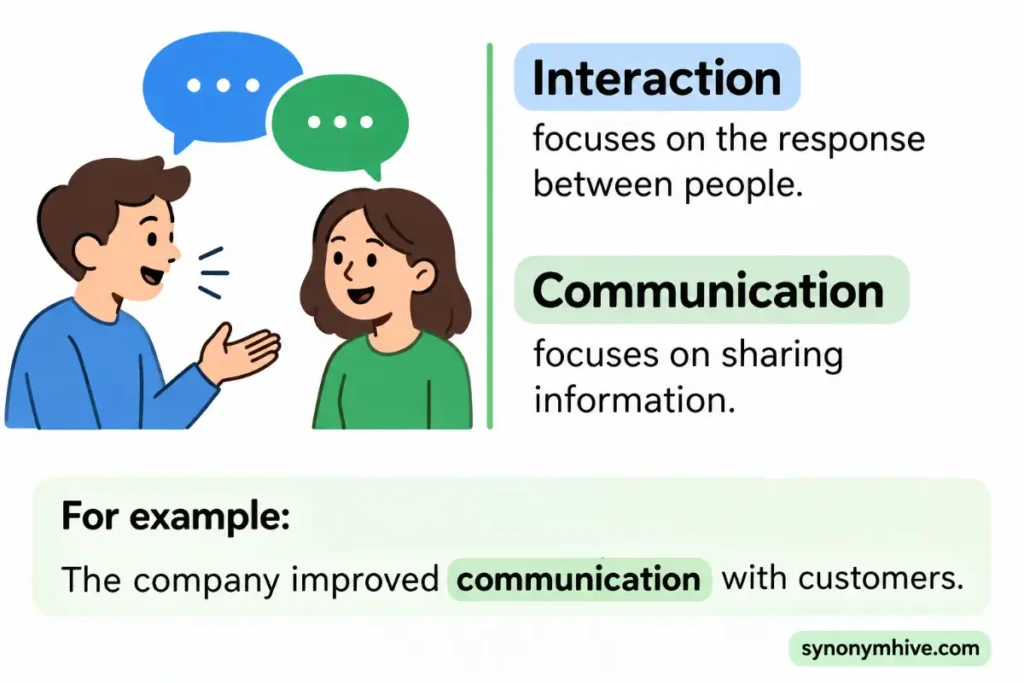
What is the difference between communication and interaction.
This could mean better emails, calls, messages, or announcements.
The company improved customer interaction.
This suggests that customers and employees had better exchanges during actual contact.
Interaction often feels more active.
It suggests that both sides are involved.
Communication can be one way.
For example, a company announcement is communication but it may not involve interaction.
What is the difference between communication and dialogue.
Dialogue is more specific than communication.
It usually describes a two way exchange.
Communication can happen in one direction.
For example:
The manager sent an announcement.
That’s communication.
The manager discussed the change with employees.
That’s dialogue.
Dialogue often suggests listening as well as speaking.
It can also sound more thoughtful and formal than conversation.
For a resume, dialogue can work well when you facilitate meaningful discussions between groups.
For everyday writing, conversation may sound more natural.
What is the difference between communication and correspondence.
Correspondence usually means written communication.
It can include emails, letters, formal messages, and other written exchanges.
For example:
I handled client correspondence.
This tells the reader that you managed written communication.
It doesn’t necessarily mean you handled meetings or phone calls.
If you communicated with clients through calls, emails, and meetings, client communication is broader.
If your work mainly involved emails and letters, correspondence is more precise.
What is the best word for communication on a resume.
Interaction works well for customer facing roles.
Correspondence fits written communication.
Dialogue works well for discussion based roles.
Coordination fits communication across teams.
Negotiation fits sales procurement and business development.
Presentation fits public speaking.
Briefing fits structured information delivery.
Liaison fits roles that connect departments or organizations.
Facilitation fits meeting and group communication.
Collaboration fits teamwork.
The best choice depends on your accomplishment.
For example:
Managed client communication.
Could become:
Managed client correspondence for 50 business accounts.
Or:
Built strong client relationships through regular consultation.
Or:
Led negotiations with major accounts.
The specific version gives the employer more information.
What is the best word for communication skills on a resume.
Communication skills can include several different abilities.
You might describe:
- Written communication.
- Verbal communication.
- Active listening.
- Public speaking.
- Presentation.
- Negotiation.
- Persuasion.
- Facilitation.
- Client relations.
- Conflict resolution.
- Cross team coordination.
- Stakeholder engagement.
- Technical explanation.
- Business writing.
- Interpersonal skills.
These terms are more useful than simply writing excellent communication skills.
For example:
Strong written and verbal communication skills.
Could become:
Clear business writing with experience presenting complex information to senior leaders.
That statement tells the reader more.
What is the best word for communication in a resume summary.
Use a term that matches the role.
Sales professionals should highlight negotiation, client relations, persuasion, and presentation.
Customer service professionals should highlight interaction, active listening, client communication, and conflict resolution.
Managers should highlight team communication, facilitation, coaching, and stakeholder engagement.
Technical professionals should highlight technical writing, presentation, explanation, and cross team coordination.
Marketing professionals should highlight messaging, content communication, and audience engagement.
Executives should highlight stakeholder communication, strategic messaging, and negotiation.
A resume summary should connect communication to results.
For example:
Customer service manager experienced in client relations conflict resolution and team coaching.
This is stronger than:
Excellent communication skills.
What is the best word for communication in an essay.
The best choice depends on the subject.
Dialogue applies to communication between characters or groups.
Expression applies to thoughts, feelings, or artistic ideas.
Interaction applies to relationships and exchanges between people.
Correspondence applies to written exchanges such as letters or emails.
Discussion applies to an exchange of ideas or opinions.
Discourse applies to formal or academic communication.Use messaging when discussing the ideas sent through media or technology.
For example:
The novel uses dialogue to reveal conflict between the characters.
Or:
The campaign’s messaging focused on environmental responsibility.
Or:
The study examines interaction between teachers and students.
These choices make academic writing more precise.
What is the best word for communication in an email.
Professional emails often benefit from simple words.
Use:
Discussion.
Conversation.
Update.
Contact.
Coordination.
Correspondence.
Dialogue.
For example:
Thank you for the communication.
This sounds stiff.
Try:
Thanks for the update.
Or:
Thanks for keeping me informed.
Or:
I appreciate the discussion.
Or:
Thanks for staying in touch.
Simple wording often sounds more natural.
What is the best word for communication in texting.
Texting usually needs casual language.
Use:
- Talking.
- Chatting.
- Messaging.
- Checking in.
- Reaching out.
- Catching up.
- Staying in touch.
- Talking things through.
For example:
We need better communication.
A natural text might say:
We need to talk.
Or:
Let’s talk things through.
Or:
Thanks for checking in.
Casual language makes texting sound human.
What is the best word for communication when speaking.
Conversation dialogue discussion and interaction are natural choices.
For example:
Good communication is important at work.
You might say:
Good communication helps people work better together.
Or:
Open discussion can solve a lot of workplace problems.
Or:
Strong interaction with customers builds trust.
When speaking, simple words usually sound more confident.
Expand your vocabulary with Another Word for Punctual Best Resume Words: Stand Out 2026.
What are examples of communication synonyms in real situations.
The best way to understand these words is to see them in action.
- She improved customer interaction by responding to questions within one business day.
- He managed client correspondence for more than 100 accounts.
- She facilitated dialogue between employees and department leaders.
- He led negotiations with three major suppliers.
- She delivered weekly presentations to senior management.
- He prepared daily briefings for the operations team.
- She coordinated communication between sales and customer support.
- He used active listening to resolve difficult customer concerns.
- She improved team collaboration through regular planning meetings.
- He created clear instructions for new employees.
- She explained complex technical information in simple language.
- He built strong client relationships through regular consultation.
- She served as a liaison between the local office and corporate headquarters.
- He used persuasive communication to gain support for a new process.
- She managed community outreach for a regional nonprofit.
- He improved stakeholder engagement through regular project updates.
- She facilitated meetings that helped three teams agree on shared goals.
- He created a messaging strategy for a new product launch.
- She handled customer complaints through careful listening and clear explanations.
- He prepared detailed reports for senior executives.
- She used negotiation skills to resolve a contract dispute.
- He improved internal communication by creating a shared reporting system.
- She led discussions about project risks and deadlines.
- He delivered presentations that helped clients understand complex financial data.
- She maintained regular contact with key business partners.
These examples demonstrate an important point.
Strong communication writing doesn’t just name the skill.
It shows how the skill was used.
How can you show communication on a resume without saying communication.
Use action verbs and specific outcomes.
Instead of:
Strong communication skills.
Write:
Presented quarterly results to senior executives.
Instead of:
Excellent written communication.
Write:
Created clear technical guides used by more than 200 employees.
Instead of:
Good interpersonal communication.
Write:
Resolved customer concerns while maintaining a 95 percent satisfaction rating.
Instead of:
Strong team communication.
Write:
Coordinated project updates across five departments.
Instead of:
Effective communication with clients.
Write:
Managed relationships with 40 key accounts through regular consultations and performance reviews.
These examples give evidence.
Evidence makes a resume more convincing.
What are common communication mistakes on resumes.
One common mistake is using communication as a vague skill without evidence.
For example:
Excellent communication skills.
Almost anyone can write that.
It doesn’t prove anything.
A better approach is to show the communication in action.
Another mistake is choosing a word that sounds more powerful than the actual work.
Don’t write negotiation if you only shared updates.
Don’t write persuasion if you simply explained information.
Accuracy matters.
Another mistake is repeating the same phrase throughout the resume.
Instead of writing communication in every section, use specific action verbs.
Communicated.
Presented.
Negotiated.
Explained.
Coordinated.
Facilitated.
Advised.
Consulted.
Reported.
Wrote.
Listened.
These verbs make your experience easier to understand.
When should you not use communication.
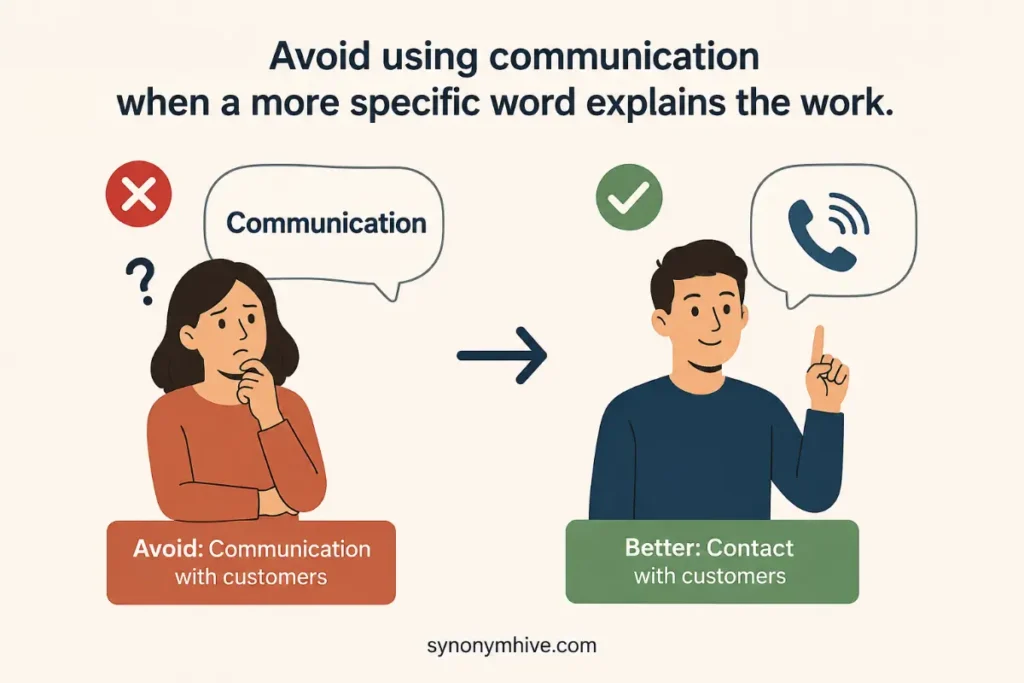
Avoid communication when a more specific word explains the work.
For example:
Communication with customers.
Could become:
Advised customers about product options.
Or:
Resolved customer concerns.
Or:
Managed client accounts.
Or:
Presented product information to prospective buyers.
The specific action gives more meaning.
Communication is still useful when you mean the broad skill.
But if the reader needs to understand exactly what you did, use the specific action.
What are the antonyms of communication.
Communication has several possible opposites depending on the context.
- Silence.
- Isolation.
- Disconnection.
- Misunderstanding.
- Secrecy.
- Nonresponse.
- Withdrawal.
Silence means no spoken communication.
Isolation means separation from others.
Disconnection means a lack of contact.
Misunderstanding means people fail to share or understand the intended meaning.
Secrecy means information is intentionally kept from others.
These aren’t perfect opposites in every situation.
Choose the one that describes the exact contrast.
How do you choose the right communication synonym.
Start by asking what kind of communication you mean.
People talking use conversation or dialogue.
Ideas being shared use discussion or exchange.
Emails being written use correspondence.
Departments being connected use liaison or coordination.
People working together use collaboration.
An agreement being reached use negotiation.
Someone being influenced use persuasion.
Information being given to an audience use presentation.
Focused information being given to a team use briefing.
A process being explained use instruction.
Technical ideas being simplified use explanation.
A cause being supported use advocacy.
Relationships being built use engagement or interaction.
This simple test can help you choose the word that feels right.
How can you make communication sound stronger on a resume.
Replace broad claims with specific actions and results.
Weak:
Excellent communication skills.
Better:
Delivered presentations to senior executives.
Stronger:
Delivered monthly performance presentations to senior executives and helped identify $250,000 in annual cost savings.
Weak:
Strong customer communication.
Better:
Managed customer inquiries.
Stronger:
Managed more than 80 customer inquiries per day while maintaining a 96 percent satisfaction score.
Weak:
Good team communication.
Better:
Coordinated team updates.
Stronger:
Coordinated project updates across four departments and reduced missed deadlines by 20 percent.
The strongest version usually combines action scope and results.
What communication words work best for different jobs.
Different careers need different forms of communication.
Conversation or dialogue describes people talking.
Discussion or exchange describes ideas being shared.
Correspondence describes written emails and other messages.
Liaison or coordination describes departments being connected.
Collaboration describes people working together.
Negotiation describes efforts to reach an agreement.
Persuasion describes attempts to influence someone.
Presentation describes information given to an audience.
Briefing describes focused information given to a team.
Instruction describes a process being explained.
Explanation describes technical ideas being made easier to understand.
Advocacy describes support for a cause.
Engagement or interaction describes efforts to build relationships.
For operations roles use coordination reporting briefing and cross team communication.
The job description can help you identify the most useful terms.
Look at the responsibilities.
Then choose language that matches those duties.
What is the difference between verbal and written communication.
Verbal communication usually refers to spoken communication.
Written communication uses text.
Verbal examples include:
- Presentations.
- Meetings.
- Interviews.
- Phone calls.
- Discussions.
Written examples include:
- Emails.
- Reports.
- Proposals.
- Instructions.
- Documentation.
A strong professional may need both.
For example:
Strong written and verbal communication skills.
Can become:
Experienced in executive presentations and technical business writing.
That version is more specific.
What is the difference between communication and collaboration.
Communication means sharing information.
Collaboration means working together toward a shared goal.
Communication supports collaboration.
But the two words aren’t interchangeable.
For example:
The team improved communication.
This means team members shared information more effectively.
The team improved collaboration.
This means team members worked together more effectively.
A person can communicate well without collaborating.
For example, a speaker can deliver a clear presentation without working with the audience.
A team can also collaborate through shared planning and communication.
What is the difference between communication and coordination.
Coordination involves organizing people activities or resources so they work together.
Communication is one tool used for coordination.
For example:
She improved communication between departments.
This could mean better updates and information sharing.
She improved coordination between departments.
This suggests that the departments became better aligned in their work.
Use coordination when organization and alignment are central to the accomplishment.
What is the difference between communication and expression.
Expression focuses on showing thoughts feelings or ideas.
Communication focuses on sharing information or meaning with others.
A person can express an emotion through facial expressions.
That expression may communicate something to another person.
For example:
His facial expression showed concern.
His expression communicated concern.
In writing, expression can describe how an author presents ideas.
Communication is broader.
What are regional differences in communication words.
There aren’t major US and UK differences in the basic meaning of communication.
The main vocabulary differences come from style and context.
Americans may commonly use terms such as:
Communication.
Interaction.
Teamwork.
Collaboration.
Messaging.
Customer engagement.
British English also uses these terms widely.
Words such as correspondence liaison and consultation can sound more formal in both varieties.
The bigger difference usually comes from the workplace rather than the country.
A technology company may use messaging and collaboration.
A law firm may use correspondence and negotiation.
A university may use dialogue and discourse.
A hospital may use consultation and patient communication.
So focus on the audience and industry.
What is another word for communication skills.
Another term for communication skills depends on the specific ability.
You could use:
- Interpersonal skills.
- Verbal communication.
- Written communication.
- Presentation skills.
- Negotiation skills.
- Active listening.
- Facilitation skills.
- Client relations.
- Public speaking.
- Business writing.
- Stakeholder engagement.
- Conflict resolution.
- Persuasion.
- Consultation.
- Technical communication.
These phrases are more specific than a general claim.
How can you improve communication wording on a resume.
Start by removing vague phrases.
Replace:
Excellent communication skills.
With:
Presented financial reports to senior executives.
Replace:
Good interpersonal skills.
With:
Resolved customer concerns through active listening and clear explanations.
Replace:
Strong written communication.
With:
Created technical documentation for more than 300 users.
Replace:
Strong communication abilities.
With:
Negotiated vendor agreements that reduced annual costs by 15 percent.
Then look for evidence.
Ask yourself:
Who did I communicate with.
How did I communicate.
What did I communicate.
How often did I do it.
What problem did it solve.
What changed because of my work.
Your answers can turn a basic resume phrase into a strong accomplishment.
What are the best action verbs for communication.
Strong communication related verbs include:
- Communicated.
- Presented.
- Explained.
- Negotiated.
- Facilitated.
- Consulted.
- Advised.
- Coordinated.
- Reported.
- Persuaded.
- Mediated.
- Briefed.
- Instructed.
- Documented.
- Clarified.
- Listened.
- Collaborated.
- Advocated.
- Reported.
- Engaged.
Choose verbs that describe real actions.
For example:
Presented quarterly results.
Negotiated supplier contracts.
Facilitated team meetings.
Advised customers on product options.
Coordinated updates across departments.
These phrases are stronger than:
Used communication skills.
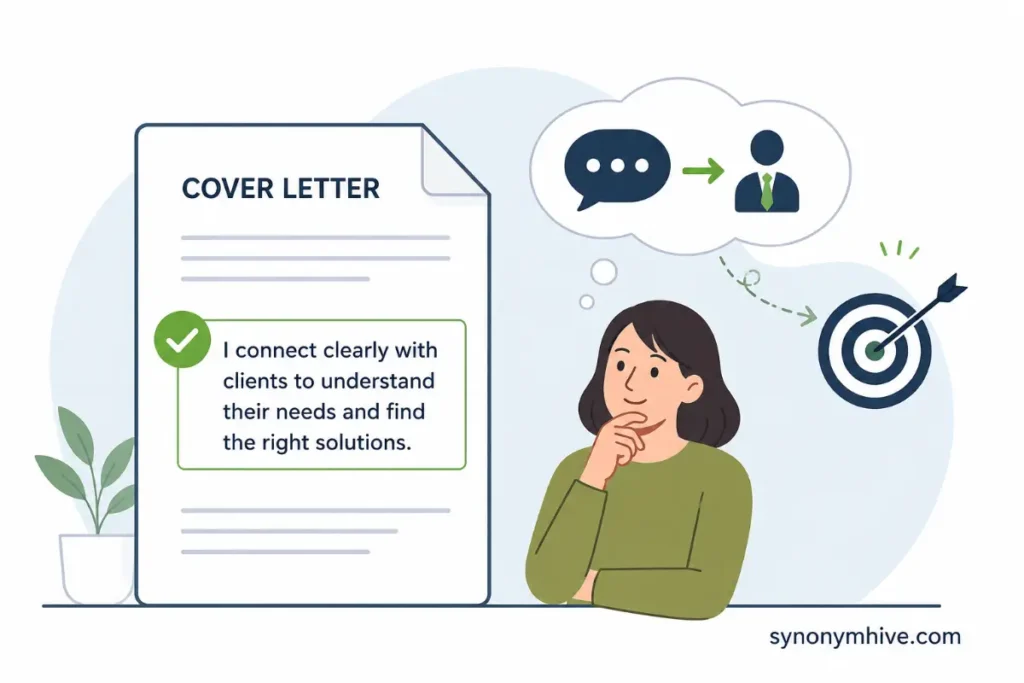
How can you describe communication in a cover letter.
A cover letter should connect communication to the job.
Instead of:
I have excellent communication skills.
Try:
I regularly present project updates to senior leaders and explain technical issues in clear language.
Or:
In my current role I manage client discussions and resolve service concerns through careful listening and clear follow up.
Or:
I coordinate communication across sales operations and customer support to keep projects on schedule.
These statements show the skill instead of simply naming it.
How can you describe communication in an interview.
Use a specific example.
Start with the situation.
Explain what you needed to communicate.
Describe what you did.
Then share the result.
For example:
A client was frustrated because a project had fallen behind schedule. I listened to the client’s concerns and explained the cause in simple terms. I then created a clear recovery plan and provided regular updates. The client accepted the plan and the project finished two weeks later.
That answer demonstrates listening explanation client management and problem solving.
You don’t need to say you have excellent communication skills.
The example proves it.
How can you use communication synonyms naturally.
The best approach is to avoid replacing every use of communication with a synonym.
That can make writing sound forced.
Instead, choose alternatives only when they add meaning.
For example:
Communication is important for good teamwork.
This sentence is fine.
You don’t need to change it.
But:
Clear communication between departments helped reduce errors.
Could become:
Better coordination between departments helped reduce errors.
Now the replacement adds a more specific idea.
Likewise:
The manager improved communication with customers.
Could become:
The manager improved customer interaction through faster responses.
Again the sentence becomes more precise.
Synonyms should improve meaning.
They shouldn’t exist just to create variety.
What should you remember about communication synonyms.
The strongest replacement for communication is the one that explains what actually happened.
Use conversation for informal talking.Dialogue describes a two way exchange.
Correspondence describes written contact.
Discussion describes the sharing of ideas.
Interaction describes two way involvement.
Coordination describes efforts to keep people aligned.
Collaboration describes people working together.
Negotiation describes efforts to reach an agreement.
Presentation describes information being delivered to an audience.
Briefing describes focused information being delivered to a team.
Persuasion describes efforts to influence decisions.
Consultation describes professional advice and input.
Liaison describes efforts to connect groups.
Reporting describes formal results being shared.
Active listening describes situations where understanding others is the key skill.
On a resume, don’t stop at the word. Show the action and result. A hiring manager learns much more from a sentence such as Led client negotiations that reduced annual costs by 12 percent than from Excellent communication skills.
Find more synonyms in Another Word for Supported Best Resume Choices 2026.
Conclusion
Communication is a broad skill, but your resume becomes much stronger when you show exactly how you used it. Instead of repeating the same word, choose precise terms such as dialogue, interaction, negotiation, presentation, coordination, collaboration, or active listening based on the work you actually performed.
The key is to match the word to the situation. A person who manages client emails has different communication strengths from someone who leads negotiations, presents to executives, explains technical information, or coordinates several departments.
The same approach works beyond resumes. In essays, emails, interviews, workplace conversations, and everyday writing, the right communication synonym can make your meaning clearer and more specific. Choose the word that describes the action rather than simply replacing communication for variety.
Frequently Asked Questions
What’s another way to say communication?
Another term for communication can be dialogue, conversation, interaction, correspondence, discussion, exchange, messaging, or collaboration. The right choice depends on the type of communication.
What is another phrase for communication on a resume?
Another expression for communication on a resume can be interaction, correspondence, negotiation, presentation, coordination, consultation, or facilitation. Pick the term that describes the actual work you performed.
What can I say instead of communication skills?
You can name the exact ability such as active listening, presentation, negotiation, business writing, client relations, facilitation, or conflict resolution.
What is a professional way to say communication?
Professional options include correspondence, dialogue, consultation, coordination, negotiation, stakeholder engagement, liaison, and presentation.
What is another word for good communication?
Clear dialogue, effective interaction, strong collaboration, open discussion, clear expression, and effective coordination can work depending on the situation.
How do I show communication skills on a resume?
Use action verbs such as presented, negotiated, explained, coordinated, advised, facilitated, and consulted. Then add a result that shows the value of your work.
Is communication a good skill to put on a resume?
Communication is a useful resume skill but it is broad. Specific examples such as negotiation, presentation, technical writing, active listening, and client relations can make your resume more convincing.