
Another word for team player can be collaborator, teammate, contributor, cooperative, supportive, or team oriented professional. The best choice depends on the skill or behavior you want to highlight.
You’re updating your resume and you reach a sentence that says you’re a great team player. It sounds positive. Still, it doesn’t tell a hiring manager much about what you actually do on a team. If you’re searching for another term for team player, you have better options that can show collaboration, communication, leadership, and support.
The strongest replacement depends on your role. You might be a collaborator who works well with others. You might be a cooperative coworker who helps the group succeed. If you often guide others, words like facilitator, contributor, or collaborator may fit better.
A strong resume does more than claim that you work well with people. It shows how you contribute to a group and what your contribution helped achieve. This guide covers more than 30 alternatives, their differences, intensity levels, common uses, resume examples, and mistakes to avoid.
Discover related words in Another Word For Achieved: Winning Resume Words 2026.
What does team player mean in plain English
A team player is someone who works well with other people to reach a shared goal. The phrase usually describes a person who:
- Communicates clearly with coworkers.
- Shares information and ideas.
- Helps others when needed.
- Listens to different opinions.
- Takes responsibility for their work.
- Supports group goals.
- Handles disagreements professionally.
- Contributes ideas and effort.
- Accepts feedback.
- Gives credit to other people.
Being a team player doesn’t mean agreeing with everyone.
A strong team member can disagree respectfully. They can raise concerns. They can challenge an idea when they think a better approach exists. The key is that they focus on the shared goal rather than personal credit.
For example:
I worked well with my team.
This sentence is positive but vague.
A stronger version is:
Collaborated with five designers to create a new product launch campaign.
Now the reader knows what you did and who you worked with.
An even stronger version could include the result:
Collaborated with five designers to create a product launch campaign that increased customer engagement by 28 percent.
That’s much more useful on a resume.
Where did the phrase team player come from
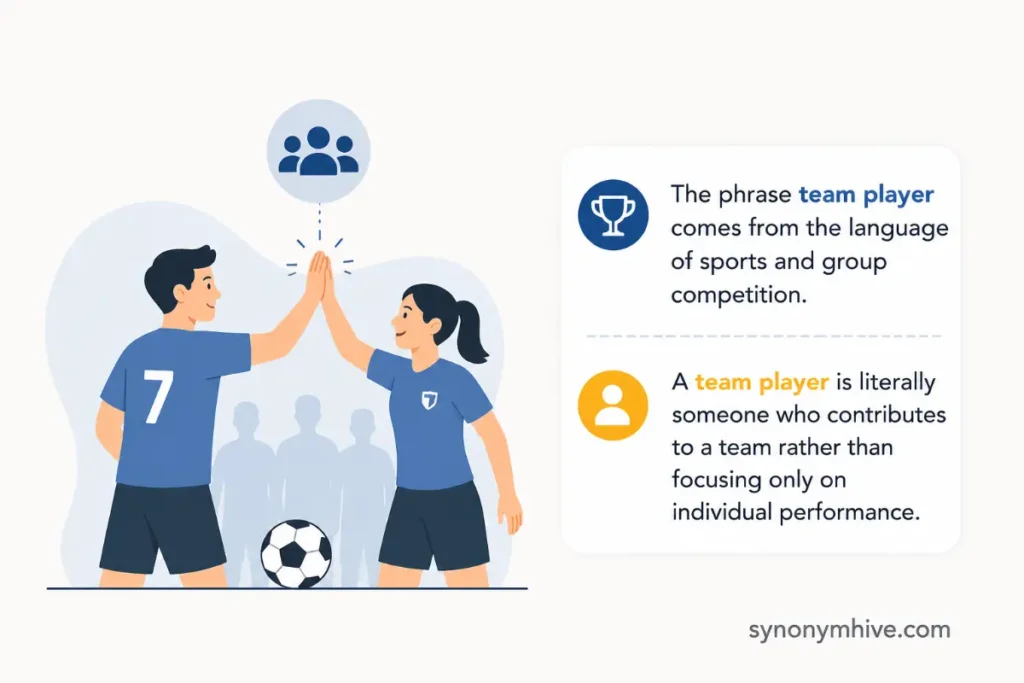
The phrase team player comes from the language of sports and group competition. A team player is literally someone who contributes to a team rather than focusing only on individual performance. Over time, the phrase moved from sports into workplaces, schools, volunteer groups, and other settings.
Today, employers often use team player to describe someone who works effectively with coworkers. The phrase is familiar and easy to understand. However, familiarity creates a problem. Because team player appears on so many resumes, it can lose its impact. If your resume says:
Great team player with excellent communication skills.
The reader has little evidence.
If it says:
Collaborated with sales and product teams to shorten customer response times by 25 percent.
The reader sees the behavior.
That distinction matters.
The best alternative doesn’t simply sound more sophisticated. It gives the reader more information.
What is another phrase for team player
Here is a broader list.
| Word | Meaning | Tone | Example |
|---|---|---|---|
| Teammate | Someone who works as part of a team | Everyday | Supported teammates during busy periods. |
| Communicator | Someone who shares information clearly | Professional | Communicated project updates across departments. |
| Partner | Someone who works closely with another person | Professional | Partnered with engineering to solve product issues. |
| Mediator | Someone who helps resolve conflict | Formal | Mediated disagreements between team members. |
| Helper | Someone who provides assistance | Casual | Helped teammates during peak periods. |
| Organizer | Someone who brings people and tasks together | Everyday | Organized team meetings and project deadlines. |
| Listener | Someone who pays attention to others | Everyday | Acted as an attentive listener during team meetings. |
| Bridge builder | Someone who connects people or groups | Conversational | Built strong relationships between departments. |
| Consensus builder | Someone who helps groups reach agreement | Professional | Built consensus during strategic planning. |
| Collegial | Friendly and cooperative with coworkers | Formal | Built collegial relationships across departments. |
| Cooperative colleague | A coworker who works well with others | Professional | Became a cooperative colleague during major projects. |
| Group contributor | Someone who adds value to a group | Formal | Served as a strong group contributor. |
| Peer supporter | Someone who helps coworkers | Professional | Served as a peer supporter for new hires. |
| Team builder | Someone who strengthens group relationships | Professional | Helped build stronger team relationships. |
| Consensus maker | Someone who helps people agree | Professional | Helped teams reach practical decisions. |
| Group oriented professional | Someone who prioritizes shared goals | Formal | Took a group oriented approach to planning. |
| Cooperative colleague | Someone who works constructively with coworkers | Professional | Built trust as a cooperative colleague. |
Some of these choices work better on resumes than others. Collaborator, contributor, facilitator, coordinator, and relationship builder tend to sound natural in professional writing. Helper and teammate are perfectly normal words but may not communicate enough detail on their own. The goal isn’t to find the fanciest synonym. The goal is to find the most accurate one.
What are simple synonyms for team player
If you want easy language, use teammate, collaborator, contributor, supporter, cooperative coworker, or helper.
For example:
I am a strong team player.
You could write:
I am a supportive teammate who helps coworkers meet shared goals.
Or:
I work well as a collaborator across different departments.
Or:
I contribute ideas and support coworkers during busy projects.
Simple words often make resumes easier to read.
A hiring manager shouldn’t have to decode your vocabulary to understand your strengths.
What are everyday alternatives to team player
Everyday language gives you several natural choices.
- Teammate.
- Collaborator.
- Supporter.
- Contributor.
- Partner.
- Helper.
- Organizer.
- Communicator.
- Problem solver.
- Relationship builder.
These words can work well when your writing needs to sound friendly and natural.
For example:
I was a strong team player during the project.
Could become:
I supported my teammates throughout the project.
Or:
I collaborated with coworkers to complete the project.
The second versions tell the reader what you actually did.
What are formal synonyms for team player
Formal writing can use collaborator, contributor, facilitator, coordinator, consensus builder, relationship builder, team oriented professional, or cross functional partner.
For example:
She is an excellent team player.
A more professional version might be:
She is an effective collaborator who builds strong relationships across departments.
Or:
She is a skilled facilitator who helps teams reach practical decisions.
These versions work because they replace a broad label with a specific strength.
What are casual alternatives to team player
In casual conversation, you don’t need formal vocabulary.
You can say:
- Good teammate.
- Helpful coworker.
- Easy person to work with.
- Someone who works well with others.
- Someone who has the team’s back.
- Someone who pulls their weight.
- Someone who helps the group succeed.
For example:
She’s a great team player.
A casual alternative is:
She’s easy to work with and always helps when the team needs her.
That’s longer but much more natural in conversation.
What are slang alternatives to team player
There isn’t one perfect slang replacement for team player.
Instead, casual phrases can describe the same behavior.
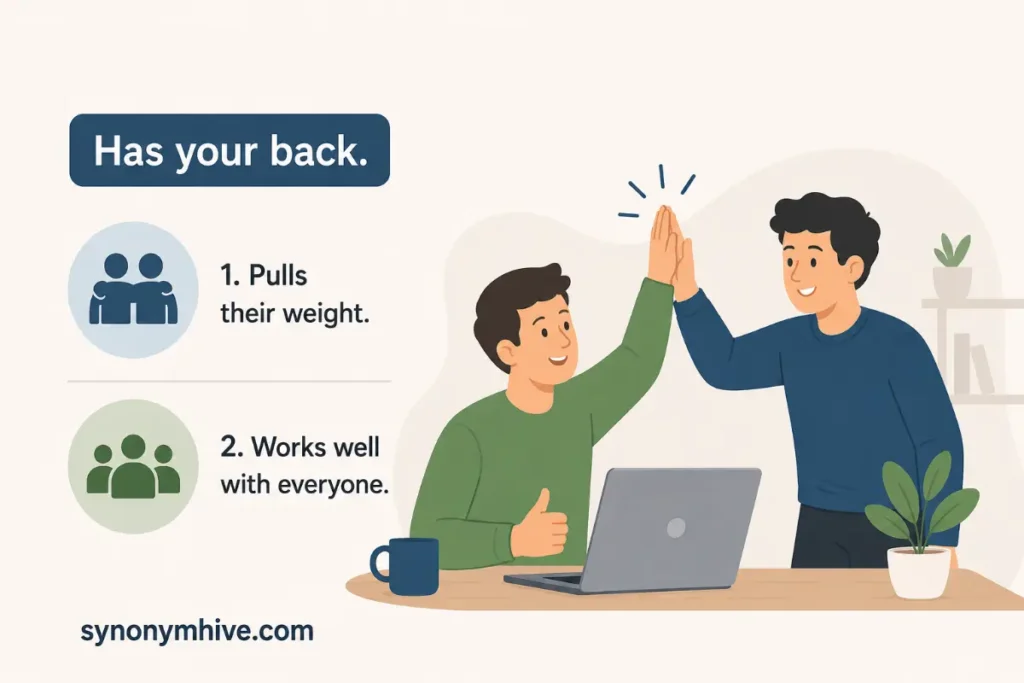
- Has your back.
- Pulls their weight.
- Works well with everyone.
- Is easy to work with.
- Is a solid teammate.
- Helps keep things moving.
- Plays well with others.
For example:
He’s a solid teammate who always has our back.
This sounds natural in casual speech.
It wouldn’t be a good choice for a formal resume.
What are team player synonyms by intensity
Not every alternative carries the same strength.
Some words simply describe cooperation.
Others suggest leadership and influence.
| Level | Word | Main idea |
|---|---|---|
| Mild | Teammate | Works as part of a group |
| Mild | Supportive | Helps coworkers |
| Mild | Cooperative | Works willingly with others |
| Moderate | Contributor | Adds useful effort or ideas |
| Moderate | Collaborator | Works closely with others |
| Moderate | Communicator | Shares information clearly |
| Moderate | Coordinator | Organizes people or tasks |
| Strong | Facilitator | Helps groups work effectively |
| Strong | Relationship builder | Creates strong working connections |
| Strong | Consensus builder | Helps groups reach agreement |
| Strong | Team builder | Strengthens group performance |
| Very strong | Cross functional partner | Works effectively across departments |
| Very strong | Team leader | Guides people toward shared goals |
A word like supportive is positive but fairly mild.
Collaborator suggests active participation.
Facilitator suggests that you help other people work together.
Consensus builder suggests that you can handle different opinions and move a group toward agreement.
Team builder suggests a stronger ability to improve group performance.
Choose the level that reflects your actual contribution.
What are team player synonyms by part of speech
Team player is a noun phrase.
For example:
She is a strong team player.
You can replace it with another noun or noun phrase.
She is a strong collaborator.
He is a reliable contributor.
She is an effective facilitator.
He is a supportive teammate.
You can also use adjectives.
She is collaborative.
He is cooperative.
She is supportive.
He is team oriented.
You can use verbs to describe the actual behavior.
She collaborates effectively across departments.
He supports his coworkers.
She coordinates work between teams.
He facilitates group discussions.
For resumes, verbs are often stronger because they show action.
Compare:
Strong team player.
With:
Collaborated with five departments to deliver a major product launch.
The second version gives the reader evidence.
What is the best alternative to team player on a resume
Collaborator is one of the strongest general choices.
Contributor is useful when you want to show that you add ideas or effort.
Facilitator works well if you help groups communicate and make decisions.
Coordinator is useful when you organize people, schedules, or tasks.
Relationship builder works well for roles that depend on trust and communication.
Team oriented professional can work in a summary statement but should still be supported by evidence.
The best resume strategy is to describe the behavior instead of labeling yourself.
Instead of:
Strong team player.
Write:
Collaborated with product, sales, and customer support teams to launch a new service.
Instead of:
Excellent team player with strong communication skills.
Write:
Partnered with five departments to solve customer issues and improve response times.
This approach feels more credible because it shows what you did.
How do you replace team player on a resume
Start with an action verb.
Use:
Collaborated.
Partnered.
Coordinated.
Supported.
Facilitated.
Contributed.
Led.
Communicated.
Organized.
Resolved.
Built.
Then add the people involved.
For example:
Collaborated with designers and developers to create a new website.
Next, add the goal.
Collaborated with designers and developers to create a new website for a national campaign.
Finally, add the result if you have one.
Collaborated with designers and developers to create a new website that increased online leads by 30 percent.
Now the sentence shows teamwork without using the phrase team player.
What is the best word for teamwork on a resume
Collaborated is one of the strongest verbs for teamwork.
Other useful choices include partnered, coordinated, facilitated, supported, contributed, led, and communicated.
For example:
Collaborated with the finance team to improve monthly reporting.
Partnered with sales to develop new client resources.
Coordinated work between design and engineering teams.
Facilitated weekly planning sessions.
Supported new employees during onboarding.
Contributed research to a major product strategy.
Each verb shows a different kind of teamwork.
What is another term for team player in a resume summary
A resume summary can use collaborative, cooperative, team oriented, relationship focused, or cross functional.
For example:
Collaborative marketing professional with five years of experience developing campaigns across sales and product teams.
Another option is:
Team oriented customer service professional with a strong record of building client relationships and supporting coworkers.
You can also avoid the label completely.
For example:
Marketing professional who builds strong cross functional relationships and turns complex ideas into clear campaigns.
That sounds more specific and gives the reader a reason to keep reading.
What is another phrase for team player in an interview
During an interview, collaborator and teammate sound natural.
You can also describe the behavior directly.
For example:
I’m a collaborative person who enjoys solving problems with a team.
Or:
I work best when I can share ideas, listen to other perspectives, and help the group reach a strong result.
A good interview answer should include an example.
Instead of saying:
I’m a great team player.
Say:
On my last project, I worked with sales and engineering to solve a customer issue. I helped organize the discussion and made sure both teams understood the customer’s needs.
Now you’re proving the claim.
What is another expression for team player in an essay
In an essay, collaborative, cooperative, contributor, participant, partner, or group member can work.
For example:
The student was a strong team player.
You could write:
The student was a cooperative group member who helped classmates complete the project.
Or:
The student contributed useful ideas and helped the group reach its goal.
Academic writing usually benefits from specific descriptions.
Avoid choosing a synonym just because it sounds formal.
Clear writing is stronger than inflated writing.

What is another alternative for team player in an email
In an email, use collaborator, teammate, partner, coworker, or someone who works well with others.
For example:
She’s a great team player.
You could write:
She’s a strong collaborator who always helps the group stay on track.
Or:
She’s a reliable teammate who works well across departments.
In everyday workplace communication, simple language usually sounds more genuine.
Need a similar word? Read Another Word for Mentor Best Resume Guide 2026.
What is another word for team player in texting
Texting calls for simple phrases.
You could say:
- Good teammate.
- Great coworker.
- Easy to work with.
- Always helps out.
- Has our backs.
- Pulls their weight.
- Works well with everyone.
For example:
He’s a great team player.
Could become:
He’s a solid teammate and always has our backs.
That sounds natural in a text.
What is another term for team player in speaking
Collaborator is useful in professional speech.
Teammate is more casual.
Supportive is useful when discussing someone’s personality.
For example:
She’s a strong collaborator.
He’s a reliable teammate.
She’s very supportive of her coworkers.
He works well with different personalities.
All four sentences communicate teamwork.
They simply highlight different qualities.
What are examples of strong team player alternatives
Here are original examples from common workplace situations.
- Collaborated with sales and marketing teams to launch a new product.
- Partnered with engineers to resolve customer issues.
- Coordinated work between three departments during a company event.
- Supported new employees throughout the onboarding process.
- Facilitated weekly meetings and helped the group reach clear decisions.
- Contributed research and ideas to a six month product strategy.
- Built strong relationships with coworkers across five departments.
- Helped resolve disagreements between design and development teams.
- Shared project updates with stakeholders and kept everyone aligned.
- Organized team resources to improve project efficiency.
- Worked with customer support to identify common client concerns.
- Led a cross functional group through a major process change.
- Developed strong partnerships with internal and external teams.
- Coordinated schedules and deadlines for a team of 20 employees.
- Supported coworkers during a period of rapid company growth.
- Facilitated discussions that helped the team agree on project priorities.
- Built trust with new team members through regular coaching and support.
- Contributed practical ideas that reduced project delays.
- Partnered with senior leaders to improve communication across departments.
- Helped the team achieve its quarterly performance goals.
Notice that none of these sentences needs the phrase team player.
The actions prove the quality.
How are collaborator and contributor different
Collaborator and contributor are close but they focus on different things.
| Collaborator | Contributor |
|---|---|
| Focuses on working with others | Focuses on adding value |
| Suggests active cooperation | Suggests useful effort or ideas |
| Strong for cross functional work | Strong for projects and group work |
| Emphasizes relationships | Emphasizes contribution |
For example:
Collaborated with the design team to improve the website.
This focuses on working with the design team.
Contributed research that improved the website strategy.
This focuses on what you personally added.
If you want to show cooperation, use collaborator.
If you want to show your specific value, use contributor.
How are cooperative and collaborative different
Cooperative means willing to work with others.
Collaborative suggests active joint work.
For example:
She is cooperative and easy to work with.
This describes her attitude.
She is collaborative and regularly partners with other departments.
This describes an active working style.
On a resume, collaborative often gives you more room to show what you did.
How are supportive and collaborative different
Supportive focuses on helping others.
Collaborative focuses on working together.
For example:
Supported new employees during their first month.
This shows that you helped other people.
Collaborated with new employees to improve the training process.
This shows shared work.
Both qualities matter.
The better word depends on your actual contribution.
How are team player and team oriented different
Team player is a noun.
For example:
She is a team player.
Team oriented is an adjective phrase.
For example:
She is a team oriented professional.
Team oriented describes a general approach to work.
Team player describes a person who demonstrates that approach.
On a resume, team oriented can work in a summary.
Still, specific evidence is stronger.
For example:
Team oriented marketing professional.
This is acceptable.
Collaborative marketing professional who has led campaigns across sales and product teams.
This gives the reader much more information.
How are facilitator and coordinator different
A facilitator helps people work through a process.
A coordinator organizes activities, people, or information.
For example:
Facilitated weekly strategy discussions.
This suggests you helped the group communicate and make decisions.
Coordinated weekly strategy meetings.
This suggests you handled scheduling and organization.
The distinction is small but useful.
Use facilitator when group communication is central.
Use coordinator when organization is central.
What are common mistakes when replacing team player
The biggest mistake is choosing a synonym that sounds impressive but doesn’t match your work.
Don’t call yourself a facilitator if you never guided group discussions.
Don’t use collaborator to describe work you completed alone.
Accuracy builds credibility.
Another mistake is using vague phrases.
For example:
Excellent team player.
Strong people skills.
Great communicator.
Works well with others.
These statements aren’t wrong.
They simply don’t provide much evidence.
Instead, describe the behavior.
Collaborated with customer service and product teams to reduce response times.
That’s clearer.
Another mistake is repeating the same teamwork word.
If every bullet starts with collaborated, your resume can feel repetitive.
Use a mix of accurate verbs.
Partnered.
Coordinated.
Supported.
Facilitated.
Led.
Contributed.
Built.
Resolved.
That creates variety without forcing unusual vocabulary.
When should you not use team player
You don’t need to remove team player from every situation.
The phrase can work in casual conversation.
For example:
He’s a great team player.
It can also work in a recommendation or performance discussion.
For example:
Maria has always been a reliable team player who supports her coworkers.
The problem usually appears when the phrase becomes a generic resume claim.
If you use team player on a resume, support it with evidence.
For example:
Team oriented professional who collaborated with five departments to deliver major client projects.
Now the phrase has context.
What are the antonyms of team player
Possible opposites include:
- Individualist.
- Lone worker.
- Noncooperative person.
- Uncooperative coworker.
- Isolated contributor.
- Self focused employee.
- Poor collaborator.
The best antonym depends on the meaning.
Individualist isn’t always negative.
Some jobs require independent thinking.
A person can be highly independent and still work well with others.
That’s why don’t treat team player and independent worker as complete opposites.
Good employees often need both skills.
Can an independent worker still be a team player
Yes.
Being a team player doesn’t mean you need constant help or supervision.
A strong team member can work independently and still communicate well with coworkers.
For example:
Completed independent research while keeping the project team updated on key findings.
This shows independence and collaboration at the same time.
That combination is valuable in many jobs.
Employers often want people who can take ownership while still supporting the group.
How can you prove teamwork on a resume
Use evidence.
Start with the people involved.
Then describe your action.
Then explain the goal.
Finally, add the result.
For example:
Collaborated with five sales representatives to improve customer onboarding and reduce setup time by 20 percent.
The sentence answers several questions.
Who did you work with?
Five sales representatives.
What did you do?
Collaborated to improve onboarding.
Why?
To reduce setup time.
What happened?
Setup time fell by 20 percent.
That’s much stronger than saying you’re a great team player.
How can you show teamwork without using the word team
You can show teamwork through verbs and context.
Use:
Collaborated with.
Partnered with.
Worked alongside.
Coordinated with.
Supported.
Facilitated.
Communicated with.
Built relationships with.
Worked across departments.
Worked with stakeholders.
For example:
Partnered with engineering to resolve customer reported issues.
This clearly shows collaboration without using the word team.
How can you choose the right synonym quickly
Start by asking what you want the reader to notice.
If you want to show cooperation, choose collaborative.
If you want to show broad workplace cooperation, choose team oriented.
The right word should make your sentence more specific.
How can you make team player sound stronger
Don’t simply replace the phrase.
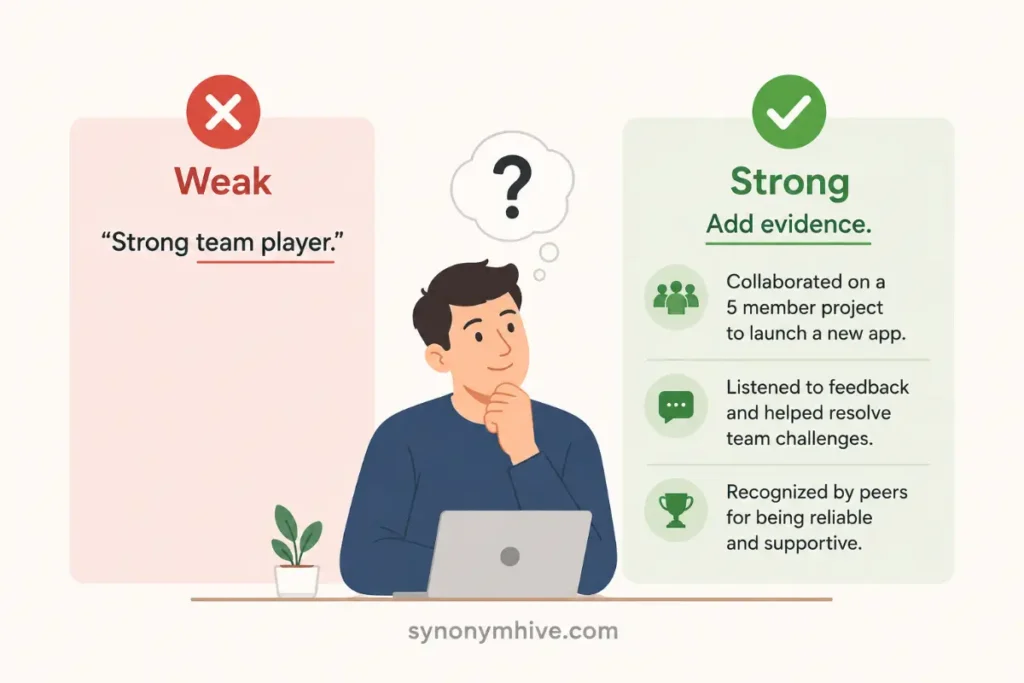
Add evidence.
Weak:
Strong team player.
Better:
Collaborative professional who works effectively across departments.
Stronger:
Collaborated with sales, marketing, and product teams to launch new customer programs.
Strongest:
Collaborated with sales, marketing, and product teams to launch three customer programs that increased retention by 18 percent.
The final sentence tells a story.
You contributed to a group.
You achieved a measurable result.
That’s the kind of detail that makes a resume more convincing.
What is the best resume strategy for teamwork
Show the behavior rather than simply naming the personality trait.
A hiring manager doesn’t need you to tell them that you’re a team player.
They need to see evidence that you can work with people.
Use strong verbs.
Add context.
Mention the people or departments involved.
Show the goal.
Add a measurable result when possible.
For example:
Collaborated with a six person product team to redesign the customer onboarding process and reduce support requests by 24 percent.
This sentence does several jobs at once.
It shows collaboration.
It gives a measurable result.
Most importantly, it sounds like something a real person accomplished.
Find more synonyms in Another Word For Improved: Winning Resume Words 2026.
Conclusion
The best replacement for team player depends on the quality you want to show. Use collaborator for active cooperation. Choose contributor when you want to highlight your value. Use supportive when helping coworkers is the main strength. Pick facilitator when you help groups communicate and make decisions. Choose coordinator when you organize people or tasks. Use relationship builder when trust and communication are central to your role.
Another word for team player should add meaning rather than simply make your resume sound more formal. Whenever possible, skip the label and describe the action. Show who you worked with. Explain what you contributed. Add the result when you have one. That gives employers real evidence of how you work with people and makes your resume much more memorable.
Frequently Asked Questions
What’s another way to say team player?
Another term for team player can be collaborator, contributor, teammate, supporter, facilitator, coordinator, or team oriented professional. The best choice depends on the quality you want to highlight.
What is another phrase for team player on a resume?
Another phrase for team player on a resume can be collaborator, contributor, facilitator, coordinator, or relationship builder. You can also show teamwork through action verbs such as collaborated, partnered, supported, and coordinated.
What is a professional way to say team player?
A professional way to say team player is collaborative professional, effective collaborator, strong contributor, or team oriented professional. Specific examples are usually stronger than any label.
What can I say instead of team player on a resume?
Use a direct phrase such as collaborated with cross functional teams or partnered with sales and marketing. This shows teamwork while also explaining what you did.
Is team player a good word for a resume?
Team player is positive but common on resumes. Specific action verbs and measurable examples usually make the same strength more convincing.
How do I describe teamwork without saying team player?
Describe the action you took with other people. For example, write Collaborated with five departments to launch a new customer program.
What is the best word for someone who works well with others?
Collaborator is one of the strongest general choices. Supportive, cooperative, teammate, facilitator, and relationship builder can also work depending on the situation.