
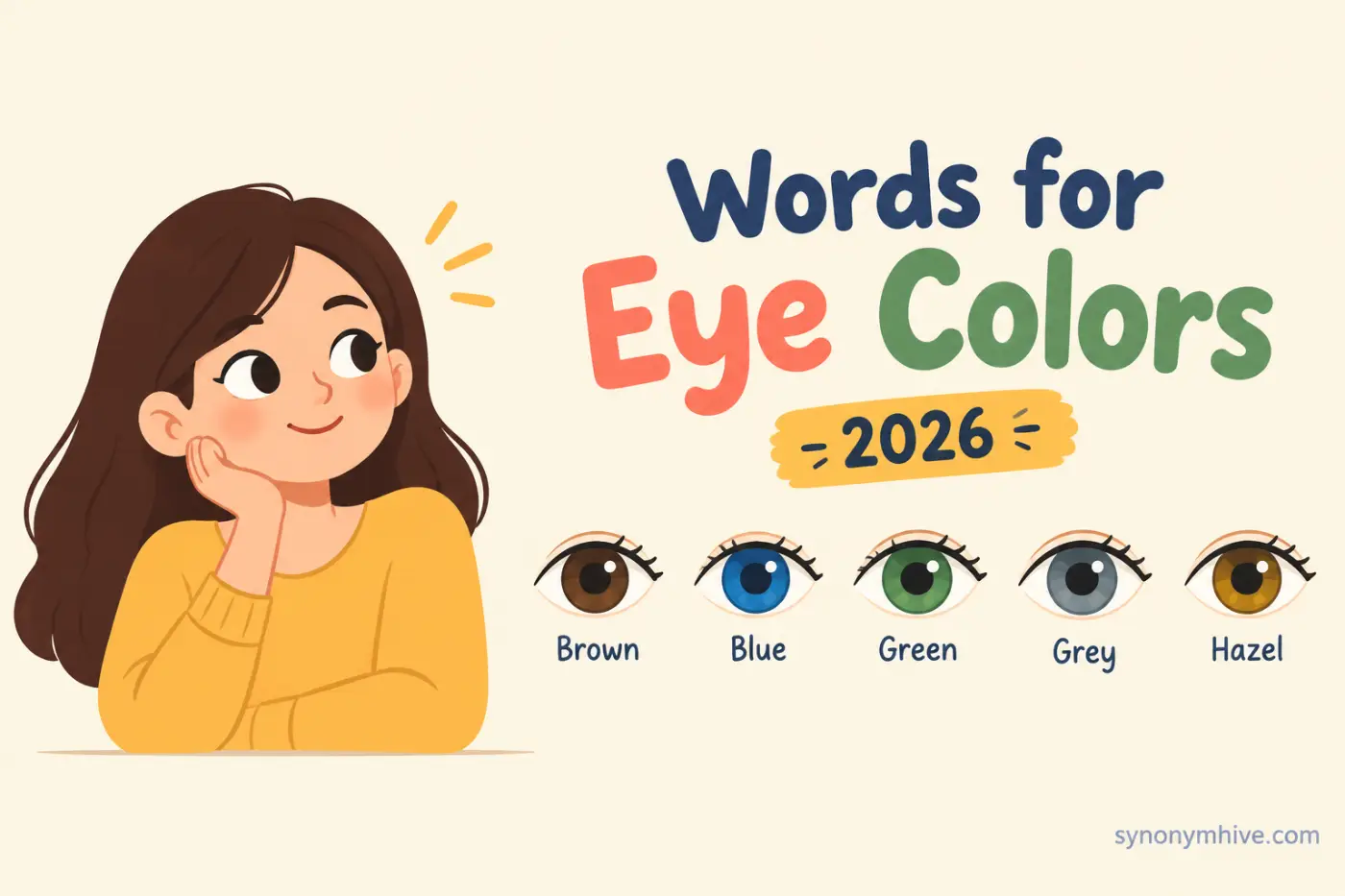
Eyes can say a lot without a single word. You might notice a friend’s bright eyes during a happy moment, describe a character’s piercing gaze in an essay, or search for the perfect phrase to compliment someone in a text. The challenge is finding language that captures the exact look, color, shape, or emotion you want to express.
The best terms to describe eyes depend on what you notice. Some words describe physical features, such as almond shaped, round, and hooded. Others capture color, like hazel, amber, and steel gray. You can also choose words that express emotion, including warm, playful, thoughtful, and intense.
Words to describe eyes are adjectives and descriptive phrases that explain their appearance, color, shape, expression, or emotional effect. The right choice helps readers picture a person clearly and understand the feeling behind their gaze.
This guide covers more than 30 useful terms, explains subtle differences between similar words, and shows you how to choose the best description for creative writing, school assignments, professional communication, everyday conversation, and romantic messages.
Looking for a better alternative? Visit Words to Describe Rain Best Guide.
What Do Words to Describe Eyes Mean?
Words that describe eyes help you communicate what you see and what a person’s gaze seems to express. A single adjective can highlight color, shape, brightness, or mood, while a longer phrase can create a more vivid picture.
For example, calling someone’s eyes blue gives the reader a basic detail. Describing them as clear, icy blue with a quiet intensity creates a stronger image. The second description adds color, texture, and an impression of personality without claiming to know everything about the person.
Where Does the Word Eye Come From?
The English word eye comes from Old English ēage. Its roots stretch back through older Germanic languages to ancient Indo European language forms. Related words appear in languages such as German, where Auge means eye, and Dutch, where oog has the same meaning.
The word has referred to the organ of sight for centuries. It also developed several figurative meanings. People use eye to describe attention, judgment, observation, and the ability to notice details. Expressions such as keep an eye on something, an eye for design, and see eye to eye show how widely the word appears in everyday English.
The verb describe comes through Latin roots connected with writing down or outlining something. In plain English, describing means using words to help another person understand what something looks like, feels like, or means.
When you combine these ideas, describing eyes means giving someone enough detail to picture their appearance or expression. You don’t need elaborate language. Often, one accurate word works better than a long string of fancy adjectives.
What Makes a Good Description of Eyes?
A useful description does more than name a feature. It gives the reader a clear and relevant detail.
Consider these three examples.
- Basic: She had brown eyes.
- More specific: She had warm chestnut brown eyes.
- More expressive: Her chestnut brown eyes softened when she smiled.
The first sentence identifies color. The second adds a richer shade. The third shows how her expression changes in a real moment.
The best choice depends on your goal. A school report might need a simple, factual description. A novel might benefit from details about light, shape, and emotion. A text to a friend may call for something casual and sincere.
Try to describe what you can observe instead of assuming that eye color or shape reveals a person’s character. For instance, thoughtful eyes describes an impression created by someone’s expression. It doesn’t prove that the person is thoughtful in every situation.
What Are the Best Words to Describe Eyes?
The most useful terms fall into four groups: simple words, everyday descriptions, formal vocabulary, and informal expressions. Each group works best in different situations.
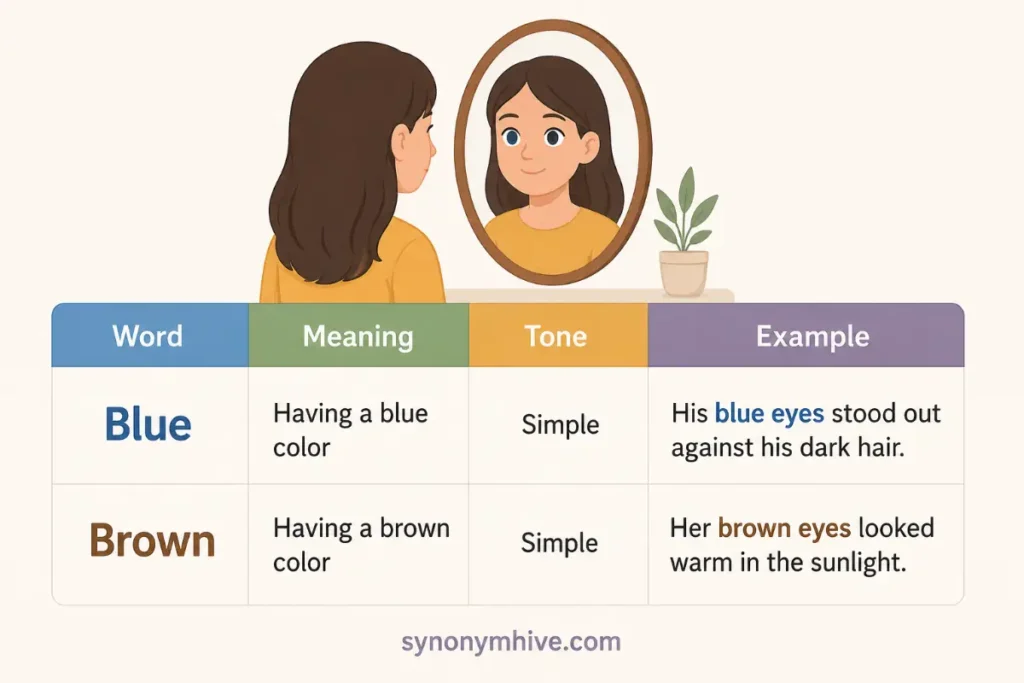
The table below gives you a practical starting point, including meanings, tone, and examples you can adapt.
| Word | Meaning | Tone | Example |
|---|---|---|---|
| Blue | Having a blue color | Simple | His blue eyes stood out against his dark hair. |
| Brown | Having a brown color | Simple | Her brown eyes looked warm in the sunlight. |
| Green | Having a green color | Simple | The child had bright green eyes. |
| Gray | Having a gray color | Simple | His gray eyes matched the cloudy sky. |
| Hazel | A blend of brown and green or gold tones | Everyday | Her hazel eyes changed in different lighting. |
| Amber | Golden or yellowish brown | Everyday | Amber eyes caught the afternoon light. |
| Bright | Reflecting light or appearing lively | Everyday | His bright eyes lit up when he heard the news. |
| Sparkling | Appearing lively or shining | Everyday | She greeted us with sparkling eyes. |
| Gentle | Soft or mild in appearance | Everyday | His gentle eyes made the conversation feel comfortable. |
| Expressive | Showing emotion clearly | Everyday | Her expressive eyes revealed her excitement. |
| Almond shaped | Narrow and oval, with tapered ends | Everyday | She had almond shaped eyes and long lashes. |
| Round | Having a noticeably rounded shape | Everyday | The puppy looked up with round, curious eyes. |
| Hooded | Having skin that partly covers the eyelid crease | Descriptive | His hooded eyes gave his face a relaxed look. |
| Deep set | Positioned farther back beneath the brow | Descriptive | Her deep set eyes created natural shadows. |
| Wide eyed | Open widely, often from surprise or curiosity | Everyday | He watched the fireworks with wide eyed wonder. |
| Piercing | Seeming to look intensely or directly at someone | Strong | Her piercing gaze held the room’s attention. |
| Intense | Showing strong focus or emotion | Strong | His intense eyes made the moment feel serious. |
| Smoldering | Suggesting restrained passion or heat | Dramatic | The actor had a smoldering gaze. |
| Soulful | Appearing emotionally deep or moving | Expressive | The portrait captured her soulful eyes. |
| Luminous | Appearing to give off or reflect soft light | Formal | Luminous eyes made the portrait feel alive. |
| Mesmerizing | Holding attention as if by fascination | Dramatic | His mesmerizing eyes drew the audience in. |
| Alluring | Attracting interest or admiration | Romantic | Her alluring gaze made him pause. |
| Serene | Calm and peaceful in appearance | Formal | She looked at the sea with serene eyes. |
| Perceptive | Suggesting close observation or awareness | Formal | His perceptive gaze noticed every small change. |
| Watchful | Alert and attentive | Everyday | The guard kept a watchful eye on the entrance. |
| Shrewd | Suggesting practical judgment or sharp observation | Formal | The detective had a shrewd, observant gaze. |
| Dreamy | Appearing lost in thought or imagination | Casual | She had a dreamy look as she watched the clouds. |
| Doe eyed | Having large, soft looking eyes, like a young deer | Informal | The character had a doe eyed expression. |
| Starry eyed | Showing wonder, hope, or romantic excitement | Informal | The starry eyed couple talked about their plans. |
| Bug eyed | Having unusually prominent or wide open eyes | Informal, often humorous | He made a bug eyed face when the magician appeared. |
These words aren’t all interchangeable. Amber describes color, hooded describes shape, and serene describes an impression. Choosing the right category keeps your writing accurate.
Also, some descriptions carry a strong emotional tone. Mesmerizing and alluring sound more dramatic than bright or clear. Use them when that stronger impression fits the person or scene.
What Words Describe Different Eye Colors?
Color words help readers picture the shade of someone’s eyes more precisely than basic labels alone. However, lighting, surroundings, and individual variation can affect how a color appears.
What Are the Best Words for Blue Eyes?
Blue eyes can look pale and delicate, deep and dramatic, or cool and steely. Choose a shade that matches the scene instead of relying on the same adjective every time.
- Sky blue: Light and open, like a clear daytime sky.
- Ice blue: Very pale blue with a cool appearance.
- Ocean blue: Deep blue that suggests the sea.
- Steel blue: A muted blue with gray undertones.
- Sapphire blue: Rich, vivid blue.
- Powder blue: Soft and pale blue.
- Clear blue: Bright blue with a clean appearance.
- Stormy blue: Dark or grayish blue with a dramatic feel.
For example, Her ice blue eyes looked almost silver beneath the winter light creates a different image from His deep ocean blue eyes seemed darker in the shade.
What Are the Best Words for Brown Eyes?
Brown eyes range from pale golden brown to deep, nearly black brown. The right word can show warmth, richness, or depth.
- Chocolate brown: Rich and warm brown.
- Chestnut: Medium to dark reddish brown.
- Coffee brown: Deep brown, similar to brewed coffee.
- Cocoa: Soft, rich brown.
- Honey brown: Light brown with golden tones.
- Caramel: Warm, light golden brown.
- Mahogany: Deep reddish brown.
- Dark brown: A straightforward description for a deep shade.
Example: Sunlight brought out the honey brown flecks in her eyes.
For a more literary tone, you might write, His dark chocolate eyes softened as he listened. This adds an emotional detail without relying on color alone.
What Are the Best Words for Green Eyes?
Green eyes can appear pale, vivid, muted, or mixed with gold and brown.
- Emerald: Rich and vivid green.
- Sage green: Soft, muted green.
- Moss green: Earthy, natural green.
- Sea green: Green with a blue influence.
- Olive green: Muted green with yellow or brown tones.
- Jade green: Clear, rich green.
- Pale green: Light green.
- Forest green: Deep green.
Example: Her emerald eyes looked brighter against the dark green sweater.
If the eyes have mixed colors, a phrase such as green eyes with golden flecks may be more accurate than naming a single shade.
What Are the Best Words for Hazel Gray and Amber Eyes?
Some eye colors don’t fit neatly into one basic category. These descriptions help capture mixed or less common shades.
| Eye Color | Useful Descriptions | Example |
|---|---|---|
| Hazel | Golden hazel, greenish brown, warm hazel | His warm hazel eyes looked greener outdoors. |
| Gray | Silver gray, slate gray, smoky gray | Her silver gray eyes caught the window light. |
| Amber | Golden amber, coppery amber, honey amber | The cat watched me with golden amber eyes. |
| Very dark brown | Espresso, deep brown, near black | His espresso brown eyes looked almost black indoors. |
| Mixed color | Green with brown flecks, blue gray, gold flecked | Her blue gray eyes changed subtly with the light. |
When you aren’t sure of an exact shade, describe what you can see. Light brown with gold flecks may be more helpful than choosing a color that doesn’t quite fit.
What Words Describe Eye Shape and Structure?
Eye shape can change the overall impression of a face. Some people have rounded eyes, while others have narrow, tapered, or partly covered eyelids. These terms describe visible features rather than beauty or personality.
What Are the Common Eye Shape Descriptions?
| Term | Plain English Meaning | Example Sentence |
|---|---|---|
| Almond shaped | Oval eyes with tapered inner and outer corners | Her almond shaped eyes gave her face a balanced look. |
| Round | Eyes that appear more circular and open | His round eyes widened at the unexpected sound. |
| Hooded | Upper eyelid skin partly covers the crease | She had hooded eyes with a soft, natural shape. |
| Deep set | Eyes positioned farther back beneath the brow | His deep set eyes created gentle shadows. |
| Monolid | An eyelid with little or no visible crease | The portrait showed her monolid eyes clearly. |
| Upturned | Outer corners angle slightly upward | Her upturned eyes gave her expression a lively quality. |
| Downturned | Outer corners angle slightly downward | The makeup emphasized her naturally downturned eyes. |
| Wide set | Eyes positioned farther apart | The character had wide set eyes and a broad forehead. |
| Close set | Eyes positioned relatively close together | The artist carefully captured his close set eyes. |
| Protruding | Eyes that project more noticeably from the eye sockets | The sculptor represented the character’s protruding eyes with care. |
| Narrow | Eyes that appear slim from side to side | He watched the bright screen through narrow eyes. |
| Wide | Eyes that appear broad or open | Her wide eyes reflected her surprise. |
Some of these terms are neutral anatomical descriptions, while others may sound blunt in everyday conversation. Protruding, for example, is more clinical than prominent. If you’re describing a real person in a friendly setting, choose a term that fits the purpose and feels respectful.
How Can You Describe Eyelids and Eyelashes?
The area around the eyes adds useful detail. You can describe the eyelids, lashes, brows, or the way light falls across the skin.
- Long lashed: Having long eyelashes.
- Thick lashed: Having dense eyelashes.
- Fine lashed: Having delicate or slender eyelashes.
- Barely visible crease: Having an eyelid crease that is difficult to see.
- Heavy lidded: Having eyelids that appear lowered or relaxed.
- Sleepy looking: Appearing tired or ready for sleep.
- Bright eyed: Looking alert, lively, or enthusiastic.
- Red rimmed: Having redness around the edges of the eyes, often from irritation, crying, or tiredness.
For example, Her long lashes framed her hazel eyes gives a clear visual detail. His heavy lidded eyes made him look tired after the overnight flight connects appearance to a situation.
Be careful with words such as sleepy and tired. They describe how someone looks at a particular moment, not necessarily their usual appearance.
What Words to Describe Eye Expressions and Emotions?
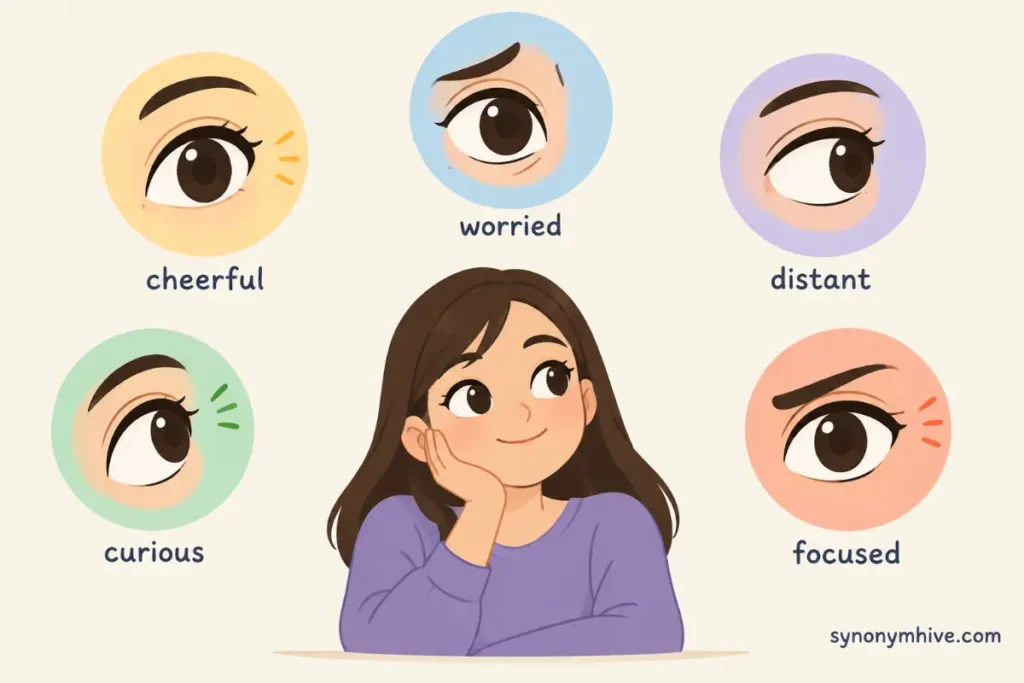
Eyes can appear cheerful, worried, distant, curious, or focused. Describing the expression helps readers understand the moment without explaining every feeling directly.
Still, an expression is an impression, not proof of what someone thinks. A person might look serious because they’re concentrating, not because they’re angry.
What Words Describe Happy Eyes?
Use these terms when someone’s eyes appear lively, welcoming, or full of joy.
| Word | Meaning | Example |
|---|---|---|
| Sparkling | Lively and bright | Her sparkling eyes showed how excited she was. |
| Twinkling | Bright with amusement or warmth | His eyes twinkled at the playful joke. |
| Bright | Alert, cheerful, or full of life | The child’s bright eyes followed the parade. |
| Joyful | Showing happiness | She looked at the birthday cake with joyful eyes. |
| Radiant | Seeming to glow with happiness or energy | His radiant expression made everyone smile. |
| Playful | Suggesting fun or teasing | She gave him a playful look across the table. |
| Animated | Full of visible movement or excitement | His animated eyes followed every part of the story. |
| Beaming | Showing great happiness | She was beaming as she watched her team win. |
Try this: Instead of writing, She looked happy, you could say, Her eyes sparkled as she opened the gift. The action gives the reader a clearer picture.
What Words Describe Sad or Worried Eyes?
These words can express sadness, concern, fear, or emotional strain. Choose the one that matches the scene rather than treating all negative feelings as the same.
- Tearful: Full of tears or close to crying.
- Red rimmed: Red around the edges, sometimes after crying.
- Downcast: Directed downward, often suggesting sadness or disappointment.
- Troubled: Appearing worried or upset.
- Haunted: Suggesting deep distress or painful memories.
- Weary: Showing tiredness or emotional exhaustion.
- Wistful: Expressing gentle sadness or longing.
- Anxious: Appearing uneasy or nervous.
- Pleading: Seeming to ask urgently for help or understanding.
- Distant: Appearing emotionally detached or lost in thought.
Example: He lowered his downcast eyes and folded the letter carefully. This sentence shows sadness through a visible action.
For a quieter emotion, Her wistful gaze lingered on the old photograph suggests longing without making the scene overly dramatic.
What Words Describe Confident or Intense Eyes?
When a character looks focused, determined, or direct, stronger terms may fit.
| Word | What It Suggests | Example |
|---|---|---|
| Focused | Attention directed at one thing | Her focused eyes followed the speaker. |
| Steady | Calm, consistent attention | He met the interviewer with a steady gaze. |
| Piercing | An intense look that seems to see through distractions | The teacher gave him a piercing look. |
| Intense | Strong concentration or emotion | Her intense eyes stayed on the finish line. |
| Determined | A firm sense of purpose | His determined gaze showed he wasn’t ready to quit. |
| Sharp | Quick, alert observation | The detective had sharp, observant eyes. |
| Watchful | Alert to what is happening | The nurse kept a watchful eye on the patient. |
| Unwavering | Not shifting or losing focus | She held an unwavering gaze during the speech. |
| Appraising | Looking closely to judge or assess something | The buyer gave the antique a careful, appraising look. |
| Commanding | Conveying authority or confidence | His commanding gaze quieted the room. |
Words like piercing, commanding, and appraising can make a character seem powerful or intimidating. Use them when the scene supports that impression.
What Words Describe Mysterious or Romantic Eyes?
Romantic and literary writing often uses language that suggests fascination, warmth, or emotional depth.
- Soulful: Seeming to express deep emotion.
- Mesmerizing: Fascinating enough to hold someone’s attention.
- Alluring: Attractive in a way that draws interest.
- Dreamy: Soft or unfocused, as if lost in thought.
- Smoldering: Suggesting restrained passion or intensity.
- Tender: Showing affection or care.
- Gentle: Soft and nonthreatening.
- Enigmatic: Difficult to understand or interpret.
- Mysterious: Creating a sense of uncertainty or curiosity.
- Languid: Slow, relaxed, or unhurried in appearance.
For example, She gave him a tender look before reaching for his hand sounds affectionate and natural. By contrast, His enigmatic gaze left the detective guessing creates mystery rather than romance.
Avoid piling several dramatic words into one sentence. Her soulful, mesmerizing, alluring, mysterious eyes feels crowded because every adjective competes for attention. One precise word and one concrete detail usually create a stronger image.
How Do You Choose Words by Intensity?
A description can sound gentle, neutral, or powerful depending on the word you choose. Think of intensity as a scale. Start with the simplest accurate term, then move toward stronger language only when you need it.
What Are Mild Words for Describing Eyes?
Mild words are useful for ordinary conversation, school assignments, straightforward reports, and descriptions that don’t need a dramatic tone.
Examples include:
- Clear.
- Soft.
- Calm.
- Gentle.
- Bright.
- Warm.
- Pale.
- Dark.
- Steady.
- Relaxed.
Example: She had clear blue eyes and a calm expression.
The description is easy to picture and doesn’t exaggerate what the speaker sees.
What Are Medium Strength Descriptions?
Medium strength words add more personality or visual detail while remaining natural.
Examples include:
- Expressive.
- Sparkling.
- Thoughtful.
- Lively.
- Intense.
- Watchful.
- Piercing.
- Soulful.
- Striking.
- Captivating.
Example: His expressive eyes showed a mix of excitement and concern.
These terms work well in personal essays, character descriptions, reviews, and stories where you want the reader to notice a particular quality.
What Are Strong or Dramatic Descriptions?
Strong words create a vivid impression. They’re useful in fiction, poetry, romance writing, and dramatic storytelling, but they can sound exaggerated in routine communication.
Examples include:
- Mesmerizing.
- Hypnotic.
- Smoldering.
- Piercing.
- Haunting.
- Enigmatic.
- Magnetic.
- Transfixing.
- Breathtaking.
- Unforgettable.
Example: The actor’s haunting gaze gave the final scene a sense of loss.
A dramatic word should earn its place. If a person simply has pleasant brown eyes, calling them hypnotic may distract readers. If the character holds someone’s attention throughout a tense scene, that stronger term may fit.
How Can You Move From Mild to Strong Language?
Use this scale as a guide, not a strict ranking. Different words describe different qualities, so intensity can depend on context.
| Mild | More Vivid | Strong or Dramatic |
|---|---|---|
| Bright | Sparkling | Mesmerizing |
| Clear | Striking | Breathtaking |
| Calm | Serene | Hypnotic |
| Focused | Piercing | Transfixing |
| Thoughtful | Soulful | Haunting |
| Attractive | Alluring | Magnetic |
| Serious | Intense | Commanding |
| Curious | Watchful | Penetrating |
Not every word in a row is a perfect synonym. For example, serene describes peacefulness, while hypnotic suggests fascination. The table shows how descriptions can become more vivid, not how to replace every word without changing the meaning.
Which Parts of Speech Can Describe Eyes?
Adjectives do most of the work, but nouns, verbs, and descriptive phrases can make your writing more varied. Using more than adjectives also helps you avoid repetitive descriptions.
Which Adjectives Work Best?
Adjectives describe qualities or features. They’re the most direct way to explain eye color, shape, appearance, or expression.
Examples include:
- Color: Blue, brown, green, gray, hazel, amber.
- Shape: Round, narrow, hooded, almond shaped, deep set.
- Light: Bright, luminous, sparkling, glossy.
- Emotion: Joyful, worried, tender, wistful, intense.
- Attention: Focused, watchful, perceptive, alert.
- Style: Striking, delicate, dramatic, distinctive.
Example: Her distinctive green eyes looked especially bright in the morning light.
Which Nouns Describe the Look in Someone’s Eyes?
Nouns can name the expression or action itself. They’re especially useful when you want to vary sentence structure.
| Noun | Meaning | Example |
|---|---|---|
| Gaze | The way someone looks at something or someone | His gaze shifted toward the open door. |
| Glance | A quick look | She stole a glance at the clock. |
| Stare | A long, fixed look | His stare made the room feel quiet. |
| Glimpse | A brief or partial view | I caught a glimpse of her bright eyes. |
| Expression | The look that reveals an apparent feeling | Her expression changed when she heard the news. |
| Wink | A brief closing of one eye, often as a signal | He gave his friend a quick wink. |
| Squint | A look made by partly closing the eyes | She gave the tiny print a squint. |
| Look | A general way of describing someone’s expression | He gave me a puzzled look. |
A noun often makes a sentence more natural than a string of adjectives. Instead of writing, He had intense, focused, serious eyes, you could write, He fixed his gaze on the speaker and listened without moving.
Which Verbs Help Describe Eye Movements?
Verbs show what the eyes do. They bring motion into a sentence and help readers imagine a scene as it unfolds.
- Gleam: Shine briefly or softly.
- Sparkle: Shine with small points of light or lively expression.
- Narrow: Become less open, often during concentration or suspicion.
- Widen: Open more fully, often with surprise.
- Flicker: Change quickly or briefly.
- Scan: Look across an area to find something.
- Follow: Move to keep looking at a person or object.
- Drift: Move slowly without a fixed focus.
- Lower: Turn downward.
- Meet: Look directly at another person’s eyes.
- Glaze over: Become dull or unfocused.
- Well up: Begin to fill with tears.
For example, Her eyes widened when the door opened communicates surprise through movement. His gaze drifted toward the window suggests that his attention moved away from the conversation.
What Phrases Describe Eyes More Naturally Than Single Words?
Sometimes a short phrase is more accurate than a single adjective. These combinations can also help you avoid repeating the same terms.
- Eyes bright with excitement.
- A steady, thoughtful gaze.
- A soft look of recognition.
- Eyes clouded by worry.
- A quick, curious glance.
- A faraway look.
- Eyes full of wonder.
- A direct and confident gaze.
- A tired look around the eyes.
- A hint of laughter in her eyes.
- Eyes that softened with affection.
- A sharp look of surprise.
Example: A hint of laughter in her eyes made the teasing remark feel kind rather than cruel.
These phrases work because they connect appearance to an action, emotion, or situation. They also let you describe a moment instead of treating someone’s eyes as a fixed feature.
Explore another synonym guide: Words to Describe Summer Ultimate Word List.
Which Words Should You Use in Different Situations?
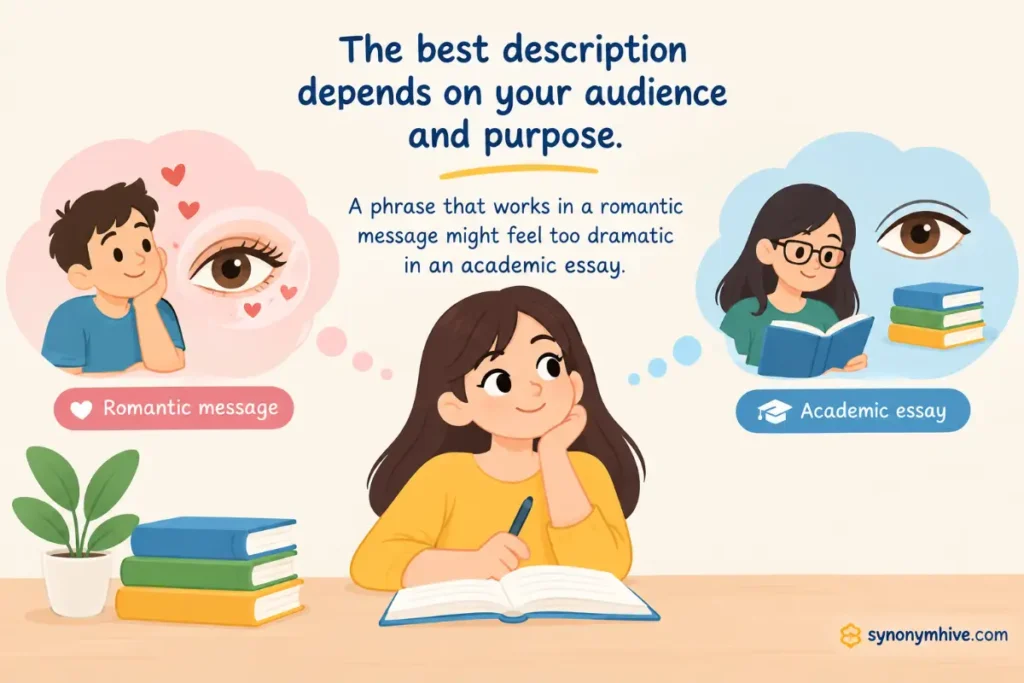
The best description depends on your audience and purpose. A phrase that works in a romantic message might feel too dramatic in an academic essay. Likewise, a clinical term that belongs in a medical description may sound awkward in everyday conversation.
What Words to Describe Eyes Work Best in a Resume?
A resume rarely needs detailed descriptions of someone’s eyes. However, if you’re writing a character reference, personal profile, acting portfolio, or professional biography, you may need to describe someone’s expression or presence.
Choose neutral words that communicate observable qualities.
Useful options include attentive, alert, focused, observant, composed, and expressive.
For example, you might write, She maintained an attentive expression throughout the client presentation. This sentence sounds professional and focuses on visible behavior.
Avoid phrases such as beautiful eyes or seductive gaze in a standard resume. They don’t communicate job related skills and can make the writing feel unprofessional.
If your resume needs to highlight your own strengths, describe your actions rather than your appearance. I pay close attention to detail and notice inconsistencies in written reports gives an employer more useful information than a comment about your eyes.
What Words Work Best in an Essay?
School essays and personal narratives benefit from precise, clear descriptions. Choose terms that support the point you’re making instead of adding adjectives just to make a sentence longer.
For descriptive writing, consider luminous, thoughtful, downcast, piercing, wistful, and steady. For formal analysis, direct gaze, facial expression, and visual focus may be more suitable.
For example, The character’s downcast eyes suggest disappointment after the argument. This sentence connects a visible detail to the scene.
If you’re analyzing a photograph, you might write, The subject’s steady gaze draws attention to the viewer’s relationship with the portrait. That description focuses on the image and its effect.
In an academic essay, avoid assuming that a person’s eye color reveals their intelligence, honesty, or character. Explain what you can observe and support interpretations with evidence from the text or image.
What Words Work Best in Texting?
Texts usually sound better when they’re short, relaxed, and sincere. You don’t need formal vocabulary to give someone a thoughtful compliment.
Useful words include pretty, bright, sparkling, warm, expressive, and beautiful. For a more personal message, describe a specific detail instead of sending a generic compliment.
For example, try these messages.
- Your eyes look so bright in that picture.
- I love how your eyes light up when you talk about something you enjoy.
- You have such warm and expressive eyes.
- Your smile makes your eyes sparkle.
- Your eyes are one of my favorite things about your face.
Keep the tone appropriate to your relationship. A friendly compliment can feel warm without sounding romantic, and a romantic message usually feels more genuine when it reflects something you’ve actually noticed.
What Words Work Best in an Email?
Most emails don’t need elaborate descriptions of someone’s eyes. If you’re writing a personal email, a note of appreciation, or a message about a photograph, choose natural language that fits the relationship.
Words such as bright, warm, kind, and expressive work in casual correspondence. In a professional email, focus on the person’s expression only when it’s relevant to the message.
For example, The portrait captures your warm expression beautifully is friendly and respectful.
If you’re discussing a photograph with a colleague, you could write, The lighting brings out the gray tones in the subject’s eyes. This sentence is specific and avoids unnecessary praise.
Don’t add comments about someone’s appearance to a business email unless the context makes them appropriate. A clear, relevant message is usually the best choice.
What Words Work Best When Speaking?
Spoken descriptions should feel natural and easy to understand. Words such as bright, kind, tired, curious, and focused work well because people recognize them quickly.
Imagine describing a person you saw at a gathering. You could say, She had bright green eyes and a really friendly expression. That sounds more natural than a string of elaborate terms.
For a story, you might say, He gave me a piercing look, then glanced away. The verb and adjective together help listeners picture the moment.
When speaking, consider your audience. A friend may appreciate a casual compliment, while a presentation may call for more neutral language. Use the simplest word that expresses what you mean.
What Are Some Original Examples of Eye Descriptions?
Examples help you see how descriptive words work in complete sentences. The following sentences cover everyday conversations, stories, schoolwork, photography, and personal messages.
What Are Some Examples for Everyday Situations?
- Her bright eyes reflected the morning sunlight.
- His tired eyes gave away how late he’d stayed up.
- The child’s curious eyes moved from one toy to the next.
- She greeted the new student with a warm, welcoming look.
- His steady gaze showed that he was paying close attention.
- Her hazel eyes appeared greener beneath the trees.
- The puppy looked up with wide, trusting eyes.
- His eyes narrowed as he tried to read the distant sign.
- She glanced at the clock with an anxious expression.
- A playful sparkle appeared in his eyes when he heard the joke.
Each example focuses on one clear detail. Some describe appearance, while others use eye movements to show what a person is doing or feeling.
What Are Some Examples for Creative Writing?
- Her silver gray eyes reflected the storm gathering beyond the window.
- He watched the empty road with a distant, thoughtful gaze.
- The detective’s sharp eyes moved over the room, searching for a clue.
- A wistful look softened her face as she opened the old letter.
- His deep brown eyes held a quiet intensity that made the room fall silent.
- The little girl’s sparkling eyes followed every movement of the puppet.
- She met his gaze with an unwavering expression.
- His normally lively eyes looked dull after the long journey.
- Beneath the soft lamplight, her green eyes seemed almost golden.
- The stranger’s enigmatic gaze left the entire room guessing.
Notice how these examples combine a descriptive word with a setting, action, or emotional cue. That extra detail gives the reader a reason to picture the eyes in a particular way.
What Are Some Examples for Romantic Messages?
- Your warm eyes make even an ordinary day feel special.
- I love the way your eyes sparkle when you laugh.
- Your gaze always makes me feel heard.
- There’s something gentle and comforting about your eyes.
- Your eyes have a way of holding my attention.
- I could spend hours listening to you and watching your expressions change.
- Your smile reaches your eyes, and that’s what I love most.
- Your eyes look beautiful in the golden evening light.
A romantic description feels strongest when it reflects a real detail. Instead of using several dramatic adjectives, mention a smile, a shared moment, or a quality you genuinely appreciate.
What Are Some Examples for Describing Photographs?
- The portrait captures the subject’s luminous blue eyes against a muted background.
- Soft window light reveals subtle golden flecks in her hazel eyes.
- The close up highlights his long eyelashes and deep set eyes.
- The photographer used a direct gaze to create a sense of connection.
- Her bright eyes contrast with the dark tones in the photograph.
- The image captures a fleeting expression of surprise.
- The subject’s calm gaze gives the portrait a peaceful mood.
- A slight squint adds character to the outdoor photograph.
For photography, describe visible features and the effect of light. Terms such as contrast, shadow, highlight, and focus may be more useful than emotional adjectives when you’re explaining the image itself.
What Are Some Examples for School Assignments?
- The character’s downcast eyes suggest that she feels disappointed.
- His piercing gaze creates tension during the confrontation.
- The narrator notices the old man’s pale blue eyes.
- The portrait emphasizes the contrast between dark hair and bright green eyes.
- Her watchful expression hints that she expects something to happen.
- The writer uses a steady gaze to suggest determination.
- The character’s tearful eyes reveal the emotional weight of the farewell.
- The description of her thoughtful eyes supports the reflective tone of the passage.
When you analyze literature, explain why a description matters. Don’t stop at identifying an adjective. Connect it to the character’s actions, the atmosphere, or the larger theme.
What Is the Difference Between Similar Eye Descriptions?
Some terms look alike but communicate different ideas. Learning these distinctions helps you select the right expression instead of relying on whichever word sounds most impressive.
Bright Eyes vs Sparkling Eyes
| Bright Eyes | Sparkling Eyes |
|---|---|
| Suggest clear light, alertness, or liveliness. | Suggest small flashes of light, excitement, or amusement. |
| Can describe appearance or energy. | Often carries a lively or cheerful tone. |
| Example: His bright eyes looked alert after the nap. | Example: Her eyes sparkled when she heard the surprise announcement. |
Use bright for a general sense of light or alertness. Choose sparkling when you want to suggest movement, excitement, or visible liveliness.
Piercing Eyes vs Intense Eyes
| Piercing Eyes | Intense Eyes |
|---|---|
| Suggest a look that feels sharp, direct, or penetrating. | Suggest strong concentration or emotion. |
| Often feels more confrontational. | Can describe concentration, passion, anger, or determination. |
| Example: The judge gave him a piercing look. | Example: The athlete’s intense gaze stayed on the finish line. |
A piercing look can feel as if someone is examining you closely. An intense look simply communicates a strong focus or feeling. The second term is broader.
Soulful Eyes vs Sad Eyes
| Soulful Eyes | Sad Eyes |
|---|---|
| Suggest emotional depth or a moving expression. | Directly suggest sadness. |
| Can sound warm, poetic, or admiring. | Usually communicates a specific negative emotion. |
| Example: The singer’s soulful eyes matched the emotion in the song. | Example: Her sad eyes showed how much she missed her friend. |
Soulful doesn’t automatically mean sad. It can describe an expression that seems thoughtful, moving, or emotionally rich. Use sad when sadness is the main impression.
Alluring Eyes vs Mesmerizing Eyes
| Alluring Eyes | Mesmerizing Eyes |
|---|---|
| Suggest attraction or appeal. | Suggest fascination that holds someone’s attention. |
| Often carries a romantic or sensual tone. | Can be romantic, dramatic, artistic, or mysterious. |
| Example: Her alluring gaze caught his attention. | Example: The dancer’s mesmerizing eyes held the audience’s focus. |
An alluring look attracts interest. A mesmerizing look seems to keep that interest. Neither word is necessary for an ordinary compliment, so use them when the stronger meaning fits.
Are There Regional Differences in Eye Descriptions?
Most common English words for eyes are understood across the United States, the United Kingdom, Canada, and Australia. Words such as blue, brown, hazel, bright, tired, and expressive work in all these varieties of English.
Differences are more likely to appear in spelling, idiom, tone, and everyday preference than in the basic meaning of a color or shape.
What Is Different in American and British English?
| Meaning | Common American English | Common British English | Note |
|---|---|---|---|
| Gray eye color | Gray | Grey | Both forms are understood in both regions, but gray is standard American spelling. |
| Describing eye color | Blue eyes, green eyes | Blue eyes, green eyes | These expressions are common in both varieties. |
| A quick look | Glance | Glance | No major regional difference. |
| A fixed look | Stare | Stare | The meaning is broadly shared. |
| A playful wink | Wink | Wink | Common in both varieties. |
| Eyes showing tiredness | Tired eyes | Tired eyes | Both expressions sound natural. |
For a US audience, use gray unless you’re following a publication’s style guide or quoting a source that uses grey.
Are Any Eye Expressions More Informal or Regional?
Some expressions depend more on context than geography.
Googly eyes often describes eyes that look exaggerated, crossed, or comically wide. It can also refer to the decorative craft eyes used on toys.
Bedroom eyes is an informal phrase for a relaxed, seductive expression. It carries a romantic or sexual suggestion, so it isn’t appropriate for every situation.
Eagle eyed describes someone who notices small details. Keep an eye out means to watch for something. Both expressions are common in American and British English.
Regional slang changes over time, so don’t assume an unusual phrase will be understood by every reader. If your audience is broad, a clear everyday term is usually the safer choice.
What Common Mistakes Should You Avoid?
Even a strong vocabulary can make writing less effective if you use words inaccurately or add too many details. Clear descriptions depend on meaning, context, and restraint.
Are You Using a Word That Doesn’t Match the Meaning?
A common mistake is choosing an attractive sounding word without checking what it means.
For example, luminous suggests light or a glowing appearance. It isn’t a direct synonym for kind. Similarly, alluring suggests attraction, while perceptive suggests the ability to notice or understand details.
Before choosing a word, ask yourself what you want the reader to notice.
- For color, choose amber, hazel, emerald, or slate gray.
- For shape, choose round, almond shaped, hooded, or deep set.
- For expression, choose joyful, worried, thoughtful, or wistful.
- For attention, choose focused, watchful, piercing, or steady.
- For attraction, choose alluring, striking, or captivating when appropriate.
This simple check can prevent a description from sounding impressive but inaccurate.
Are You Using Too Many Adjectives?
Too many adjectives can make a sentence feel forced.
Weak example: She had beautiful, sparkling, luminous, captivating, mesmerizing green eyes.
Stronger example: Her green eyes sparkled when she laughed.
The stronger sentence gives the reader one clear image and connects it to an action. It also sounds more natural.
Try choosing one main descriptor and adding a second detail only when it improves the picture. You can always add more information in a later sentence.
Are You Making Assumptions About Personality?
Eye color and shape don’t reliably reveal a person’s character. Calling someone honest because they have blue eyes or dangerous because they have narrow eyes turns an appearance into an unsupported judgment.
You can describe how an expression seems without presenting that impression as a fact.
For example, His steady gaze made him seem confident during the interview is more careful than His eyes proved he was confident.
The first sentence explains an impression in a particular setting. The second makes a claim the appearance alone can’t support.
Are You Using Romantic Language in the Wrong Setting?
Words such as seductive, smoldering, and alluring can sound romantic or sexual. They may suit a love story or a personal message, but they can feel intrusive in a workplace, school assignment, or formal description.
For a neutral tone, choose expressive, bright, steady, or attentive. If you’re unsure how a compliment will be received, keep it simple and respectful.
Are You Confusing Eye Shape With Eye Expression?
Shape and expression are different things.
Almond shaped describes the physical outline of the eyes. Thoughtful describes an impression created by someone’s expression. A person can have almond shaped eyes that look joyful, serious, tired, or curious.
Keeping these categories separate makes descriptions more precise. It also helps you avoid using an emotional adjective when you mean a physical feature.
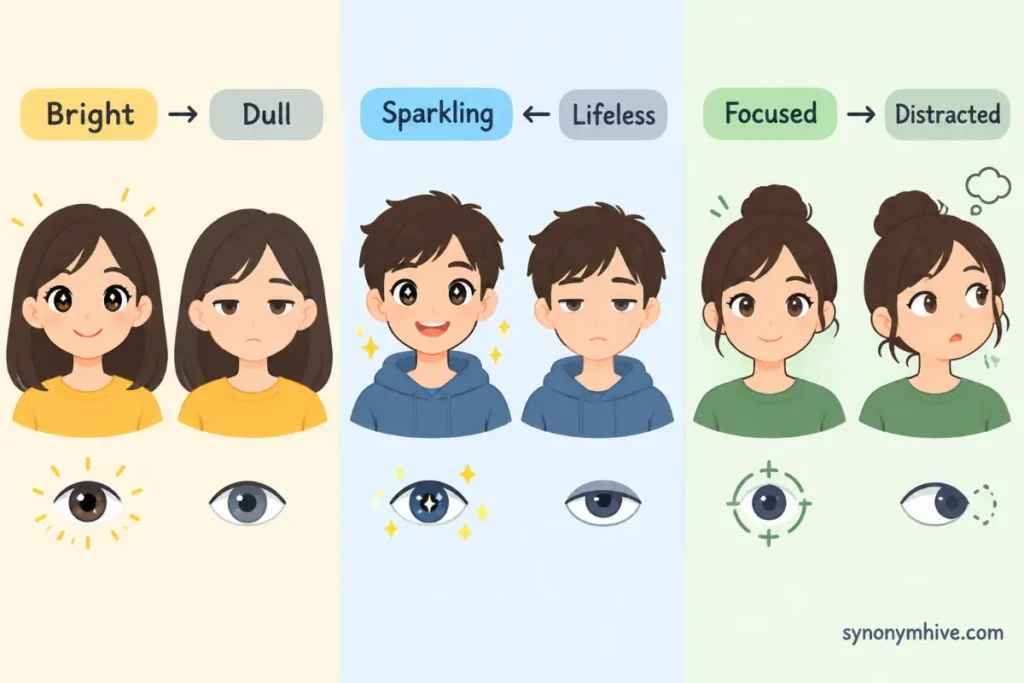
What Are the Antonyms of Eye Description Words?
Antonyms can help you create contrast or explain a change in appearance. Not every descriptive word has one exact opposite, so choose the alternative that fits the meaning.
| Word | Possible Opposite | Example |
|---|---|---|
| Bright | Dull | Her eyes looked bright in the morning and dull after a long day. |
| Sparkling | Lifeless | His sparkling expression faded into a lifeless stare. |
| Focused | Distracted | She went from a focused gaze to a distracted glance. |
| Wide | Narrow | His eyes narrowed after being wide with surprise. |
| Open | Closed | The photograph captured one eye open and the other closed. |
| Calm | Agitated | His calm gaze changed to an agitated look. |
| Alert | Drowsy | Her alert expression gave way to a drowsy look. |
| Joyful | Sad | His joyful eyes became sad when he heard the news. |
| Warm | Cold | Her warm expression turned cold during the argument. |
| Clear | Cloudy | The description shifted from clear eyes to a cloudy appearance. |
Some pairs express a change in mood rather than strict dictionary opposites. For example, warm and cold can describe the impression created by a gaze, not a physical temperature.
How Can You Choose the Right Description Quickly?
When you need a word in the middle of writing, use a simple process. It helps you find a precise term without searching through a long list every time.
- Identify the feature. Decide if you’re describing color, shape, light, expression, or movement.
- Choose a familiar word. Start with a clear term such as brown, round, bright, or thoughtful.
- Add a specific detail. Use a shade, action, or setting to make the description more vivid.
- Match the tone. Keep the language casual for texting, neutral for professional writing, and expressive for creative work.
- Check the meaning. Make sure the word communicates what you intend.
- Remove extra adjectives. If two words express the same idea, keep the stronger one.
For instance, if you’re describing someone in a story, you might begin with He had brown eyes. Then ask what makes the moment distinctive. Perhaps the light reveals gold flecks, or his gaze changes when he recognizes someone. The final sentence could be, Gold flecks appeared in his brown eyes when he turned toward the window.
That description gives the reader more information without adding unnecessary length.
Explore more word choices in words to describe a sunset Best Guide.
Conclusion
The most effective words to describe eyes are the ones that match the detail you want readers to notice. Start with the basics, such as color and shape, then add a word about light, expression, or movement when it helps the picture feel complete.
For everyday writing, simple terms like bright, warm, clear, and thoughtful often work best. For stories and poetry, more vivid choices such as piercing, luminous, wistful, and mesmerizing can create a stronger mood. The key is to use each word accurately and avoid stacking too many adjectives into one sentence.
Pay attention to context, too. A romantic message, a school essay, and a professional description call for different tones. With a little practice, you’ll find the right language more quickly and write descriptions that feel natural, specific, and memorable.
Frequently Asked Questions
What Are Some Good Terms to Describe Eyes?
Good choices include bright, expressive, sparkling, piercing, gentle, luminous, thoughtful, and mesmerizing. Choose a word based on the eyes’ appearance or the expression you want to convey.
What’s Another Way to Say Someone Has Beautiful Eyes?
You can say someone has striking, captivating, radiant, expressive, or lovely eyes. For a more personal compliment, describe a detail you genuinely notice, such as the way their eyes sparkle when they smile.
What Are the Best Synonyms to Describe Eyes in Creative Writing?
The best choices depend on the scene. Try piercing for an intense gaze, wistful for gentle longing, luminous for a glowing appearance, and enigmatic for a mysterious expression.
How Do I Describe Eye Color Without Saying Blue or Brown?
Use more specific shade names, such as ice blue, steel blue, chestnut brown, honey brown, emerald green, silver gray, or golden amber. You can also describe mixed colors, such as green eyes with brown flecks.
What Is the Difference Between Almond Shaped and Hooded Eyes?
Almond shaped eyes have an oval outline with tapered corners. Hooded eyes have upper eyelid skin that partly covers the crease, so the two terms describe different physical features.
What Expression Describe Eyes That Show Emotion?
Words such as joyful, tearful, wistful, worried, tender, playful, and intense can describe an emotional expression. Use them to explain how someone’s eyes appear in a particular moment, rather than treating the expression as proof of their feelings.
How Can I Describe Eyes in One Sentence?
Mention one clear feature and connect it to a detail or action. For example, Her hazel eyes sparkled as she laughed, or His steady gray gaze stayed on the speaker throughout the meeting.