
Have you ever written an essay, email, report, or resume and noticed you kept using the word analyze? Using the same word again and again can make your writing feel repetitive. Learning synonyms for analyze helps you express your ideas more clearly and choose words that better match the situation.
alternatives for analyze include examine, study, evaluate, assess, inspect, investigate, review, explore, interpret, and break down. Each one has a slightly different meaning, so choosing the right word makes your writing more accurate.
The best phrases for analyze are examine, evaluate, assess, study, investigate, inspect, review, interpret, explore, and break down. The right choice depends on what you’re analyzing and why. This guide explains the meaning and origin of the word, shares more than 30 alternatives, compares similar words, and shows practical examples you can use in school, work, and everyday writing.
Looking for another word? See Synonyms For Stated Ultimate Guide: Word Finder 2026.
What Does Analyze Mean
To analyze means to study something carefully so you can understand it better. People analyze data, books, reports, problems, behavior, experiments, and even sports games. The goal is to look closely at the details before reaching a conclusion. Here are a few examples.
- Scientists analyze test results.
- Students analyze poems in English class.
- The manager analyzed sales data before making a decision.
- Detectives analyze evidence during an investigation.
In simple words, analyze means looking at something carefully to understand how it works or what it means.
Word Origin And Plain English Meaning
The word analyze comes from the Greek word analysis, which means to break apart or to loosen. The idea is simple. You separate something into smaller parts so it’s easier to understand. Over time, the word became common in science, education, business, medicine, and everyday conversations.
In plain English, analyze means:
- Study something carefully.
- Look closely at the details.
- Break something into smaller parts.
- Understand how something works.
- Reach a conclusion after careful thinking.
Think about solving a puzzle. You don’t solve it by staring at the whole picture. You look at one piece at a time until everything fits together. That’s what it means to analyze something.
Synonyms For Analyze Master Word List
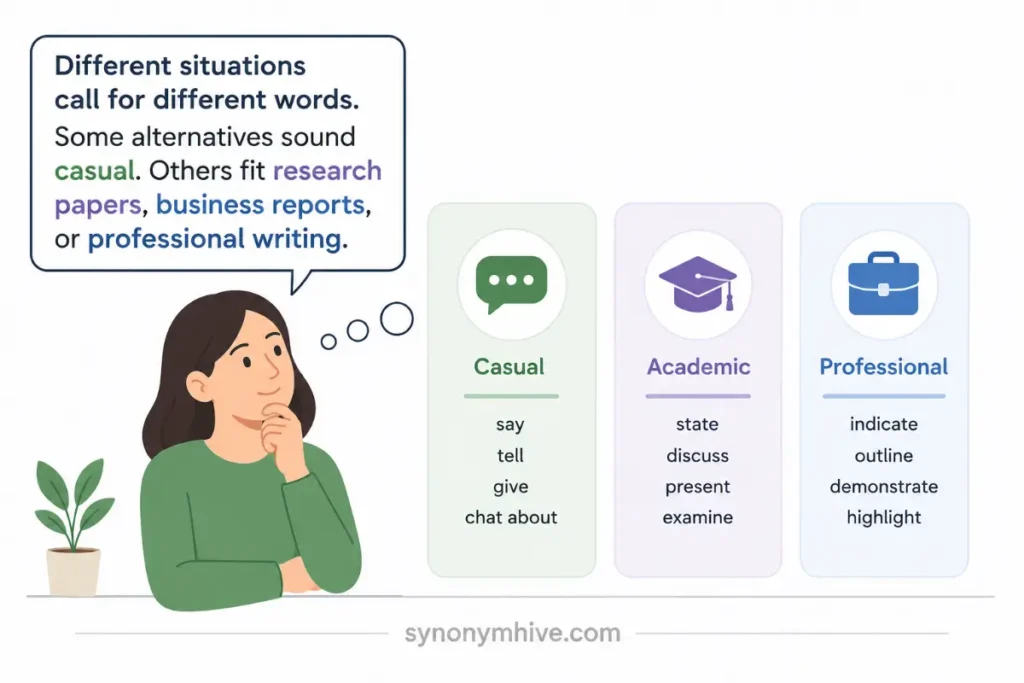
Different situations call for different words. Some alternatives sound casual. Others fit research papers, business reports, or professional writing.
Simple Synonyms
| Word | Meaning | Tone | Example |
|---|---|---|---|
| Study | Learn carefully. | Simple | Study the chart before answering. |
| Look At | Examine something. | Simple | Let’s look at the numbers again. |
| Check | Review quickly. | Simple | Check your work before submitting it. |
| Review | Read or inspect again. | Simple | Review the report carefully. |
| Explore | Learn more about something. | Simple | Explore different solutions. |
| Think About | Consider carefully. | Simple | Think about the problem first. |
| Break Down | Divide into smaller parts. | Simple | Break down the process step by step. |
| Understand | Learn the meaning. | Simple | Try to understand the results. |
Everyday Synonyms
| Word | Meaning | Tone | Example |
|---|---|---|---|
| Examine | Look closely. | Everyday | Examine the evidence carefully. |
| Assess | Judge carefully. | Everyday | Assess the situation before acting. |
| Evaluate | Measure value or quality. | Everyday | Evaluate your progress each month. |
| Inspect | Look for problems. | Everyday | Inspect the equipment daily. |
| Investigate | Search for facts. | Everyday | Police investigate accidents. |
| Compare | Find similarities and differences. | Everyday | Compare the two reports. |
| Interpret | Explain the meaning. | Everyday | Interpret the survey results. |
| Observe | Watch carefully. | Everyday | Observe how the machine works. |
Formal Synonyms
| Word | Meaning | Tone | Example |
|---|---|---|---|
| Examine Thoroughly | Study in detail. | Formal | Researchers examined the samples thoroughly. |
| Assess Critically | Judge with careful thought. | Formal | Experts assessed the proposal critically. |
| Scrutinize | Examine very closely. | Formal | Auditors scrutinized the financial records. |
| Appraise | Evaluate carefully. | Formal | The consultant appraised the risks. |
| Diagnose | Find the cause of a problem. | Formal | Doctors diagnose illnesses through testing. |
| Audit | Review systematically. | Formal | The company audited its finances. |
| Evaluate Objectively | Judge without bias. | Formal | The panel evaluated the applications objectively. |
| Research | Gather and study information. | Formal | Students researched the topic for weeks. |
Casual Synonyms
| Word | Meaning | Tone | Example |
|---|---|---|---|
| Figure Out | Find the answer. | Casual | Let’s figure out what happened. |
| Dig Into | Investigate deeply. | Casual | I’ll dig into the issue tomorrow. |
| Look Over | Read quickly. | Casual | Can you look over my essay? |
| Go Through | Review carefully. | Casual | Go through the checklist again. |
| Pick Apart | Examine every detail. | Casual | Critics picked apart the movie. |
| Size Up | Judge quickly. | Casual | She sized up the competition. |
| Check Out | Examine informally. | Casual | Check out these results. |
| Take A Close Look | Examine carefully. | Casual | Take a close look at this graph. |
Building a larger vocabulary helps you write naturally without repeating the same word in every paragraph.
Synonyms By Intensity
Some situations only require a quick review. Others demand careful investigation.
Mild Analysis
These words work well in everyday conversations.
| Word | Best Use |
|---|---|
| Look At | Casual discussions. |
| Check | Daily tasks. |
| Review | General reading. |
| Think About | Personal decisions. |
| Explore | Learning new ideas. |
Moderate Analysis
These words fit school and workplace writing.
| Word | Best Use |
|---|---|
| Analyze | General writing. |
| Examine | Essays and reports. |
| Evaluate | Performance reviews. |
| Assess | Business decisions. |
| Compare | Assignments and research. |
Strong Analysis
These words describe detailed or professional investigation.
| Word | Best Use |
|---|---|
| Investigate | Police and research. |
| Scrutinize | Legal and financial work. |
| Audit | Business and accounting. |
| Diagnose | Medical situations. |
| Research | Academic studies. |
Choosing the right level of intensity helps your writing sound precise instead of exaggerated.
Synonyms By Part Of Speech
The word analyze is a verb, but related words appear in several forms.
Verbs
| Word | Example |
|---|---|
| Analyze | Analyze the survey results. |
| Examine | Examine the evidence carefully. |
| Evaluate | Evaluate each option fairly. |
| Assess | Assess the risks before investing. |
| Review | Review your notes before the test. |
| Investigate | Detectives investigate every clue. |
| Compare | Compare the two products. |
Nouns
| Word | Example |
|---|---|
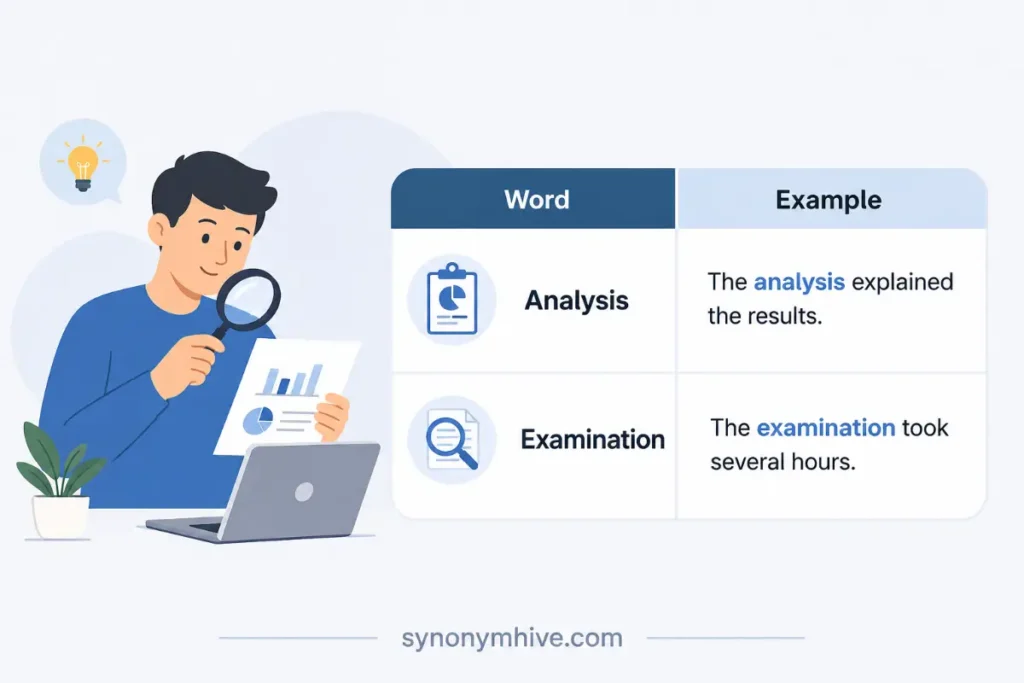
| Analysis | The analysis explained the results. |
| Examination | The examination took several hours. |
| Evaluation | The evaluation showed strong performance. |
| Assessment | The assessment helped identify strengths. |
| Review | The review was positive. |
| Investigation | The investigation continued for weeks. |
Adjectives
| Word | Example |
|---|---|
| Analytical | She has an analytical mind. |
| Detailed | The report was detailed. |
| Objective | Objective thinking improves decisions. |
| Careful | A careful review found the mistake. |
| Thorough | They completed a thorough inspection. |
| Critical | Critical thinking solves problems. |
Using different word forms makes your writing smoother and helps you avoid repeating the same verb.
Do Americans And British People Use Different Words
Most synonyms for analyze are common in both American English and British English. The biggest difference is spelling. American English uses analyze, while British English uses analyse.Most related words, including examine, evaluate, assess, review, inspect, and investigate, have the same spelling and meaning in both countries.
| Word Or Phrase | More Common In | Notes |
|---|---|---|
| Analyze | United States | Standard American spelling. |
| Analyse | United Kingdom | Standard British spelling. |
| Examine | International | Common in every type of writing. |
| Evaluate | International | Popular in education and business. |
| Investigate | International | Frequently used in news and research. |
If you’re writing for an American audience, analyze, examine, evaluate, review, and assess are the most natural choices.
Which Synonym Should You Use
The best synonym depends on what you’re writing and who will read it. A research paper needs formal language. A text message sounds better with simple words. Picking the right word makes your writing feel natural and easy to understand.
Best Word For A Resume
A resume should show your skills with clear action verbs.
| Best Word | Why It Works | Example |
|---|---|---|
| Analyze | Direct and professional. | I analyzed sales data to improve forecasting. |
| Evaluate | Shows judgment. | I evaluated project performance every quarter. |
| Assess | Demonstrates decision making. | I assessed business risks before launch. |
| Review | Shows attention to detail. | I reviewed contracts for accuracy. |
| Investigate | Highlights problem solving. | I investigated customer complaints to improve service. |
These verbs make your achievements sound stronger than simply saying you looked at something.
Best Word For An Essay
School essays often need clear and accurate language.
| Best Word | Best Use | Example |
|---|---|---|
| Analyze | Literature and research. | Students analyze themes in the novel. |
| Examine | General academic writing. | The article examines social change. |
| Evaluate | Opinions and arguments. | Evaluate the author’s main claim. |
| Compare | Similarities and differences. | Compare both historical events. |
| Interpret | Meaning and symbolism. | Interpret the poem’s message. |
Choose the word that matches your assignment instead of using the same verb every time.
Best Word For A Text Message
Casual conversations usually sound better with simple language.
| Best Word | Example |
|---|---|
| Look At | Let’s look at it together. |
| Check | Check these numbers. |
| Figure Out | We’ll figure it out. |
| Go Through | Go through the list first. |
| Look Over | Can you look over my email? |
Simple words make conversations feel friendly and natural.
Best Word For An Email
Professional emails should be clear without sounding too formal.
| Situation | Best Word | Example |
|---|---|---|
| Business | Review | Please review the attached report. |
| Management | Evaluate | We’ll evaluate the proposal tomorrow. |
| Customer Service | Assess | We’ll assess your request today. |
| School | Analyze | Please analyze the case study before class. |
| Team Communication | Examine | Let’s examine the latest results together. |
These words sound professional while remaining easy to understand.
Best Word For Speaking
Short and familiar words are often the easiest for listeners to follow.
| Word | Example |
|---|---|
| Look At | Let’s look at the facts. |
| Review | We’ll review today’s progress. |
| Examine | Let’s examine the problem carefully. |
| Check | Check your answers again. |
| Analyze | We need to analyze the results first. |
Clear language keeps people engaged.
Looking for another word? See Synonyms For Assist: Help Boosters 2026.
Original Example Sentences
These examples show different ways to use analyze and related words.
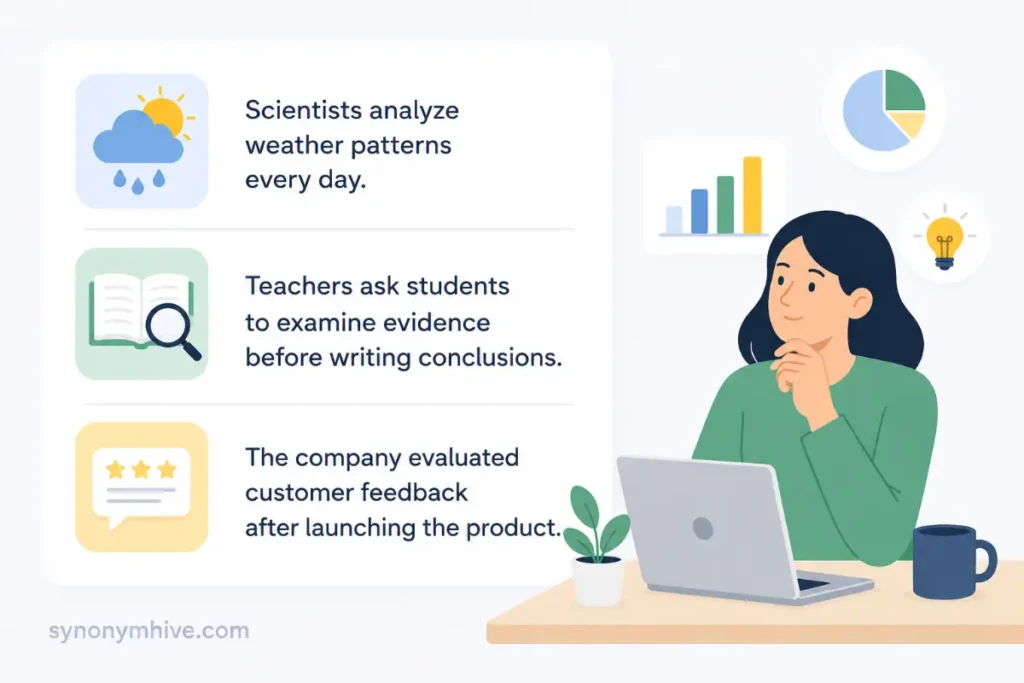
- Scientists analyze weather patterns every day.
- Teachers ask students to examine evidence before writing conclusions.
- The company evaluated customer feedback after launching the product.
- Doctors assess symptoms before recommending treatment.
- Police investigated the cause of the accident.
- I reviewed my presentation before the meeting.
- Engineers inspected the bridge for safety concerns.
- We compared several options before making a decision.
- The coach analyzed the team’s performance after every game.
- Researchers interpreted the survey results carefully.
- Let’s figure out why the computer stopped working.
- Auditors scrutinized the financial records before approving the report.
Analyze Vs Examine
These words are closely related, but they are not identical.
| Analyze | Examine |
|---|---|
| Looks for meaning and conclusions. | Looks closely at details. |
| Often includes interpretation. | Focuses on careful observation. |
| Common in research and education. | Common in both formal and everyday writing. |
Examples.
Correct.
Scientists analyzed the test results.
Correct.
The mechanic examined the engine.
If you’re trying to explain what something means, analyze is usually the better choice.
Analyze Vs Evaluate
People often confuse these words because both require careful thinking.
| Analyze | Evaluate |
|---|---|
| Understand how something works. | Judge quality or value. |
| Focuses on explanation. | Focuses on judgment. |
| Often comes before evaluation. | Usually follows analysis. |
Examples.
The students analyzed the novel.
The teacher evaluated their essays.
You usually analyze something before deciding how good or effective it is.
Analyze Vs Investigate
These verbs overlap, but they serve different purposes.
| Analyze | Investigate |
|---|---|
| Studies information carefully. | Searches for facts or causes. |
| Focuses on understanding. | Focuses on discovering. |
| Often uses existing information. | Often gathers new evidence. |
Examples.
Researchers analyzed the collected data.
Detectives investigated the crime scene.
Investigation often comes before analysis.
Common Mistakes People Make
Many writers misuse analyze because they assume every careful action counts as analysis. Avoid these common mistakes.
- Using analyze when you only mean look at.
- Repeating analyze several times in one paragraph.
- Confusing evaluate with analyze.
- Using investigate when no evidence is being gathered.
- Choosing formal words in casual conversations.
Simple and accurate wording almost always sounds stronger than complicated vocabulary.
When Not To Use Certain Words
Some alternatives only work in specific situations.
- Don’t use scrutinize in everyday conversations unless you truly mean extremely close examination.
- Don’t use diagnose unless you’re identifying the cause of a problem, especially in medicine or technical fields.
- Don’t replace review with analyze if you’re only checking something quickly.
- Don’t use audit unless you’re talking about finances, systems, or official inspections.
- Don’t use investigate unless you’re actively searching for facts or evidence.
Choosing the right word makes your writing more precise and easier to understand.
Antonyms And Opposite Words
Understanding opposite words helps you understand analyze even better. While analyzing means looking at something carefully to understand it, these words describe the opposite idea.
| Word | Meaning | Example |
|---|---|---|
| Ignore | Pay no attention to. | Don’t ignore customer feedback. |
| Overlook | Miss or fail to notice. | She overlooked an important detail. |
| Guess | Decide without enough facts. | Don’t guess the answer. |
| Assume | Accept something without proof. | Never assume the results are correct. |
| Neglect | Fail to give proper attention. | He neglected the warning signs. |
| Dismiss | Reject without careful thought. | The manager dismissed the idea too quickly. |
| Skip | Leave something out. | Don’t skip the final review. |
| Misunderstand | Interpret something incorrectly. | They misunderstood the instructions. |
These words remind you that good decisions usually come from careful thinking instead of quick assumptions.
Quick Tips For Choosing The Right Word
Choosing the right synonym is easier when you know your goal.
- Use analyze when explaining how something works or what it means.
- Use examine when looking closely at details.
- Use evaluate when judging quality or performance.
- Use assess when measuring risks, strengths, or progress.
- Use review when checking work before making changes.
- Use investigate when searching for facts or evidence.
- Use interpret when explaining meaning.
- Use compare when discussing similarities and differences.
The best word depends on what you’re trying to communicate, not on finding the fanciest vocabulary.
Quick Reference Table
This table gives you a fast answer when you need a replacement.
| If You Mean | Best Word |
|---|---|
| Study carefully | Analyze |
| Look closely | Examine |
| Judge quality | Evaluate |
| Measure performance | Assess |
| Check work | Review |
| Search for facts | Investigate |
| Explain meaning | Interpret |
| Find similarities | Compare |
| Watch carefully | Observe |
| Divide into parts | Break Down |
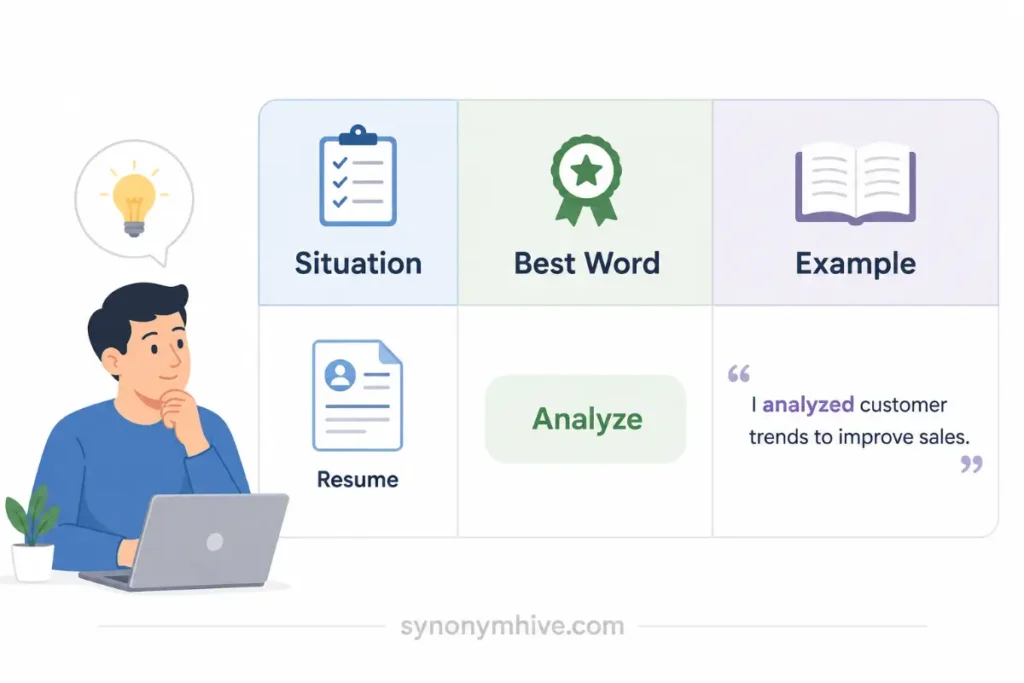
Everyday Situations And The Best Choice
Different situations call for different words.
| Situation | Best Word | Example |
|---|---|---|
| Resume | Analyze | I analyzed customer trends to improve sales. |
| Essay | Examine | The essay examines the causes of climate change. |
| Business Email | Review | Please review the attached proposal. |
| School Project | Compare | Compare the two historical events. |
| Presentation | Evaluate | Let’s evaluate the survey results. |
| Team Meeting | Assess | We need to assess our progress. |
| Daily Conversation | Look At | Let’s look at the problem together. |
| Research Paper | Investigate | Researchers investigated the effects of pollution. |
Choosing words that match the situation makes your writing sound natural and professional.
Why Word Choice Matters
Many people think every synonym means exactly the same thing, but small differences can completely change the message. For example, analyze focuses on understanding something by studying it carefully. Evaluate focuses on judging quality. Review means checking something again. Investigate means searching for facts. Interpret explains meaning.
Using the right word helps readers understand exactly what you mean without extra explanation. Learning alternatives for analyze isn’t about replacing one word every time. It’s about building a vocabulary that helps you communicate clearly in every situation.
Find similar expressions in Synonyms for Diverse: Better Words 2026.
Conclusion
Learning synonyms for analyze gives you more flexibility every time you write an email, essay, report, presentation, or resume. Instead of repeating the same word, you can choose alternatives like examine, evaluate, assess, review, investigate, interpret, or compare based on your purpose.
Before picking a synonym, think about what you’re trying to say. Are you studying details, judging quality, explaining meaning, or searching for evidence? Once you answer that question, the right word usually becomes obvious. Strong writing isn’t about using difficult vocabulary. It’s about choosing clear words that fit the situation and help readers understand your message without extra effort.
Frequently Asked Questions
What’s Another Way To Say Analyze?
Some of the best phrases for analyze include examine, evaluate, assess, review, investigate, interpret, study, compare, inspect, and break down. Each one fits a different purpose.
Is Analyze The Same As Evaluate?
No. Analyze means studying something carefully to understand it. Evaluate means judging its quality, value, or effectiveness.
What’s The Best Synonym For Analyze In An Essay?
Analyze, examine, interpret, and evaluate are excellent choices because they fit academic writing and sound natural.
Can I Use Review Instead Of Analyze?
Sometimes. Review works when you’re checking or reading something again. It doesn’t always mean studying it in depth.
Is Analyze A Professional Word?
Yes. It is widely used in business, education, science, healthcare, engineering, and research because it clearly describes careful thinking and investigation.
What’s Another Way To Say Analyze Data?
You can say evaluate data, examine data, review data, assess data, interpret data, or study data. The best choice depends on what you’re doing with the information.
How Do I Choose The Right Synonym?
Think about your goal first. If you’re explaining something, use analyze. If you’re judging quality, use evaluate. Choose “review” or “examine” to check details. If you’re searching for facts, use investigate.