

Writing a resume can make even a highly organized person stop and search for a better word. You may know exactly what you want to say. Yet the same word can start to feel dull after you use it several times.
If you’re looking for another term for organized, you have plenty of choices. The best option depends on the skill you want to highlight. A person who keeps files in order may be methodical. Someone who plans projects well may be systematic. A worker who handles several tasks smoothly may be efficient.
Another word for organized can be methodical, systematic, orderly, structured, efficient, or well planned. The best choice depends on the situation and the quality you want to show.
Find more synonyms in Another Word for Versatile Resume Choices 2026.
What Does Organized Mean In Plain English
Organized describes someone or something arranged in a clear and useful way. An organized person knows what needs to happen, keeps track of important details, and can usually find what they need without wasting time.
The word can describe people, work, information, rooms, plans, events, files, thoughts, and systems. For example, an organized employee may keep project records easy to find. An organized student may plan study time before an exam. An organized manager may assign tasks and deadlines clearly.
The word can also describe something that has been arranged carefully. You might say that a meeting was organized well. You could describe an organized report as clear and easy to follow.
The central idea stays the same. Organization creates order and makes work easier to manage. It can also help people save time, avoid mistakes, and stay focused.
That makes organized a useful word. Still, it doesn’t always tell the reader enough. On a resume especially, simply calling yourself organized doesn’t show how that skill helps you do your job.
For example:
I am organized and dependable.
A stronger version would be:
I manage competing deadlines and maintain accurate project records.
The second sentence gives evidence. It shows organization instead of simply claiming it.
Where Does The Word Organized Come From
Organized comes from the verb organize. The history of organize can be traced back to the Greek word organon, which means tool or instrument. The word later passed through Latin and French before becoming part of English.
That history connects well with the modern meaning. An organization works like a useful system. It brings separate parts together so they can work toward a purpose.
Over time, organize developed several related meanings. It can mean arranging things, planning activities, managing people, creating systems, or putting information into a useful order.
The adjective organized became a common way to describe someone who works with order and purpose. Today, it can describe both physical arrangements and mental or professional habits.
For example, someone can have an organized desk. They can also have an organized approach to solving problems. A company can have organized records. A team can have an organized workflow.
The word is broad because organization can appear in many parts of life. That’s also why a more specific synonym can sometimes make your writing stronger.

What Is Another Lexeme For Organized
The best alternative depends on the exact quality you want to describe.
If you want a simple replacement, try orderly, tidy, or neat. These words work well when you mean that something is arranged clearly or looks clean.
If you want to show careful planning, try methodical, systematic, or structured. These words suggest more than basic neatness. They show that someone follows a process or works with a clear plan.
If you want to highlight productivity, try efficient. This word focuses on getting good results without wasting unnecessary time or effort.
If you want to show preparation, try prepared or well planned. These choices work well when someone thinks ahead and gets ready before an event or task.
If you need a professional resume word, systematic, structured, methodical, coordinated, and efficient are strong choices. If you’re writing a casual text, neat, tidy, prepared, or on top of things may sound more natural.
The strongest replacement doesn’t simply sound impressive. It matches the action or quality you want the reader to notice.
What Are The Best Synonyms For Organized
There are many useful alternatives to organized. Some are simple and familiar. Others sound more professional or formal. A few work best in casual conversation.
| Word | Meaning | Tone | Example |
|---|---|---|---|
| Orderly | Neat and arranged well | Simple | She keeps an orderly workspace. |
| Tidy | Clean and arranged | Everyday | He keeps his notes tidy. |
| Neat | Clean and well arranged | Everyday | Her files are neat and easy to find. |
| Methodical | Careful and planned | Formal | He takes a methodical approach to research. |
| Systematic | Based on a clear system | Formal | She uses a systematic process to review records. |
| Structured | Built around a clear plan | Professional | He creates structured project plans. |
| Efficient | Produces good results with little waste | Professional | She is efficient when managing several tasks. |
| Systematized | Put into an organized system | Formal | He systematized the filing process. |
| Disciplined | Consistent and controlled | Professional | She follows a disciplined work routine. |
| Prepared | Ready because of good planning | Everyday | He is always prepared for client meetings. |
| Planned | Thought out before action | Everyday | She takes a planned approach to events. |
| Coordinated | Arranged so parts work together | Professional | He coordinated several team schedules. |
| Arranged | Put into a useful order | Simple | The documents are carefully arranged. |
| Sorted | Separated into useful groups | Everyday | She sorted the files by date. |
| Categorized | Divided into clear groups | Formal | He categorized customer records by type. |
| Classified | Grouped by specific features | Formal | The records were classified by priority. |
| Detailed | Careful about important information | Professional | She creates detailed project plans. |
| Thorough | Complete and careful | Professional | He takes a thorough approach to planning. |
| Well prepared | Ready through careful planning | Professional | He is well prepared for presentations. |
| Well planned | Designed with clear preparation | Professional | The event was well planned. |
| Streamlined | Made simpler and more efficient | Professional | He created a streamlined filing process. |
Which Synonym Is Best For A Resume
Resume writing calls for specific language. You don’t need the fanciest word. You need the word that shows a useful workplace strength.
Systematic works well for research, analysis, records, and processes. It tells the reader that you follow a clear method rather than simply keeping things neat.
Methodical works well when accuracy and careful steps matter. It can be a strong choice for finance, research, administration, quality control, and other detail focused roles.
Structured works well for planning, project work, training, management, and presentations. It shows that you create a clear framework for completing work.
Efficient works well when you want to connect organization with productivity. It tells the reader that your approach helps you complete work without wasting time or resources.
Coordinated works well for teamwork, scheduling, events, operations, and project management. It shows that you can keep several moving parts working together.
Detail oriented can work when accuracy and small details are important. Still, it becomes more convincing when you support it with a specific example.
For example:
I am very organized.
Try this:
I manage multiple project deadlines while maintaining accurate client records.
The second version gives the employer something concrete to remember. It shows what you actually do instead of asking the reader to accept a general claim.
Which Synonyms Are Mild And Which Are Strong
Synonyms don’t all carry the same level of meaning.
Tidy, neat, arranged, sorted, and orderly are mild choices. They mainly describe basic order. These words work well when you simply want to say that something is in a good condition or useful arrangement.
Prepared, planned, coordinated, disciplined, and detailed are stronger because they suggest active effort. They show that someone takes steps to stay ready and keep work under control.
Methodical, systematic, structured, efficient, streamlined, and systematized can sound stronger in professional writing. These words suggest a clear process, repeatable method, or effective system.
The best choice still depends on context. A strong word used in the wrong situation can sound less natural than a simple word that fits perfectly.
For example, calling a casual text systematic may sound stiff. Calling a complex research process tidy may sound too weak.
Good writing isn’t about choosing the biggest word. It’s about choosing the most accurate word.
How Does Organized Change By Part Of Speech
Organized is mainly used as an adjective.
For example:
She is organized.
The team is organized.
The files are organized.
The verb form is organize.
For example:
She organizes weekly meetings.
He organizes customer records.
The noun form is organization.
For example:
Good organization saves time.
The project requires careful organization.
Organizational is another adjective. It usually describes something connected to an organization or its structure.
For example:
The company needs better organizational planning.
These different forms can help you avoid repetition. Instead of using organized several times in a resume, describe the action behind the skill.
For example:
She organizes schedules.
He maintains accurate records.
They structure project workflows.
The team coordinates deadlines.
This approach sounds more natural and gives stronger evidence.
What Is Another Word For Organized On A Resume
For a resume, systematic is often one of the strongest choices when your work follows a clear process.
For example:
I use a systematic approach to manage customer records and project deadlines.
Methodical is another strong option when your work depends on careful attention.
For example:
I take a methodical approach to reviewing financial documents.
Structured works well for planning.
For example:
I create structured project plans that keep teams focused on deadlines.
Efficient is useful when organization helps you save time.
For example:
I use efficient scheduling methods to manage competing priorities.
The best resume language connects the quality to an action. That gives your claim more weight and helps the hiring manager see how the skill applies to the job.
What Is Another Word For Organized In An Essay
Essays often need a word that describes ideas instead of personal work habits.
Structured works well when describing the way an essay is built. It suggests that the writer has arranged ideas in a clear framework.
Coherent works when you mean that ideas connect clearly and make sense together.
Logical is useful when ideas follow a clear line of reasoning.
Systematic can describe a careful academic approach.
For example:
The essay follows a structured argument that moves from the problem to the proposed solution.
The writer presents a coherent explanation of the issue.
The report presents a logical sequence of events.
The researcher used a systematic process to compare the results.
These words are more precise than simply calling an essay organized.
What Is Another Term For Organized In An Email
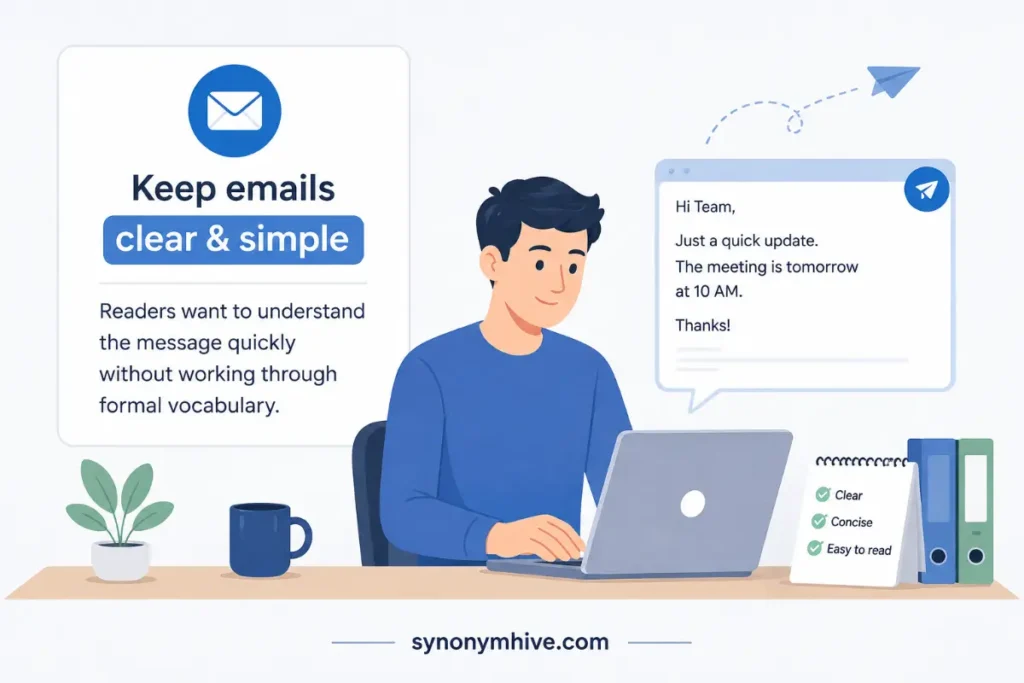
Email usually calls for simple language. Readers want to understand the message quickly without working through formal vocabulary.
If you’re describing a plan, use well planned or coordinated. If you’re talking about someone’s work habits, organized or efficient may sound most natural.
For example:
The meeting is well planned and ready for the team.
I’ve put the information into a clear format so it’s easy to review.
Maria is very efficient at managing client requests.
Avoid using a formal synonym simply because it sounds impressive. An email should sound like something a real person would actually send.
What Is Another Phrase For Organized In A Text
Text messages usually need casual language.
Neat works when you’re talking about physical things. Tidy also sounds natural.
On top of things is useful when you’re talking about someone who manages several tasks well.
Together can work when you mean that someone has everything under control.
For example:
You’re really on top of things with this project.
I have everything together for tomorrow.
These choices sound more natural than systematic in a casual text. The simpler word usually feels more personal and relaxed.
What Is Another Lexeme For Organized In Everyday Speech
Everyday conversations usually favor familiar words. You might say neat, tidy, prepared, planned, or on top of things.
For example:
Your desk is really tidy.
You’re always prepared.
She keeps everything neat.
He’s on top of things.
The best everyday word depends on what you are describing. If you mean physical cleanliness, tidy or neat works well. If you mean planning, prepared or planned may fit better.
What Are Some Real Examples Of Organized Synonyms
Context can change the best synonym. These examples show how different words fit different situations.
For example:
The office manager keeps all employee records orderly and easy to access.
The student created a structured study plan before final exams.
The project manager uses a systematic process to track deadlines.
The assistant is methodical when reviewing invoices.
The event team stayed coordinated throughout the busy weekend.
She keeps her research notes tidy so she can find sources quickly.
He uses an efficient calendar system to manage client meetings.
The teacher gave students a well planned schedule for the semester.
The writer created a coherent argument that was easy to follow.
The supervisor is always prepared for unexpected problems.
She sorted the customer records by account type.
He categorized the files so the team could find information faster.
The company created a streamlined process for handling requests.
She maintains a disciplined routine that keeps her projects moving.
He has everything together before an important presentation.
These examples show why a direct synonym isn’t always enough. Each word adds a slightly different shade of meaning.
Methodical Vs Systematic What Is The Difference
Methodical and systematic are close in meaning. Still, they emphasize different ideas.
Methodical usually focuses on the way a person works. It suggests careful steps, patience, and steady attention.
Systematic usually focuses on the system or process being used. It suggests that tasks follow a clear structure.
For example:
| Methodical | Systematic |
|---|---|
| She is methodical when checking reports. | She uses a systematic process for checking reports. |
| Focuses on careful behavior. | Focuses on an organized system. |
| Strong for accuracy. | Strong for processes. |
Choose methodical when you want to describe a person’s careful working style. Choose systematic when you want to describe a repeatable process.
Organized Vs Efficient What Is The Difference
Organized and efficient often appear together. They don’t mean the same thing.
Organized means tasks, information, or materials are arranged well. Efficient means you achieve a result without wasting unnecessary time, effort, or resources.
Someone can be organized without being efficient. For example, a person may maintain a very detailed filing system but spend too much time managing it.
Someone can also be efficient without looking highly organized. A skilled worker may finish tasks quickly using a simple personal system.
For example:
| Organized | Efficient |
|---|---|
| She keeps project files in clear folders. | She completes project tasks quickly. |
| Focuses on order. | Focuses on results and resource use. |
| Useful for planning and structure. | Useful for productivity. |
Use organized when order matters. Use efficient when results and time matter.
Orderly Vs Tidy What Is The Difference
Orderly and tidy are also close. Tidy usually suggests cleanliness and a neat appearance. Orderly suggests that things have been arranged in a clear order.
A tidy desk looks clean. An orderly filing system follows a useful structure.
Tidy is common in everyday speech. Orderly sounds slightly more formal.
For a resume, orderly can work when describing records or workspaces. Tidy usually sounds too casual unless the context specifically involves physical organization.
How Is Organized Used In The US And UK
The core meaning stays the same in American and British English. The main spelling difference comes from the verb organize.
American English generally uses organize and organized. British English often uses organise and organised.
For a US audience, use organize and organized.
Some related words can also feel different across regions. Terms such as tidy and sorted may appear more often in British conversation in certain situations. American English often favors simple terms such as organized, neat, prepared, and on top of things.
For a US resume, organized remains perfectly natural. You can also choose a more precise professional word such as systematic, structured, methodical, or efficient.
What Are Common Mistakes With Organized
One common mistake is using organized as a vague compliment.
For example:
I am an organized employee.
This statement isn’t wrong. It simply doesn’t prove much.
A stronger version explains the behavior.
For example:
I manage five active projects while tracking deadlines, client requests, and weekly reports.
Another mistake is using a formal synonym that doesn’t fit the situation. Calling someone systematic in a casual text can sound stiff and unnatural.
A third mistake is confusing organized with clean. A clean desk may be tidy. Organization goes beyond appearance. It involves structure, planning, access, and control.
Another common mistake is repeating organized across a resume. Instead of using the same adjective in every section, describe specific actions. You can manage schedules, coordinate teams, maintain records, structure projects, plan events, prioritize tasks, or track deadlines.
When Should You Not Use Organized
Don’t use organized when you really mean efficient. If the key point is speed or productivity, efficient may communicate more.
Don’t use organized when you mean careful. Methodical or thorough may fit better.
Don’t use organized when you mean clean. Tidy or neat is more precise.
Don’t use organized when you mean logical. Coherent or logical may be stronger for writing and ideas.
Don’t use organized when you mean prepared. Prepared or ready may sound more natural.
The goal isn’t to replace every use of organized. The goal is to choose the word that communicates the exact idea.
What Are The Antonyms Of Organized
The main opposites include disorganized, messy, chaotic, scattered, confused, untidy, careless, and disorderly.
Disorganized is the direct opposite. Messy often describes physical spaces or work that lacks order. Chaotic suggests a stronger lack of structure. Scattered can describe thoughts, attention, information, or work.
Confused can describe unclear ideas or arrangements. Untidy usually focuses on physical appearance. Disorderly suggests a lack of order or control.
Choose the antonym carefully because each word carries a different level of criticism. Messy may describe a cluttered desk without suggesting poor performance. Chaotic sounds much stronger and can suggest that a situation is difficult to control.
What Are Quick Tips For Choosing The Right Word
Start by thinking about the exact quality you want to show. Don’t automatically replace organized with the first synonym you find.
Use tidy for physical neatness. Use orderly for clear arrangement.
Choose efficient for productive work. Use prepared for readiness. Choose coordinated for teamwork and schedules. Use thorough for careful and complete work. Choose disciplined for consistent habits.
For casual conversation, on top of things can sound much more natural than a formal synonym.
When using a synonym on a resume, add a real example. Specific evidence gives the word more credibility.
Finally, read the sentence aloud. If the word sounds unnatural when spoken, choose a simpler option. Good writing should sound natural in the reader’s head.
How Can You Make Organized Sound Stronger On A Resume
Strong resume writing doesn’t depend on impressive adjectives alone. Employers want evidence.
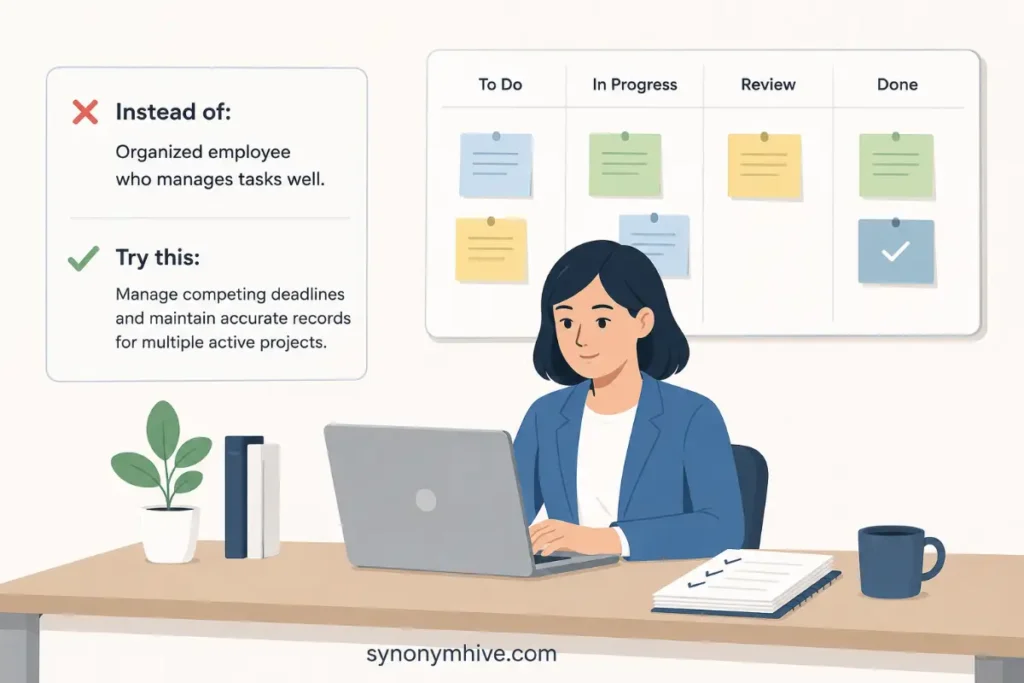
Instead of:
Organized employee who manages tasks well.
Try this:
Manage competing deadlines and maintain accurate records for multiple active projects.
Instead of:
Highly organized office assistant.
Try this:
Coordinate calendars, meeting materials, records, and client requests for a busy office.
Instead of:
Organized project manager.
Try this:
Plan project timelines, track milestones, and coordinate team deliverables.
Notice the difference. The stronger examples use action words. They also explain what the person actually does.
This approach supports EEAT because it gives readers concrete information instead of empty claims. It also makes your resume easier for a hiring manager to understand quickly.
Looking for another word? See Another Word For Growth Mindset Best Resume Words 2026.
Which Word Shows The Most Organization
Systematic and methodical usually suggest a high level of organization. Systematic emphasizes a clear process. Methodical emphasizes careful execution. Structured emphasizes a clear framework. Disciplined emphasizes consistency. Efficient emphasizes useful results.
No single word is always strongest. The right word depends on the evidence behind it.
Building repeatable processes may make systematic your best choice. Checking complex information carefully may make methodical a better fit. Creating project plans may make structured work better. Consistently meeting deadlines may make disciplined say more. Saving time through good planning may make efficient the strongest choice.
The goal is precision rather than exaggeration.
How Should You Choose A Resume Synonym Based On Your Job
Different jobs call for different shades of meaning.
Administrative work can benefit from organized, efficient, methodical, and detail oriented skills. Project management often calls for structured, coordinated, systematic, and planned approaches.
Research roles can highlight methodical, systematic, thorough, and detailed work. Teaching positions can use prepared, structured, planned, and organized to describe strong preparation.
Customer service roles can emphasize prepared, efficient, responsive, and coordinated skills. Finance positions can highlight methodical, accurate, systematic, and disciplined qualities.
Creative roles can use structured, prepared, and well planned to show that creativity doesn’t come at the expense of organization. Leadership positions can highlight coordinated, disciplined, prepared, and organized skills for managing people and priorities.
The best resume word should connect naturally to the duties of the role.
How Can You Replace Organized Without Changing The Meaning
You don’t always need a direct synonym. Sometimes the best replacement is a stronger phrase that tells the reader exactly what you mean.
Clearly labeled files can replace organized files.
Well planned meetings can replace organized meetings.
Structured workflow can replace organized work.
Dependable project coordinator can replace organized employee.
Systematic approach can replace organized approach.
This gives you more flexibility. It also helps your writing sound less repetitive.
What Is Another Phrase For Organized When You Mean Prepared
Prepared is useful when organization leads to readiness.
For example:
She arrives prepared for every client meeting.
The project team was fully prepared for the launch.
The student came prepared with notes and questions.
Prepared doesn’t always mean organized. It means ready. Still, strong planning often creates that readiness.
Use prepared when the most important idea is that someone has done the work needed to handle a task or event.
What Is Another Term For Organized When You Mean Detail Oriented
Detail oriented describes someone who pays close attention to small points. It works well for jobs that require accuracy.
For example:
She is detail oriented when reviewing contracts.
He is detail oriented when entering customer information.
Still, don’t use detail oriented simply because it sounds professional. If your real strength is planning, organized or structured may be more accurate. If your strength is accuracy, detail oriented may fit better.
The distinction matters because employers value specific skills. A precise word can communicate more than a broad one.
What Is Another Expression For Organized When You Mean Good At Planning
Well planned is one of the simplest choices. It works when preparation is the main idea.
For example:
The training session was well planned and easy to follow.
Strategic can also work when planning involves goals and priorities.
For example:
She takes a strategic approach to managing project resources.
Planned and strategic are not identical. Planned focuses on preparation. Strategic focuses on choices made to reach a larger goal.
Use strategic when the person thinks about priorities and long term outcomes. Use planned when the focus is preparation and structure.
What Is Another Lexeme For Organized When You Mean Good At Managing Tasks
Efficient and disciplined often work well here.
Efficient emphasizes results. Disciplined emphasizes consistency.
For example:
She uses efficient scheduling methods to manage several client accounts.
He follows a disciplined routine to meet weekly deadlines.
You can also describe the action directly.
For example:
She manages competing priorities while keeping projects on schedule.
This sentence may be stronger than simply saying she is organized because it gives the reader evidence.
What Is Another Phrase For Organized When You Mean Good At Managing People
Coordinated may fit when several people need to work together.
For example:
He coordinated a team of twelve employees across several weekly projects.
Delegated may fit when someone assigns work to others.
For example:
She delegated tasks based on each team member’s skills and workload.
Managed is broader.
For example:
He managed schedules, resources, and team responsibilities.
These words describe actions. That makes them stronger for professional writing because the reader can see what the person did.
What Is Another Term For Organized When You Mean Clear Ideas
Coherent and logical can work better than organized when you’re describing thoughts or writing.
For example:
The report presents a coherent explanation of the issue.
The essay follows a logical structure.
The presentation has a clear structure.
Organized works when you want a broad term.
Coherent fits when you want to stress connected ideas.
Logical works when you want to stress sound reasoning.
Structured fits when you want to stress the arrangement.
The right choice makes the sentence more precise without making it harder to understand.
What Is Another Term For Organized In Academic Writing
Academic writing often benefits from precise terms.
Structured works well for papers and arguments. Systematic works well for research methods. Logical works well for reasoning. Coherent works well for connected ideas. Thorough works well for complete research. Methodical works well for careful analysis.
For example:
The paper presents a structured analysis of workplace communication.
The researcher followed a systematic process.
The discussion provides a coherent explanation of the findings.
The author uses a logical sequence to support the main argument.
These choices help readers understand exactly what you mean. They also prevent you from using organized as a catchall word.
What Is Another Phrase For Organized In Professional Communication
Professional communication should sound clear rather than inflated.
If people or schedules need to work together, use coordinated.
When information follows a clear format, use structured.
Once someone is ready, use prepared.
When time and resources matter, use efficient.
If a repeatable process matters, use systematic.
For example:
I’ve prepared the materials for tomorrow’s meeting.
The report uses a structured format.
The team coordinated the schedule with the client.
The process is efficient and easy to manage.
These sentences sound natural because each word matches the situation.
How Can You Avoid Repeating Organized In Your Resume
Repetition can make a resume feel flat. Instead of using organized in every section, describe what you actually do.
For example:
Manage schedules.
Track deadlines.
Coordinate team tasks.
Maintain accurate records.
Structure project plans.
Prepare meeting materials.
Categorize information.
Prioritize competing tasks.
Maintain clear documentation.
Create repeatable workflows.
These action phrases show organization without relying on the adjective. They also give employers more useful information about your abilities.
This is one of the easiest ways to make a resume sound stronger. Instead of telling the employer what quality you have, show how that quality appears in your work.
Why Does Specific Evidence Beat Generic Claims
Recruiters often scan resumes quickly. A generic claim can disappear into the page.
Organized is positive. Still, many applicants can say they are organized. Evidence gives the word weight.
Compare these two statements.
I am highly organized and hardworking.
Manage schedules for three departments while tracking deadlines and maintaining accurate records.
The second sentence creates a picture. A reader can see the work.
That is why strong resume writing focuses on actions, results, and relevant details. A good resume doesn’t need to tell the reader that you’re organized at every opportunity. It can demonstrate the quality through specific accomplishments.
A Better Way To Use Resume Synonyms
Don’t search for the most complicated synonym. Search for the most accurate one.
If people or schedules need to work together, choose coordinated.
When information follows a clear format, select structured.
Once someone is ready, describe them as prepared.
When time and resources matter, prefer efficient.
If a repeatable process matters, consider systematic.
This approach makes your writing clearer and more credible. It also helps you avoid the common mistake of choosing words simply because they sound impressive.
What Is Another Phrase For Organized In A Cover Letter
A cover letter gives you more room to explain the skill.
Instead of saying:
I am an organized professional.
Try this:
I manage competing priorities while keeping projects on schedule and records accurate.
You can also write:
My methodical approach helps me catch small errors before they become larger problems.
Or:
I use structured planning to keep projects moving from the first deadline to the final review.
These examples show the quality through action. They also connect the skill to a useful result.
What Is Another Term For Organized In A Job Interview
In conversation, organized is completely natural. Still, you can describe the skill with a short example.
For example:
I’m very systematic with project planning. I break large tasks into smaller steps and track each deadline.
Or:
I stay on top of competing priorities by reviewing my schedule at the start and end of each day.
This answer sounds more convincing than simply saying:
I’m organized.
Interviewers usually learn more from your process than from the adjective itself. A short example can show how you think and work.
What Is Another Expression For Organized In A Business Email
Use simple language in business emails.
For example:
I’ve put the schedule into a clear format.
I’ve coordinated the team calendar.
These sentences are direct and professional without sounding stiff. They also tell the reader exactly what you did.
What Is Another Alternative For Organized In Casual Conversation
Casual speech usually favors familiar words.
Try neat, tidy, prepared, together, or on top of things.
For example:
She’s really tidy.
He’s always prepared.
You’ve got everything together.
She’s on top of things.
These choices sound more natural than formal terms in everyday conversation. Simple words often work best when the goal is friendly communication.
Why Should You Choose Accuracy Over Fancy Words
A fancy synonym isn’t automatically a better synonym.
Imagine describing a clean bedroom as systematic. The word might technically suggest order, but tidy would sound much more natural.
Now imagine describing a research process as tidy. That word doesn’t communicate enough. Systematic or methodical would make more sense.
The same idea applies to resumes. A recruiter doesn’t need complicated vocabulary. They need a clear picture of what you can do.
Choose the word that fits the job and the sentence. When in doubt, prefer the simple option that communicates the meaning clearly.

Is Organized A Strong Resume Word
Organized is a useful resume word, but it can be too general on its own.
The word works best when supported by evidence.
For example:
Organized administrative professional who manages calendars, records, client requests, and meeting logistics.
Even better:
Manage calendars, maintain client records, coordinate meetings, and track deadlines across multiple projects.
The second example shows the skill instead of simply naming it.
This is a useful rule for almost any resume adjective. If you can replace the adjective with an action and a result, the sentence will usually become stronger.
Can Organized Sound Too Generic
Yes. Organized can become generic when it appears without proof.
Words such as hardworking, motivated, and organized are common on resumes. They aren’t bad words. They simply need context.
Think of the adjective as the label and your example as the proof.
A hiring manager doesn’t need a long explanation. One clear action can do the job.
For example:
Maintain accurate records for more than 500 customer accounts.
That sentence quietly communicates organization, attention to detail, and responsibility.
It also gives the employer something concrete to picture.
How Can You Pick The Right Synonym In Five Seconds
Ask one simple question.
What do I actually mean by organized here?
If the answer is neat, choose tidy or orderly.
If the answer is working well with others, choose coordinated.
This quick test prevents awkward word choices. It also helps you write with more precision.
Explore another synonym guide: Another Word for Developed Best Resume Choices 2026.
Conclusion
Choosing another word for organized starts with the meaning you want to communicate. A strong replacement should add precision rather than simply make the sentence sound fancier.
Use tidy or neat for physical order. Choose methodical for careful work. Use systematic for repeatable processes. Choose structured for plans and frameworks. Use efficient when productivity matters. Pick coordinated when several people or tasks need to work together.
For resumes, the strongest approach combines the right adjective with clear evidence. Instead of saying you’re organized, show how you manage deadlines, records, schedules, projects, or priorities. That small change makes your writing more specific and credible.
Frequently Asked Questions
What Is Another Term For Organized?
The best alternatives include systematic, methodical, structured, orderly, efficient, prepared, coordinated, and disciplined. Pick the word that matches the specific skill you want to describe.
What’s Another Way To Say Organized?
You can say systematic, methodical, structured, orderly, tidy, efficient, prepared, or on top of things. The best choice depends on the setting and the meaning you want to express.
What Is Another Alternative For Organized On A Resume?
Systematic, methodical, structured, efficient, and coordinated are strong resume choices. Add a specific example so the employer can see how you use the skill.
What Is A Professional Word For Organized?
Systematic and methodical are strong professional options. Structured and coordinated also work well for planning, project work, and teamwork.
What Word Means Organized And Efficient?
Efficient describes strong results with little wasted time or effort. Organized describes clear order and control, so the two words can work together when both qualities matter.
What Is The Difference Between Organized And Systematic?
Organized describes good order or preparation. Systematic suggests that someone follows a clear and repeatable system.
What Is The Opposite Of Organized?
The most direct opposite is disorganized. Other options include messy, chaotic, scattered, untidy, and disorderly, depending on the situation.