

You’re writing a resume and you reach a sentence that says you were responsible for managing a team. It sounds fine at first. Then you notice you’ve used responsible for several times. If you’re searching for another word for responsible for you have plenty of stronger choices.
The best replacement depends on what you actually did. You might have led a team. Managed a project. Oversaw daily operations. Coordinated schedules. Directed a department. Handled customer accounts. Each verb gives the reader a clearer picture of your work.
Another term for responsible for can be managed, handled, led, oversaw, directed, coordinated, supervised, administered, or maintained. The best choice depends on the task and your level of authority.
This guide covers the meaning and origin of responsible for and gives you more than 30 useful alternatives. You’ll also see the best choices for resumes, essays, emails, texts, interviews, and everyday speech. The examples focus on natural language that shows what you actually did.
Expand your vocabulary with another word for confident Simple Guide 2026.
What does responsible for mean in plain English
Responsible for means having a duty, task, role, or area that you are expected to handle.
For example:
I was responsible for managing the sales team.
This means managing the sales team was part of your job.
You could also say:
I managed the sales team.
The second version is often stronger on a resume because managed is a direct action verb.
Responsible for can describe small tasks or major duties.
For example:
She was responsible for answering customer emails.
He was responsible for the company budget.
They were responsible for training new employees.
The phrase itself doesn’t tell the reader how well you performed the task.
That’s why resumes often benefit from stronger verbs.
Compare these two sentences:
I was responsible for improving customer satisfaction.
Improved customer satisfaction by 18 percent through a new feedback process.
The second sentence gives the reader an action and a result.
That makes the experience easier to understand.
Where did responsible for come from
The word responsible comes from the Latin root respondere which means to answer or respond. The idea later developed into the sense of being accountable for something.
Responsibility became connected with duty and obligation.
When you say someone is responsible for a task you mean that person has an expected duty connected to it.
The phrase can also carry a sense of accountability.
For example:
The manager is responsible for the team’s performance.
This suggests the manager has a duty to guide the team and may be expected to answer for its results.
That’s an important difference between responsible for and some alternatives.
Managed tells us what someone did.
Responsible for tells us what fell within someone’s duties.
Oversaw suggests supervision.
Handled suggests direct involvement.
Directed suggests authority and control.
Coordinated suggests bringing people or activities together.
Supervised suggests watching and guiding other people.
The right replacement should match the real role.

What is another word for responsible for
Here is a broader list.
| Word | Meaning | Tone | Example |
|---|---|---|---|
| Coordinated | Organized people or activities | Professional | Coordinated company events. |
| Administered | Managed a system or program | Formal | Administered employee benefit programs. |
| Maintained | Kept something working or accurate | Neutral | Maintained customer records. |
| Delivered | Completed or produced an expected result | Professional | Delivered client projects on schedule. |
| Administered | Ran or managed a formal process | Formal | Administered testing programs. |
| Supported | Helped a person or process succeed | Neutral | Supported customer onboarding. |
| Facilitated | Helped a process happen smoothly | Professional | Facilitated team workshops. |
| Produced | Created or completed something | Direct | Produced monthly financial reports. |
| Developed | Created or improved something | Strong | Developed employee training materials. |
| Implemented | Put a plan into action | Professional | Implemented a new filing system. |
| Oversaw | Supervised activity or operations | Professional | Oversaw regional sales operations. |
| Ran | Managed or operated something | Everyday | Ran the company’s social media account. |
| Took charge of | Accepted control of a task | Conversational | Took charge of the product launch. |
| Looked after | Cared for or managed something | Casual | Looked after customer accounts. |
| Took care of | Handled a task or issue | Casual | Took care of supplier payments. |
| Worked on | Contributed to a task | Casual | Worked on employee training. |
| Helped with | Assisted with a responsibility | Casual | Helped with event planning. |
| Accounted for | Explained or represented something | Formal | Accounted for monthly expenses. |
| Governed | Controlled through rules or authority | Formal | Governed company compliance procedures. |
| Regulated | Controlled according to standards | Formal | Regulated quality control processes. |
| Managed | Took direct responsibility for results | Professional | Managed a portfolio of client accounts. |
What are simple synonyms for responsible for
If you want plain English, use managed, handled, led, ran, organized, or took care of.
For example:
I was responsible for customer accounts.
You could say:
I managed customer accounts.
Or:
I handled customer accounts.
Or:
I looked after customer accounts.
The first two are stronger for professional writing.
In casual conversation, took care of can sound perfectly natural.
For example:
I took care of the customer accounts while my manager was away.
Simple language often works best because the reader doesn’t have to interpret it.
What are everyday alternatives to responsible for
Everyday English gives you several natural choices.
Managed.
Handled.
Ran.
Led.
Organized.
Looked after.
Took care of.
Worked on.
Helped with.
For example:
She was responsible for the office schedule.
A natural version is:
She handled the office schedule.
You could also say:
She managed the office schedule.
The choice depends on how much control she had.
If she created the schedule and made changes herself, managed may fit.
If she simply dealt with requests and updates, handled may be more accurate.
What are formal synonyms for responsible for
Formal writing can use managed, administered, oversaw, directed, supervised, coordinated, governed, regulated, implemented, and executed.
For example:
He was responsible for employee training.
A more professional version is:
He administered the employee training program.
Or:
He oversaw employee training.
Or:
He directed the employee development program.
Each verb creates a slightly different picture.
Administered suggests running a structured program.
Oversaw suggests supervision.
Directed suggests authority.
Don’t choose the most formal word just because it sounds impressive.
Accuracy matters more.
What are casual alternatives to responsible for
In casual speech you can use:
Took care of.
Looked after.
Handled.
Ran.
Worked on.
Helped with.
Was in charge of.
For example:
I was responsible for the food at the event.
You could say:
I took care of the food for the event.
Or:
I handled the food for the event.
Or:
I was in charge of the food.
These sound natural in conversation.
What are slang alternatives to responsible for
Slang doesn’t offer exact replacements because responsible for is more about meaning than style.
Still, casual expressions can communicate a similar idea.
- Took care of it.
- Had it covered.
- Was on it.
- Took charge.
- Ran the show.
- Looked after it.
- Had the job.
For example:
Don’t worry. I’ve got it covered.
This means the speaker has accepted responsibility for the task.
Ran the show is more informal and suggests someone was in control.
For example:
She ran the show during the event.
That wouldn’t belong in a formal resume, but it can work in casual speech.
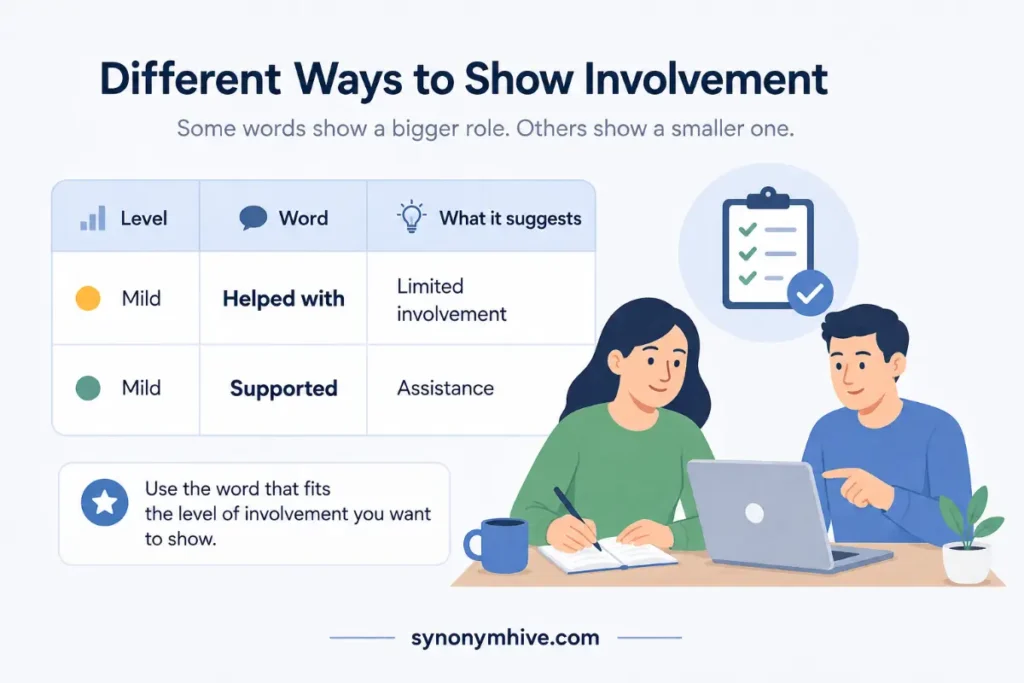
What are responsible for synonyms by intensity
Not every alternative shows the same level of authority. Some words suggest basic involvement. Others suggest complete control.
| Level | Word | What it suggests |
|---|---|---|
| Mild | Helped with | Limited involvement |
| Mild | Supported | Assistance |
| Mild | Worked on | Participation |
| Moderate | Handled | Direct involvement |
| Moderate | Organized | Control over arrangements |
| Moderate | Coordinated | Control over moving parts |
| Moderate | Monitored | Ongoing observation |
| Strong | Managed | Direct control |
| Strong | Supervised | Authority over people |
| Strong | Oversaw | High level supervision |
| Strong | Led | Direction and leadership |
| Very strong | Directed | Strong authority |
| Very strong | Controlled | Direct authority |
| Very strong | Governed | Formal control |
This matters on a resume.
If you only helped with an event, don’t say you directed it.
If you supervised employees, don’t reduce your contribution to helped with.
Choose a verb that reflects your actual role.
That makes your resume more credible.
What are responsible for synonyms by part of speech
Responsible is an adjective.
For example:
She is responsible for payroll.
The phrase responsible for works as an adjective phrase.
Most alternatives are verbs.
For example:
She manages payroll.
She administers payroll.
You can also use nouns when you restructure the sentence.
For example:
She has responsibility for payroll.
She has ownership of the project.
However, action verbs are often stronger on resumes.
Compare:
Responsible for managing a team.
Managed a team of 10 employees.
The second sentence gets to the action immediately.
What is the best alternative to responsible for on a resume
Managed is one of the strongest general replacements.
Oversaw is useful for supervision.
Led works for teams and projects.
Coordinated works for people, schedules, and activities.
Administered fits programs and systems.
Directed works when you had significant authority.
Handled fits tasks you personally managed.
Implemented works when you put a new plan or system into action.
Maintained fits ongoing systems and records.
Developed fits things you created or improved.
The best resume verb depends on the action.
Don’t replace responsible for with managed in every sentence.
That simply creates another form of repetition.
Instead, choose verbs that show different parts of your experience.
What is the best word for responsible for on a resume
The best word is usually the strongest accurate action verb.
For example:
Responsible for managing a team.
Better:
Managed a team of 15 employees.
Responsible for improving customer service.
Better:
Improved customer satisfaction by redesigning the support process.
Responsible for creating reports.
Better:
Created monthly performance reports for senior leadership.
Responsible for hiring employees.
Better:
Recruited and trained new employees.
Notice the pattern.
The strongest version doesn’t just replace responsible for.
It removes the weak construction completely.
How do you replace responsible for in resume bullet points
Start with the action.
Instead of:
Responsible for managing daily operations.
Write:
Managed daily operations across three retail locations.
Instead of:
Responsible for customer service.
Write:
Resolved customer issues and improved satisfaction scores.
Instead of:
Responsible for scheduling.
Write:
Coordinated weekly schedules for a team of 25 employees.
Instead of:
Responsible for inventory.
Write:
Monitored inventory levels and reduced stock shortages.
Instead of:
Responsible for social media.
Write:
Managed social media content across four company platforms.
Strong resume writing puts the action first.
What is another phrase for responsible for in an essay
In essays, managed, handled, oversaw, controlled, caused, created, shaped, influenced, or led may work depending on the subject.
For example:
The mayor was responsible for the new housing policy.
You could write:
The mayor introduced the new housing policy.
Or:
The mayor shaped the new housing policy.
Or:
The mayor led the effort to create the new housing policy.
In academic writing, accuracy matters.
Don’t use managed if the person didn’t directly manage something.
Sometimes responsible for describes cause rather than duty.
For example:
Poor planning was responsible for the delay.
You could say:
Poor planning caused the delay.
That’s a completely different use of the phrase.
What is another expression for responsible for in an email
In a professional email, use direct verbs.
For example:
I’m responsible for the project schedule.
You could write:
I manage the project schedule.
Or:
I oversee the project schedule.
Or:
I coordinate the project schedule.
In a casual email:
I’ll take care of the schedule.
The relationship with the reader should guide your choice.
What is another alternative for responsible for in texting
Texting usually calls for simple language.
Try:
I handle it.
I’ll take care of it.
I’ve got it.
I’m in charge of it.
I manage that.
I’m working on it.
For example:
Don’t worry about the booking. I’ve got it.
That’s much more natural in a text than:
I am responsible for the booking.
What is another word for responsible for in speaking
Speaking usually sounds better with direct verbs.
Instead of:
I was responsible for managing the team.
Say:
I managed the team.
Instead of:
I was responsible for customer accounts.
Say:
I handled customer accounts.
Instead of:
I was responsible for training new staff.
Say:
I trained new staff.
Direct verbs make your speech sound confident.
They also help you explain your experience without unnecessary wording.
What is the best word for responsible for managing a team
Managed, supervised, led, and directed are the strongest options.
Managed suggests overall control.
Supervised focuses on guiding employees.
Led highlights leadership.
Directed suggests higher authority.
For example:
Managed a team of 20 sales representatives.
Supervised five customer service employees.
Led a cross functional project team.
Directed regional operations across three offices.
Choose the verb based on your real authority.
What is the best word for responsible for a project
Managed, led, coordinated, directed, delivered, or oversaw can work.
Managed a software development project.
Led a product launch.
Coordinated a company event.
Directed a marketing campaign.
Oversaw a major construction project.
Delivered a project ahead of schedule.
The final example focuses on completion rather than control.
That distinction can make your resume more interesting.
What is the best word for responsible for employees
Managed, supervised, led, trained, coached, developed, or directed can work.
For example:
Managed 12 employees.
Supervised five warehouse workers.
Led a team of customer service agents.
Trained new employees.
Coached junior sales representatives.
Developed team members through regular performance reviews.
Each verb tells the reader something different.
You may also like Another Word for Developed Best Resume Choices 2026.
What is the best word for responsible for operations
Managed, oversaw, directed, administered, monitored, or coordinated can work.
For example:
Managed daily operations.
Oversaw regional operations.
Directed warehouse operations.
Monitored operational performance.
Coordinated supply chain activities.
The best choice depends on your level of authority.
What is the best word for responsible for budgets
Managed, controlled, monitored, administered, allocated, or tracked can work.
For example:
Managed a $2 million annual budget.
Monitored monthly spending.
Allocated funds across five departments.
Tracked project expenses.
Administered departmental budgets.
These verbs give much more information than responsible for budgets.
What is the best word for responsible for customer service
Handled, managed, supported, assisted, resolved, served, or led can work.
For example:
Handled customer inquiries.
Resolved customer complaints.
Managed key client accounts.
Supported customer onboarding.
Led a customer service team.
The best verb depends on what you actually did.
What is the best word for responsible for sales
Managed, generated, developed, drove, led, handled, or closed can work.
For example:
Managed a portfolio of 80 client accounts.
Generated $500,000 in new sales.
Developed relationships with major clients.
Drove revenue growth through targeted outreach.
Closed high value sales deals.
These verbs are much more useful on a resume because they show action and results.
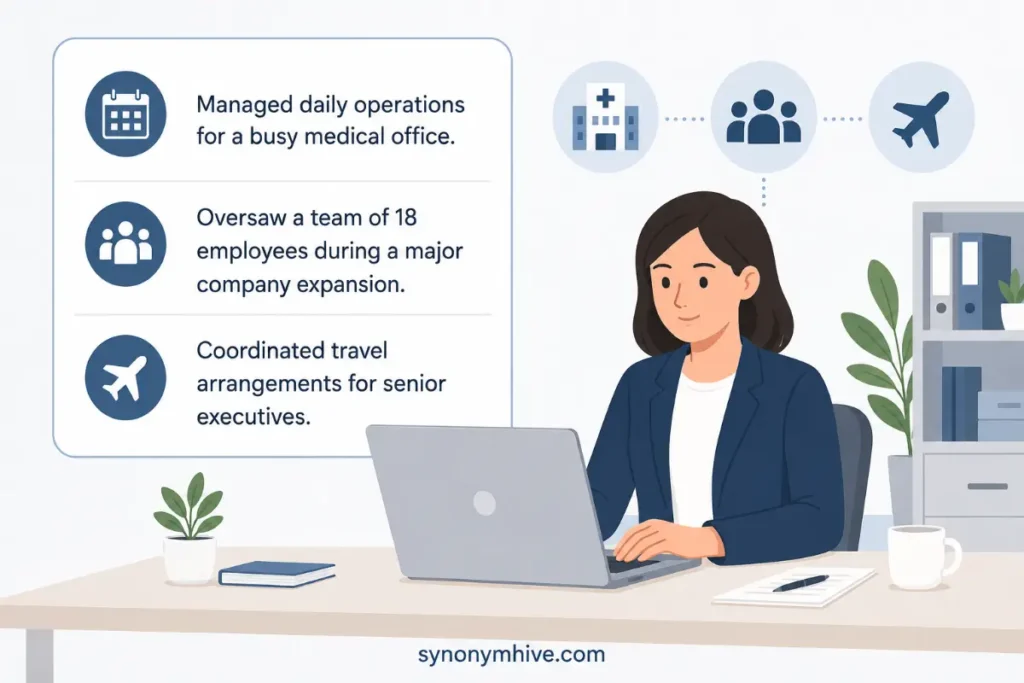
What are examples of responsible for synonyms in real situations
Here are original examples showing how these words work in different settings.
- Managed daily operations for a busy medical office.
- Oversaw a team of 18 employees during a major company expansion.
- Coordinated travel arrangements for senior executives.
- Led a six month product launch from planning through release.
- Handled more than 100 customer inquiries each week.
- Supervised new employees during their first 90 days.
- Directed marketing campaigns across several digital channels.
- Administered employee records and benefit programs.
- Maintained accurate financial records for multiple departments.
- Monitored inventory and reduced supply shortages.
- Implemented a new customer feedback system.
- Developed training materials for new hires.
- Organized weekly meetings and tracked action items.
- Managed vendor relationships and contract renewals.
- Coordinated schedules for a team of 30 field workers.
- Guided junior employees through complex projects.
- Executed a new content strategy across company platforms.
- Delivered client projects ahead of schedule.
- Supported customers throughout the onboarding process.
- Improved internal processes to reduce delays.
The strongest examples focus on action.
You can make them even better by adding measurable results.
For example:
Managed a team of 15 employees.
Becomes:
Managed a team of 15 employees and improved monthly productivity by 20 percent.
The second version gives the reader evidence.
How are managed and oversaw different
Managed and oversaw are close but not identical.
| Managed | Oversaw |
|---|---|
| Suggests direct control | Suggests higher level supervision |
| Often involves hands on work | Can involve monitoring several activities |
| Works well for teams and projects | Works well for operations and programs |
| Common on resumes | Common in leadership descriptions |
For example:
Managed a team of 10 designers.
This suggests direct management of the designers.
Oversaw a department of 40 employees.
This can suggest broader supervision.
If you worked directly with the team every day, managed may be more accurate.
If you monitored several teams or a large operation, oversaw may fit better.
How are led and managed different
Led emphasizes direction.
Managed emphasizes control and organization.
For example:
Managed a sales team.
This tells the reader you had responsibility for running the team.
Led a sales team through a new market launch.
This adds a leadership element and a specific challenge.
A person can manage without being a strong leader.
A leader can influence people without formally managing them.
That’s why these words should not be treated as perfect substitutes.
How are handled and managed different
Handled usually suggests direct personal involvement.
Managed often suggests broader control.
For example:
Handled customer complaints.
This means you personally dealt with the complaints.
Managed customer service operations.
This suggests you were responsible for the wider process.
If you answered customer emails yourself, handled may be right.
If you managed the entire support function, managed is stronger and more accurate.
How are coordinated and managed different
Coordinated focuses on organization.
Managed focuses on control.
For example:
Coordinated schedules for five departments.
This suggests you brought information and people together.
Managed five departments.
This suggests a higher level of authority.
Coordination doesn’t always mean management.
A project coordinator can organize work without being the manager of everyone involved.
How are supervised and oversaw different
Supervised usually focuses on people.
Oversaw can cover people, projects, systems, and operations.
For example:
Supervised 10 warehouse employees.
Oversaw warehouse operations.
The first focuses on employees.
The second focuses on the broader operation.
Both are strong professional verbs.
What are common mistakes with responsible for
One common mistake is using responsible for in every resume bullet.
For example:
Responsible for managing employees.
Responsible for scheduling meetings.
The repetition makes the resume feel flat.
Replace the phrase with direct action verbs.
Managed employees.
Handled customer accounts.
Created reports.
Coordinated meetings.
Another mistake is choosing a verb that exaggerates authority.
If you assisted a manager, don’t write directed.
If you helped with a project, don’t claim you led it.
Strong resumes are honest.
Another mistake is confusing duty with achievement.
Responsible for increasing sales doesn’t prove that sales increased.
Write the actual result if you have one.
Increased sales by 15 percent through targeted client outreach.
That gives the reader something concrete.
When should you not use responsible for
There are times when responsible for is perfectly appropriate.
Use it when you’re describing a person’s official duty.
For example:
The director is responsible for company compliance.
That sentence is clear and natural.
Use it when accountability matters more than action.
For example:
The manager is responsible for approving all expenses.
In this case, the phrase clearly identifies authority.
You don’t need to eliminate responsible for from every piece of writing.
The goal is to avoid unnecessary repetition and use a stronger verb when it adds meaning.
What are the antonyms of responsible for
The opposite depends on the intended meaning.
If responsible for means accountable for, possible opposites include:
Not accountable for.
Not involved in.
Free from responsibility.
Unrelated to.
Independent of.
If responsible for means having a duty, alternatives may include:
Exempt from.
Not assigned to.
Outside the role of.
Not required to handle.
If responsible describes a person’s behavior rather than their duties, the opposite might be irresponsible.
Context matters.
How can you choose the right alternative quickly
Ask yourself what you actually did.
Managed something, use managed.
Oversaw something, use oversaw.
Led people, use led.
Directed something with formal authority, use directed.
Coordinated moving parts, use coordinated.
Handled a task personally, use handled.
Supervised employees, use supervised.
Administered a formal system, use administered.
Maintained something to keep it working, use maintained.
Implemented a plan, use implemented.
Developed something new, use developed.
Monitored progress, use monitored.
Delivered a completed project, use delivered.
This approach makes word choice much easier.
How can you make responsible for sound stronger
Don’t focus only on replacing the phrase.
Focus on the action.
Instead of:
Responsible for employee training.
Write:
Trained new employees and created onboarding materials.
Instead of:
Responsible for improving sales.
Write:
Increased sales by 22 percent through targeted customer outreach.
Instead of:
Responsible for company events.
Write:
Organized quarterly company events for more than 200 employees.
Instead of:
Responsible for managing social media.
Write:
Managed four social media channels and increased engagement by 30 percent.
The stronger sentences show action, scope, and results.
That’s what employers want to see.
What should you use instead of responsible for on a resume
Use a direct action verb whenever possible.
Managed.
Led.
Oversaw.
Directed.
Coordinated.
Supervised.
Administered.
Implemented.
Developed.
Maintained.
Monitored.
Handled.
Organized.
Executed.
Produced.
Delivered.
Supported.
Choose the verb that describes the work accurately.
Then add useful details.
Mention the team size.
Mention quality improvements.
Concrete details turn ordinary resume language into evidence.
How does responsible for compare across US and UK English
Responsible for is common in both American and British English.
The phrase itself doesn’t create a major regional difference.
Some workplace vocabulary can vary.
Americans often use resume.
British English commonly uses CV.
Americans may use program for certain workplace initiatives.
British English often uses programme in many contexts.
The action verbs managed, led, coordinated, supervised, and oversaw work naturally in both varieties.
The main difference is usually spelling and workplace terminology rather than the phrase responsible for itself.
For a US audience, use simple direct language.
That works well across professional settings.
How can you avoid repetition on a resume
Start by looking at your first word in each bullet.
If five bullets begin with responsible for, change the structure.
For example:
Managed customer accounts.
Coordinated sales meetings.
Developed client presentations.
Resolved customer concerns.
Improved account retention.
Now every line starts with an action.
You can also vary the type of verb.
Use management verbs for leadership.
Use achievement verbs for measurable results.
This creates a resume that feels active and focused.

How can you show ownership without saying responsible for
Use verbs that demonstrate ownership.
Led.
Managed.
Directed.
Created.
Built.
Developed.
Launched.
Implemented.
Established.
Improved.
Delivered.
For example:
Responsible for launching a new website.
Becomes:
Launched a new company website that increased online inquiries by 35 percent.
The second version clearly shows ownership.
You don’t have to tell the reader that you were responsible.
Your action proves it.
What is the best strategy for resume writing
Use the simplest strong verb that accurately describes your work.
Don’t try to make every sentence sound powerful.
Make every sentence clear.
For example:
Managed a team of eight.
That’s strong.
Managed a team of eight and reduced employee turnover by 15 percent.
That’s stronger because it adds a result.
Led a team of eight through a company restructuring.
That’s different because it adds context.
Directed operations across three locations.
That’s strong when you actually had that authority.
Good resume writing isn’t about fancy vocabulary.
It’s about accurate action and useful evidence.
Learn more useful word alternatives in Another Word for Versatile Resume Choices 2026.
Conclusion
The best alternative to responsible for is usually a direct action verb that tells the reader what you did. Use managed for direct control. Choose oversaw for broader supervision. Use led for leadership. Pick coordinated for organizing people or activities. Use handled for direct personal involvement. Choose supervised for managing employees. Use directed for strong authority. Select administered for formal programs and systems.
Another term for responsible for should never be chosen just because it sounds more impressive. The strongest resume language reflects your actual contribution. Start with the action. Add useful details. Then show the result when you can. That approach makes your writing clearer and gives employers a much better reason to remember your experience.
Frequently Asked Questions
What’s another way to say responsible for?
Another phrase for responsible for can be managed, handled, led, oversaw, coordinated, supervised, directed, administered, or maintained. Choose the verb that best matches the task.
What is another phrase for responsible for on a resume?
Another term for responsible for on a resume can be managed, oversaw, led, directed, coordinated, supervised, or administered. Direct action verbs usually create stronger resume bullet points.
What is a professional way to say responsible for?
Managed, oversaw, directed, supervised, coordinated, and administered are professional alternatives. The right word depends on your level of authority and the task involved.
What can I say instead of responsible for managing a team?
Use managed, led, or supervised. For example, write Managed a team of 15 employees instead of Responsible for managing a team of 15 employees.
What is another term for responsible for a project?
Managed, led, coordinated, directed, or oversaw can describe project responsibility. Choose managed for direct control and coordinated for organizing people or activities.
How do I replace responsible for in resume bullets?
Start with a direct action verb and add scope or results. For example, replace Responsible for customer service with Resolved customer issues and improved satisfaction scores.
Is responsible for bad on a resume?
Responsible for isn’t wrong on a resume but repeated use can make your writing passive and vague. Direct verbs such as managed, led, created, improved, and coordinated usually show your contribution more clearly.